

Belgium National Strike Disrupts Transport Feb 5
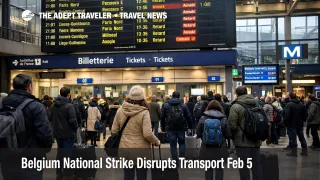
A national strike day in Belgium on February 5, 2026 is expected to create uneven, cross sector disruption that can degrade public transport, airport ground access, and staffing dependent services. For visitors, the practical problem is not only whether a train or flight operates, it is whether you can reliably reach the station, terminal, or meeting point when local layers thin out without much notice. Travelers with tight same day chains in Brussels, Belgium, Charleroi, Belgium, and other cities should protect the first mile and last mile now, because those short links are the first to fail when service becomes patchy.
The shift from a regional disruption story to a broader strike day matters because it compresses traveler alternatives at the same time. When more people abandon buses and trams, taxis, rideshares, and private transfers tighten, and station corridors can bottleneck. Brussels South Charleroi Airport (CRL) has already warned that access to and from the airport may be affected on February 5, 2026, which is a clear signal that the approach roads and public transport links are part of the risk surface, not just the terminal experience.
Who Is Affected
Air travelers are affected first, especially anyone whose itinerary assumes a routine bus, tram, or metro connection to reach an airport coach, a rail station, or a terminal curb. Charleroi departures are a high exposure case because CRL draws heavily from regional ground links, and the airport's own notice focuses on access disruption rather than a controlled schedule reduction. Visitors flying from Brussels Airport (BRU) are still vulnerable when they are starting outside the immediate rail corridor, because the failure point is often getting from a hotel to the line that gets you into the airport system.
City travelers who planned to move by local transit inside Brussels, Ghent, Belgium, Antwerp, Belgium, or Liège, Belgium should expect an inconsistent network rather than a clean shutdown pattern. De Lijn, which runs bus and tram services in Flanders, has already flagged reduced service tied to trade union action on February 5, 2026 in East Flanders, which is a useful example of how localized gaps can appear even when the overall headline reads as a national day. In Brussels, STIB MIVB advises that it posts an initial forecast the evening before a planned action, which matters because the day of reality can diverge from what a traveler assumed when they booked.
Rail travelers can be affected even when intercity service runs, because strike day risk concentrates on station access, crowding, and the fragility of domestic feeder legs into major junctions. SNCB NMBS directs passengers to its strike information and updates as actions approach, and that operator cadence is one of the best leading indicators for whether you should shift from rail to road for a protected departure. This is the same last mile failure pattern discussed in Wallonia Transit Strike Disrupts Buses and Trams, but a national day increases the chance that your fallback options are simultaneously strained.
What Travelers Should Do
Start with immediate actions and buffers. If you have a flight, an international train, or a timed tour on February 5, 2026, rebuild the plan as if local transit will not show up, then layer resilience back in. That usually means a prebooked transfer with a pickup buffer, a hotel move to walking distance of a major station, or a direct taxi plan with a backup provider, not a single app and hope.
Use a clear decision threshold for rebooking versus waiting. If a missed feeder leg would cause you to miss a flight on a separate ticket, miss bag drop or boarding cutoffs, or force an unplanned overnight, rebook now by shifting to an earlier departure, changing departure points, or converting the access leg to a private transfer. If the consequence is only a later arrival, and you have schedule slack plus multiple workable options that do not depend on one fragile step, it can be rational to wait for operator forecasts the evening before.
Monitor the right signals over the next 24 to 72 hours. Check the relevant operator service pages the evening of February 4 and again on the morning of February 5, because planned actions often publish line level reality late. Watch for escalation language about blockades or access constraints, especially around Charleroi, and be ready to shift to earlier departures when taxi supply tightens. If your trip continues into the next week, keep an eye on whether additional action days are confirmed or broadened, because repeated strikes compound fatigue in traveler alternatives and raise overnight risk.
Background
An interprofessional strike day propagates through travel in layers, and the traveler pain point is usually the coupling between those layers. The first order effect is reduced staff availability across buses, trams, and other public facing services, which creates gaps that look small on paper but behave like hard failures when you are trying to hit a timed departure. The second order ripple is substitution pressure, when thousands of travelers pivot to taxis, rideshares, private transfers, and limited rail spines, availability tightens, prices rise, and pickup reliability becomes less predictable.
A third ripple shows up in connection geometry. When local access becomes unreliable, major junctions and airports behave like capacity constrained nodes even if they are technically open, because more people arrive earlier, more people bunch into fewer workable arrival windows, and assistance desks face longer queues. This is why a strike day can create hotel night extensions even for travelers whose flight or train is still operating, the access plan fails, and the day's remaining options no longer align with check in, security, or station entry timing. If your itinerary relies heavily on Belgian domestic rail as the access layer, the day by day publication model described in Belgium Rail Strike Daily Timetable Through Jan 30 is a useful mindset even outside that specific rail action, treat the planner output and operator updates as the schedule, not your original assumption.