

Wallonia Transit Strike Disrupts Buses and Trams
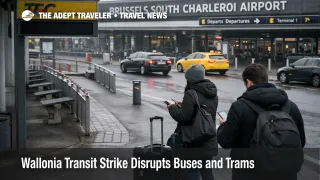
Public transport in Wallonia remains uneven and, in some corridors, close to nonfunctional as the ongoing TEC labor action continues beyond its start on January 26, 2026. The travelers most affected are visitors and business passengers who planned airport runs, station transfers, or timed rail departures that depend on a bus, tram, or metro style feeder leg in Liège, Belgium, Charleroi, Belgium, and surrounding towns. The practical move is to plan each strike day as if local transit will not show up, then rebuild your route around rail spines, walkable last miles, and prebooked rides where you cannot walk.
The Wallonia transit strike disruptions problem is that the most fragile segment is often the shortest one. A missed 15 minute hotel to station hop can cascade into a missed intercity train, a forfeited ticket, or an expensive last minute overnight, even if the mainline rail system is running.
Who Is Affected
Travelers moving through Wallonia's smaller cities and industrial zones are exposed first because local networks there are frequently the only practical way to reach a major station or airport bus link. Reporting during this strike has repeatedly pointed to very heavy disruption in the Liège Verviers area and severe paralysis in Charleroi when operations stall across bus and metro networks.
Air passengers are exposed in two distinct ways. First, Wallonia based departures that require ground access to Brussels South Charleroi Airport (CRL) can break if airport access depends on buses or connecting local legs, and the airport itself has warned of strike related access disruption around February 5. Second, travelers in Wallonia who are flying from Brussels Airport (BRU) can still be hit because the failure point is often getting from a hotel or town center to the rail or coach link that reaches Brussels.
Rail travelers are the second major risk group, especially anyone depending on feeder transit to reach Brussels stations for onward trains. Even when intercity trains operate, the journey fails if you cannot reliably get to the platform on time. This risk can increase again if nationwide interprofessional strike actions broaden beyond Wallonia on February 5, 10, and 12, because multi sector actions tend to strain both transport staffing and traveler alternatives at the same time.
What Travelers Should Do
Start with immediate actions and buffers. If you have an airport run, a long distance train, or a timed tour in the next 24 to 72 hours, shift your plan to one that works with zero local transit. That can mean moving to a hotel within walking distance of a main station, booking a fixed time taxi or private transfer instead of relying on hail rides, and leaving earlier than normal so you still have choices if the first attempt fails. If you are heading to Brussels South Charleroi, treat the ground approach as the trip, not a simple prelude, because access disruption is the predictable consequence of a transit labor day.
Use a clear decision threshold for rebooking versus waiting. If a missed local leg would cause you to miss a flight on a separate ticket, or a train with limited rebooking flexibility, rebook now by shifting departure times earlier, changing departure airports, or moving your rail itinerary to a station you can reach on foot. If your plans are flexible and you are staying within one city, you can sometimes wait and adapt in real time, but only if you are not chaining timed reservations that punish late arrival.
Monitor the right signals over the next 24 to 72 hours. First, track whether disruption is concentrated in specific Wallonia zones or spreading broadly, because the traveler solution changes from targeted detours to full day reroutes. Second, watch for widening impacts tied to national strike calls, which can compress taxi availability and drive up costs as more travelers shift to the same alternatives. Third, keep a backup city mobility plan on hand, similar to what travelers are already using during other European transit actions, including Germany Transit Strike Disrupts Berlin Transfers, NE Rail and Paris Metro And RER Works Disrupt Travel Feb 2 to 8, because the shared lesson is that the last mile breaks first.
How It Works
A public transport strike in Wallonia propagates through the travel system in layers, and the traveler pain point is rarely the part you think you can improvise. The first order effect is the visible one, buses and trams do not run, routes are canceled, and service becomes uneven even on lines that technically operate. Local reporting has described severe and, in some areas, near total disruption, including repeated warnings that travelers should expect major reliability gaps rather than normal headways.
The second order ripple is what breaks travel days. When local transit fails, demand collapses onto taxis, rideshare, and any remaining rail segments, which causes availability to tighten and prices to rise. At the same time, rail itineraries become more fragile because the feeder layer that delivers you to Brussels junctions is no longer dependable, increasing misconnect risk and forcing more travelers into same day replans. If multi sector strike days materialize at the national level, the ripple can broaden beyond Wallonia by stressing cross region commuting corridors, station staffing, and airport access links, even when flights and trains are still scheduled to operate.
For travelers, the forward thinking posture is to stop treating local transit as a utility and treat it as a variable. A plan that is resilient in Wallonia this week is one that has a walkable last mile, a prebooked paid fallback, and enough schedule slack to survive one full failure before you miss the anchor departure.
Sources
- Walloon public transport still severely disrupted on Tuesday morning
- Bus drivers' strike continues in Wallonia
- Interprofessional strike on 5 February: Risk of disruption to airport access
- Strikes and union actions, SNCB NMBS
- Disruption to public transport from 30 January to 5 February 2026
- Belgium travel advice