

Berlin Airport Icing Delays, Rebooking and Refunds
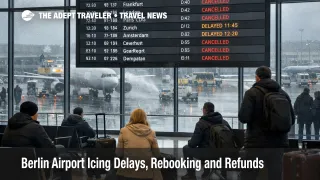
Freezing rain and snow disrupted departures at Berlin Brandenburg Airport (BER) on February 5, 2026, with the airport warning of cancellations and delays and, for a period, halting takeoffs as conditions made aircraft de icing unsafe or impractical. Travelers departing Berlin, Germany, and anyone connecting onward through Berlin faced short notice schedule changes and higher misconnect risk as airlines worked through aircraft, crew, and gate re sequencing. The practical next step is to choose, quickly and deliberately, between a refund and a reroute, then lock your decision into a confirmed itinerary or written refund record before disruption queues and customer support backlogs grow.
The bigger lesson is that winter operations fail fast when freezing rain hits, because the constraint is not only runway friction and visibility, it is also the rate at which aircraft can be treated, inspected, and dispatched safely. When that rate drops, departure banks break, inbound aircraft arrive late or get swapped, and the network absorbs the shock by canceling lower priority segments and rolling crews into later pairings. That propagation is why Europe bound travelers often see "my flight is fine" flip to "cancelled" late in the process, even when weather at the destination looks manageable.
Adept Traveler has recently covered how winter constraints at major hubs can create multi layer knock on disruption, including diversions, missed connections, and hotel compression in recovery windows, see Frankfurt Snow Closes FRA Runways, Diversions Grow and how ground networks become the hidden failure point during winter alerts, see UK Snow Warnings Disrupt Rail and Ferries Feb 3.
Who Is Affected
Travelers flying out of Berlin Brandenburg are the first affected group, especially those on short haul departures where airlines have more flexibility to cancel and re accommodate onto later flights. The next tier is anyone using Berlin as a connection point, because a departure halt pushes inbound aircraft and crews out of sequence, which can break later rotations even after weather improves.
The highest financial exposure tends to fall on three traveler types. First are travelers on separate tickets, for example a low cost carrier hop to a hub, then a long haul on a different booking, because a weather delay that breaks the first leg can erase the second ticket with no automatic protection. Second are travelers with hard cutoffs, such as cruise embarkation days, event arrivals, or last connections, because the cost of failure is an unplanned hotel night or a same day replacement fare. Third are travelers on peak disruption days who cannot access support quickly, because app outages and call center saturation turn even straightforward reroutes into long waits, and that delay can be the difference between a protected seat and a sold out cabin.
What Travelers Should Do
Start with a decision threshold that matches your trip stakes. If you can tolerate arriving a day late, a reroute can preserve the trip without new spending, but you should still demand a confirmed reissued itinerary, not a verbal promise. If arriving late makes the trip worthless, choose a refund early, and capture proof of the refund request in the airline channel you used, because EU and UK rules require the airline to offer a choice between reimbursement and rerouting after cancellations, regardless of why the disruption happened.
Next, protect the connection you actually care about by keeping the itinerary "protected" on one ticket whenever possible. Under EU and UK frameworks, the airline's duty to reroute you is built around the booking they sold, so a single booking is the cleanest way to keep the obligation on them when weather breaks the first leg. If you are on separate tickets and disruption is building, the lowest risk move is often to proactively rebook the second ticket before the misconnect becomes certain, because once you are a no show, options shrink and prices jump.
Then focus on out of pocket cost control, because this is where travelers leak money during winter spikes. Even when cash compensation is excluded by "extraordinary circumstances" like severe weather, EU and UK rules still include assistance concepts such as meals, communication, and accommodation when waiting reaches certain thresholds, and they still require rerouting or reimbursement after cancellations. If the airline cannot provide accommodation promptly, keep spending reasonable, keep receipts, and document why you had to self arrange, then submit a claim through the airline's official channel. For international itineraries, the Montreal Convention framework can support claims for provable damages from delays, and the U.S. Department of Transportation notes this path for international travel when seeking reimbursement for delay related expenses.
Over the next 24 to 72 hours, watch operational signals, not only your flight number. Freezing rain warnings and black ice alerts correlate with slow ramp work, longer turn times, and repeated departure pauses, because de icing capacity becomes the bottleneck. If the airport is publicly warning of cancellations and delays, assume recovery will be uneven, and choose wider connection times, earlier departures, or alternate hubs while seats still exist.
How It Works
Winter delay rights in Europe are a mix of two separate ideas that travelers often confuse. The first is cash compensation, which under EU261 and its UK equivalent generally depends on the disruption being within the airline's control, and severe weather is commonly treated as an extraordinary circumstance that removes the compensation obligation. The second is the baseline choice and care duties, meaning rerouting or reimbursement after cancellations, plus assistance when waits become long, which can still apply even when compensation does not.
Operationally, freezing rain is especially disruptive because it can make it difficult to apply and maintain safe anti icing protection on aircraft surfaces, and it can also create unsafe working conditions on ramps and equipment. When departures stop, aircraft and crews do not reach their next stations, which reduces available capacity across later banks, and pushes carriers to protect higher priority long haul segments by canceling short haul feeders. Those cancellations then spill into hotels near hubs and into rail substitution demand, because travelers look for any same day path to keep a trip alive.
Sources
- Freezing rain causes cancellations, delays at Berlin airport (Reuters)
- Welcome to BER, weather disruption notice (Berlin Brandenburg Airport)
- Black ice hazard information and recommendations (Deutscher Wetterdienst)
- Air passenger rights, EU261 overview and extraordinary circumstances (Your Europe, EU)
- Delays and cancellations guidance, UK rules and extraordinary circumstances (UK Civil Aviation Authority)
- Fly Rights, Montreal Convention note for international itineraries (U.S. DOT)