

Cyclone Fytia Madagascar Floods Disrupt Roads and Ferries
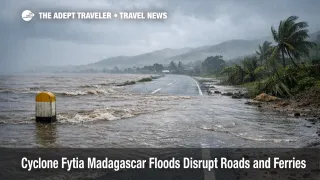
Tropical Cyclone Fytia crossed Madagascar after making landfall near Soalala, Madagascar, bringing damaging winds, heavy rainfall, and widespread flooding that disrupted key travel corridors. The most immediate impacts are on travelers moving by road across the northwest, west coast, and central highlands, plus anyone relying on coastal small craft, and ferries for onward positioning. If you have transfers, domestic flights, or multi stop tours in the affected regions, plan for detours, add buffer nights, and avoid tight same day connections until conditions normalize and operators confirm access.
The operational trigger is not just wind, it is water. Météo Madagascar warned of intense rainfall totals that can drive generalized flooding, flash rises on rivers, landslides, and road failures as the system moved inland and across the country. That combination tends to sever a trip at the weakest link, a washed out bridge, a low water crossing, a slope failure, or a road segment that becomes impassable even when nearby neighborhoods look fine.
Who Is Affected
The highest disruption risk is concentrated where alerts and impacts overlapped, including Boeny and Melaky, and portions of Betsiboka and Bongolava, with flood and landslide risk extending toward central highland districts that feed routes into the capital region. In practical travel terms, that means overland itineraries around Mahajanga Province, Madagascar, as well as cross island drives that rely on stable river crossings and mountain roads, are more likely to break than point to point trips that stay inside one well supported hub.
Marine movements along exposed coastal stretches are also at elevated risk. In its special bulletin, Météo Madagascar advised mariners to remain sheltered on the Analalava to Maintirano stretch, and also discouraged going to sea between Fenoarivo Atsinanana and Mananjary as conditions deteriorated. Even if you are not taking a ferry, this matters because rough seas can pause cargo and resupply, which then cascades into hotel provisioning, fuel availability in smaller towns, and the ability of local operators to run excursions safely.
Domestic transport can become unstable for a second reason, access. Even when aircraft and crews are available, passengers still have to reach the airport, and staff and supplies have to move on the ground. If you are using Ivato International Airport (TNR) as your national gateway, or positioning to coastal airports such as Nosy Be-Fascene International Airport (NOS) or Philibert Tsiranana Airport (MJN), treat the road leg to the terminal as the first potential failure point, not the flight itself.
For additional context on how quickly Madagascar trip reliability can change around the capital, see Madagascar travel advisory, protests disrupt flights. For a weather analogue that shows how route by route recovery works after major flooding, see Cyclone Ditwah In Sri Lanka Disrupts Travel Routes.
What Travelers Should Do
If you are already in Madagascar, assume that road conditions can change faster than maps update. Reconfirm each transfer the morning of travel, avoid night drives, and keep at least one extra day of slack before any long haul departure. If a driver or hotel advises that a corridor is unstable, treat that as a decision point, not a suggestion, because a single washed out segment can force a very long detour or a full stop.
If you are due to arrive within the next 72 hours, set a conservative threshold for moving plans. If your itinerary requires crossing regions that were under cyclone alerts, or if your tour has multiple fixed pickups that depend on being on time, rebook into a resilient base and rebuild as out and back day trips only after local operators confirm access. If you cannot shift dates, prioritize refundable lodging, and avoid pre paying for long transfer days that cannot be rerouted cleanly.
Over the next 24 to 72 hours, monitor three things in parallel, the latest cyclone and flood messaging from Météo Madagascar, any operator notices from airlines or ferry providers, and on the ground confirmation from your hotel or driver about which road segments are passable. The most common failure pattern after a system like Fytia is that main roads reopen in pieces, then close again after additional rain bands, so treat any single green signal as provisional until it holds through at least one full day of traffic.
If you need a hub based plan while conditions settle, Antananarivo, Madagascar - Travel News and Guides from The Adept Traveler can help you track related updates tied to the capital region.
Background
Cyclone disruptions propagate through Madagascar's travel system in layers. The first order effect is physical access, flooding and landslides cut roads, damage bridges, and slow emergency and maintenance crews, which immediately cancels or delays transfers and tours. The second order effects hit capacity and positioning, when vehicles, guides, fuel, and supplies cannot move, hotels in the impacted footprint may operate with constraints, and safer hubs can see rapid inventory tightening as travelers consolidate.
The third layer is schedule fragility. Even when airports remain open, a domestic network can become harder to operate reliably when aircraft rotations, crews, and passengers are out of position, and when road access to terminals is uncertain. That is why travelers should avoid separate ticket domestic connections right now, and why buffer nights near gateways matter more than usual. Independent evidence of the storm's track and severity, including satellite observation and humanitarian impact summaries, also indicates that assessment and recovery can lag because some of the hardest hit areas remain difficult to reach immediately after flooding.
Sources
- BULLETIN CYCLONIQUE SPECIAL DU 31 JANVIER 2026 A 05 HEURES LOCALES (Météo Madagascar PDF)
- Cyclone (Météo Madagascar)
- Overall Orange alert Tropical Cyclone for FYTIA-26 (GDACS)
- Overall Orange alert Tropical Cyclone for FYTIA-26 (GDACS impact summary)
- February 4, 2026 - Tropical Cyclone Fyita (NASA MODIS)
- CARE Statement on Cyclone Fytia in Madagascar: After landfall urgent response underway (CARE)
- Tropical Cyclone FYTIA in Madagascar (Copernicus EMS Mapping)
- Weather tracker: Cyclone Fytia in Madagascar kills several people and floods homes (The Guardian)