

Western Europe Strike Spillover Risk For Airport Transfers
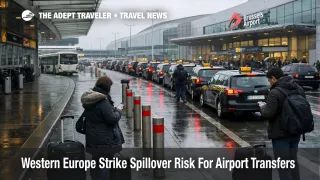
Western Europe strike spillover transport risk is rising as labor actions and multi sector stoppages create short notice gaps in the travel chain, especially on the last mile to airports and main stations. Travelers are most affected when hotel to station, station to airport, or airport to city transfers rely on buses, trams, metros, or airport rail links that can be reduced or halted with limited lead time. The practical move is to treat transfers as a separate segment that needs its own buffer, a backup mode, and earlier decision points for switching routes.
The next high risk windows cluster around Belgium's interprofessional strike days on February 5, 10, and 12, 2026, which can pressure local transport and municipal services across the country, even when airline schedules look normal. Germany has already seen large scale municipal transport walkouts that severely disrupted buses and trams across most states, a pattern that tends to block airport access rather than cancel flights outright. Spain's train drivers have called a three day nationwide rail strike for February 9 to 11, 2026, which raises the risk that airport rail links and long distance rail legs fail at the same time. Italy has also seen rail disruption around Milan that affected commuter and airport rail services, an example of how a single regional dispute can break airport access for visitors with tight plans.
Two related disruptions are already on the Adept Traveler radar, and they show the same system failure pattern, first the local feeder leg, then the larger trip. Wallonia Transit Strike Disrupts Buses and Trams highlights how a short bus or tram ride can be the fragile segment that breaks the whole itinerary. Spain Rail Strike Feb 9 to 11 Hits Trains Nationwide is a reminder that multi day action can drain rail capacity, then spill into hotels and rebooking once the day's inventory is gone.
Who Is Affected
Travelers who depend on public transport to reach an airport or a main station are the first group at risk, especially in cities where airport access is dominated by metro, tram, commuter rail, or a single branded airport express line. That includes visitors transiting Brussels Airport (BRU) and Brussels South Charleroi Airport (CRL) during Belgium's nationwide action days, plus anyone connecting through Brussels stations when local feeders are unreliable.
Rail first itineraries are the second high exposure group, because strikes often reduce frequency rather than fully shut networks, which tempts travelers to keep tight connections that collapse once real world wait times appear. Spain's February 9 to 11 window is most problematic for travelers who planned to use rail to protect a short haul flight connection, or who timed airport access around a specific departure.
Air travelers can still be hit even without flight cancellations, because spillover can arrive through airport ground layers, curbside congestion, reduced staffing at service desks, and disrupted staff commutes that affect who can show up for a shift. Germany's recent municipal transport strike shows the mechanism clearly, flights can operate, but the path to the terminal fails, and arriving passengers can get stuck at the airport with fewer onward options.
Cruise and tour travelers are the final group that gets surprised, because they often anchor the entire day around fixed departure times. A delayed rail or metro leg can cost embarkation, a timed tour pickup, or a paid intercity train segment that is difficult to rebook at the last minute in winter travel peaks.
What Travelers Should Do
For trips that touch Belgium on February 5, 10, or 12, 2026, or Spain on February 9 to 11, 2026, build a transfer backup before you leave the hotel. If you planned to arrive by metro, tram, bus, or airport rail, identify a taxi or rideshare pickup point, confirm it is allowed at your terminal or station, and plan the earlier departure time you would use if service drops to a reduced schedule.
Use a clear threshold for rebooking versus waiting. If your itinerary requires a same day connection and the only feasible path depends on a single public transport line, treat any announced disruption as a reason to switch modes or move the trip earlier, not as something to monitor passively. As a practical buffer rule, plan to arrive at the airport three hours earlier than you normally would for short haul European travel when your airport access is transit dependent, and plan to arrive at the station 60 to 90 minutes earlier than your usual rail cushion when you must connect onward. This is less about check in time, and more about absorbing uncertainty in the approach to the terminal.
Over the next 24 to 72 hours, monitor the specific operators that control your corridor, not just the airline or rail brand on your ticket. When municipal transport is involved, the service pattern can change several times on the same day, and disruption can be uneven by line and depot. If you see repeated service gaps, rising taxi queues, or a shift toward advice that suggests avoiding nonessential travel, assume the evening peak will be harder to protect because rebooking inventory and hotel availability shrink quickly.
How It Works
Strike spillover breaks travel in layers. The first order effect is usually not a headline flight cancellation, it is the feeder system that moves people and staff to the asset, such as buses, trams, metros, and airport rail links. When that layer thins out, travelers arrive later and in more uneven waves, which increases curbside congestion and concentrates lines at the few counters and customer service desks that are staffed.
The second order ripple is network timing. Airports and major rail hubs run on banked waves, and when enough passengers miss the wave, airlines and rail operators have to move people into later departures that were not built to absorb the surge. That is when same day rebooking collapses, taxi and hotel demand rises, and a one city disruption turns into missed connections in other countries because aircraft, crews, and passengers are now out of position for the next cycle. Germany's municipal transport strike pattern is a useful example of how the disruption can be widespread even when national rail and long distance services remain more intact.
Sources
- Tens of thousands of transport workers walk off job in Germany
- Spain's train drivers' union protest outside the Transport Ministry in Madrid
- Belgian unions appeal refusal for new rail strike in early February
- Current Strikes in Belgium (February 2026)
- Milan hit by rail strike in run-up to opening of Games
- Spanish train drivers call three-day strike after deadly railway crashes