

Inverness Airport Technical Outage Diverts Flights Feb 5
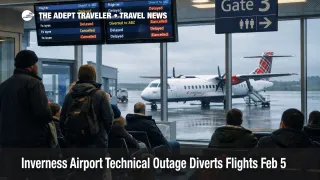
A technical issue disrupted operations at Inverness Airport (INV) on February 5, 2026, triggering diversions and delaying departures across a network that has limited spare aircraft and fewer later day frequencies to absorb disruption. Travelers on regional services were affected first, including anyone relying on a single daily rotation or a tight same day connection beyond the Highlands. The practical move now is to treat February 6 as a recovery day, confirm your exact flight status before heading to the terminal, and be ready to reroute via another Scottish airport if your arrival time matters.
The Inverness Airport technical outage matters because even a short interruption can strand aircraft and crews away from base, which then breaks the next set of rotations and pushes delays into the following day.
Who Is Affected
Passengers flying into or out of Inverness are the obvious center of impact, but the knock on effects tend to spread wider than the airport itself. Inverness is a key access point for the Highlands, and it also functions as a positioning node for smaller city pairs where there may be only one or two departures a day. When flights divert, the aircraft often lands at an alternate airport with limited handling capacity for that specific flight, and the crew may time out before the aircraft can be turned, which means the disruption does not end when the technical issue clears.
Travelers with onward connections are exposed in two directions. Inbound travelers can miss pre booked transfers, rail departures, or ferry check in cutoffs because the diversion adds an extra ground segment after landing. Outbound travelers can lose their flight entirely if the inbound aircraft that should operate it never arrives back to Inverness in time. This dynamic is similar to what Scotland saw during the Edinburgh ATC IT Failure Shuts Airport December 5, where a localized operational failure triggered diversions and left schedules fragile even after flights resumed.
What Travelers Should Do
Start with immediate actions and buffers. If you are flying on February 6, do not rely on the published timetable alone, check your airline app for the aircraft assignment and status, then re check before you depart for Inverness. If your flight shows a late inbound, a diversion earlier in the day, or repeated rolling delays, treat it as a high probability disruption and protect any hard cutoff plans by adding an overnight in the Inverness area or by shifting your connection to later in the day.
Use clear decision thresholds for rebooking versus waiting. If you must arrive by a specific time, for a cruise embarkation, a wedding, a guided tour start, or a last onward flight on a separate ticket, a same day reroute is usually the safer bet once your delay pushes beyond roughly 2 hours and the route has few remaining departures. In contrast, if you are on a protected connection, or you have multiple later options the same day, waiting can make sense, but only if your airline has confirmed reaccommodation and you have a realistic backup plan for ground transport if you divert.
Monitor the right signals over the next 24 to 72 hours. Watch for aircraft and crew positioning to normalize, which often shows up as fewer cancellations on the first departures of the morning and fewer last minute gate changes. Also watch winter road conditions into and out of the Highlands, because even when the root cause is technical, diversions can force long drives on corridors that remain weather sensitive, including routes that can be affected by snow gate closures. For recent Highland road context tied to airport access, see A939 Snow Gates Close Highlands Route Feb 4.
How It Works
A technical outage tied to air traffic control operations does not have to last long to cause a long tail of disruption. The first order effect is straightforward, departures stop or slow, arrivals divert, and aircraft end up parked somewhere other than where the schedule expects them to be. The second order effects are what travelers actually feel the next day. Carriers that serve Inverness, including Loganair and other operators in the Highland network, run tight rotations with limited standby aircraft, so one diversion can consume the only available crew duty time for that leg, forcing a cancellation even after the airport restarts service.
Once diversions occur, the disruption propagates across at least two additional layers. First, connections break at hub banks, because Inverness feeders that arrive late miss onward waves at larger airports, and the next wave might not have spare seats. Second, ground transport demand spikes, because diverted passengers may need to travel from an alternate airport back to the Highlands, or outbound passengers may choose to drive south to salvage a departure from another airport. In practical routing terms, Aberdeen International Airport (ABZ) is often the most efficient alternate by road, with drive times from the Inverness area that can be under 2 hours in good conditions, while Edinburgh Airport (EDI) and Glasgow Airport (GLA) commonly mean closer to a 3 hour drive, and sometimes longer with winter conditions or congestion.
If you are rerouted to Aberdeen, public transport may be viable, but it is not fast. A direct coach between Inverness and Aberdeen is typically quoted at around 3 hours and 22 minutes fastest, which can be useful if you cannot rent a car, but it still adds meaningful time and complexity to an already disrupted day.
Sources
- Inverness Airport - Highlands and Islands Airports Limited
- please check with your airline for the latest update
- Inverness flights cancelled by 'technical issue'
- Inverness Airport Station to Aberdeen Airport (ABZ) - 5 ways to travel
- Inverness to Edinburgh Airport (EDI) by bus
- Inverness to Glasgow Airport (GLA) - 7 ways to travel
- M96 Service | Inverness | Elgin | Aberdeen | Luxury Travel - Citylink
- Edinburgh ATC IT Failure Shuts Airport December 5
- A939 Snow Gates Close Highlands Route Feb 4