

July 2026 U.S. Europe Flight Bookings Lag 2025
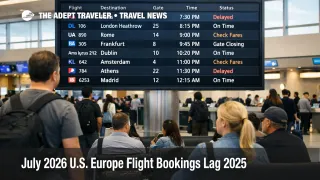
Summer demand across the Atlantic is not tracking like last year, at least in one widely watched slice of booking data. Cirium says bookings for flights between the United States and Europe for July 2026 are running below the pace seen in the same advance purchase window a year earlier. Travelers planning July trips are the most affected, especially those comparing multiple gateways and trying to decide when to lock in airfare.
The practical takeaway is not that planes will be empty, but that pricing power may be less one way than headlines imply. If July 2026 demand is softer in third party channels, airlines and sellers have more incentive to compete on price, bundles, and flexibility. Travelers should shop carefully, keep alerts active, and focus on total trip cost rather than a single headline fare.
The July 2026 U.S. Europe bookings indicator points to a slower booking pace versus last year for flights in both directions, based on third party channels that do not capture direct airline sales.
Who Is Affected
Cirium's comparison looks at bookings made between October 7, 2025, and January 31, 2026, for July travel, then compares that pace to the same calendar window a year earlier. Cirium also cautions that the dataset is directional because it is drawn primarily from online travel agencies and global distribution systems, not direct airline bookings. That matters because airline direct channels can behave differently when carriers push app only discounts, loyalty offers, or targeted promos.
In Cirium's sample, bookings were down in both directions between the U.S. and nine major Europe city markets, including Amsterdam, Netherlands, Athens, Greece, Paris, France, Dublin, Ireland, Rome, Italy, Frankfurt, Germany, Madrid, Spain, Munich, Germany, and Milan, Italy. Two large markets showed split signals: London Heathrow Airport (LHR) had a small increase on Europe origin and a decline on U.S. origin, while Barcelona El Prat Airport (BCN) showed a gain on U.S. origin but a steep decline on Europe origin.
This is also landing in a year where the FIFA World Cup 2026 is in the United States, Canada, and Mexico, and where demand patterns can be uneven by week. FIFA says it received more than 500 million ticket requests in its random selection draw application period, and that applicants would be notified by email no earlier than February 5, 2026. That scale signals that some transatlantic demand could cluster around match cities and key dates, even if broad July demand is not surging across every market.
What Travelers Should Do
If you are traveling in July 2026, treat this as an opportunity to shop with discipline rather than a reason to delay indefinitely. Set alerts for two to three routing options, including one alternate gateway on each end, and decide your buy price in advance. When an acceptable fare appears on a schedule you can actually use, book it, then stop re shopping unless your alerts show a meaningful drop that justifies rebooking.
Use a clear threshold for rebooking versus waiting. If your trip depends on a specific nonstop, a tight cruise or tour start, or a same day onward connection, buy earlier and prioritize flexible terms. If you are flexible on departure day, departure airport, or connection city, you can wait longer, but only if the fare rules and seat availability do not trap you into an expensive last minute purchase.
Over the next 24 to 72 hours, monitor three moving parts that can change your outcome. First, watch whether airlines publish targeted transatlantic sales that are only visible on their sites, since the Cirium dataset does not include direct bookings. Second, track World Cup related price spikes for the exact weeks you would travel, because localized demand can override broad averages. Third, keep an eye on entry and document requirements that can break itineraries at the airport, because a paperwork issue can be more disruptive than a modest fare change, and UK ETA Enforcement Blocks UK Travel Feb 25, 2026 is a reminder that new checks often show up at boarding, not at arrival.
How It Works
Cirium's booking pace snapshot is best read as a signal about one layer of the travel system, distribution. When OTA and GDS bookings soften, sellers often respond with sharper pricing, more aggressive packaging, or better change terms to keep load factors healthy. That first order effect shows up in the fare marketplace, where travelers can sometimes find better deals on shoulder days, less popular connection banks, or secondary airports.
The second order ripples are where travelers get caught if they only look at price. Lower fares can move demand around the network, shifting which flights fill first and which connection banks become brittle. When banks fill unevenly, schedule changes and reaccommodation can cascade into missed connections, longer layovers, or involuntary overnight stops, which then increases demand for airport hotels and last minute ground transport. For travelers, the real risk is not just the ticket price, but how much your plan depends on a single flight, a single connection, or a single day.
This is also playing out against a broader shift airlines have described, where demand is spreading beyond the classic July and August peak into other times of year. That can reduce the pressure on specific summer weeks, but it can also mean airlines feel more comfortable holding higher prices on the most desirable departures while discounting less convenient options. If you want context on how climate and seasonality have already altered travel choices and pricing behavior, Europe's 2025 Heatwave Is Shifting Summer Travel Patterns for Americans is a useful reference point for why peak summer demand is no longer a single predictable spike.
Sources
- Cirium snapshot shows July transatlantic bookings are significantly down
- Over 500 million ticket requests submitted, World Cup 2026
- Over 500 million ticket requests submitted as FIFA World Cup 2026 Random Selection Draw application period concludes
- Soccer, FIFA receives record 500 million ticket requests for 2026 World Cup