

UK ETA Enforcement Blocks UK Travel Feb 25, 2026
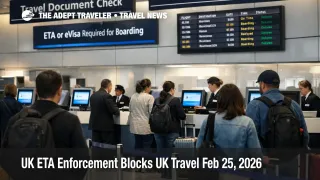
The United Kingdom is moving from rollout to enforcement of its Electronic Travel Authorisation system, and the key traveler consequence is simple: many visa free visitors will not be able to legally travel if they do not have an approved ETA before departure. The Home Office says visitors from 85 nationalities, including the United States, Canada, and France, will need digital permission to travel from February 25, 2026, either via an ETA or an eVisa. Carriers, including airlines, rail operators, and ferry companies, are expected to check that permission before you board, which means the most common failure mode is denied boarding at check in, not a problem you can fix on arrival.
The operational shift matters because it pushes a border rule into the day of travel workflow. Airline systems will surface missing, expired, or mismatched permission during online check in, document verification, and bag drop, and staff can be required to stop travel when your permission is not present for the passport you are using. That turns a paperwork miss into a cascading itinerary failure: missed protected connections, lost rail reservations, and unplanned hotel nights in your departure city when you cannot depart as scheduled.
Who Is Affected
The highest risk group is travelers from countries that are used to visa free short stays to the UK, because many of those travelers historically boarded with just a passport and a ticket. The Home Office frames the February 25, 2026 enforcement milestone around 85 nationalities, and it also emphasizes that ETA requirements apply to people taking connecting flights when they will pass through UK passport control.
Exemptions are real, and confusion about exemptions is where airport day friction spikes. British and Irish citizens, including dual citizens, are exempt from needing an ETA. The Home Office also advises dual British citizens to travel with a valid British passport or a certificate of entitlement so they do not get caught in carrier checks that can lead to denied boarding.
Transit is the edge case that trips up experienced travelers. The Home Office factsheet says that travelers transiting and going through UK passport control need an ETA, while passengers transiting through London Heathrow Airport (LHR) and Manchester Airport (MAN) who do not go through passport control do not currently need an ETA. In practice, many itineraries that look like an airside connection can become landside because of baggage reclaim on separate tickets, an overnight, a terminal change without an airside route, or a disruption rebooking, and that is when a missing ETA becomes a boarding stop.
For a deeper decision tree focused on London connections, see UK ETA London Transit Requirements, February 25, 2026. If you want the broader entry checklist view across common visitor scenarios, use UK Entry Requirements For Tourists In 2026.
What Travelers Should Do
Treat this as a pre departure compliance task, not an airport day errand. Start by confirming whether your passport needs an ETA using official GOV.UK guidance, then apply through the UK ETA app or the GOV.UK application flow. The official ETA fee is £16, and GOV.UK says decisions are usually returned within a day but you should allow up to 3 working days, Monday to Friday, because some applications require additional review.
Use a clear threshold for rebooking versus waiting. If you are within 72 hours of departure without an approval, or if you discover your reservation is tied to a different passport than the one you used for the ETA, it is usually smarter to move to a later departure than to gamble on last minute resolution. Carriers generally cannot override the requirement at check in, and when you are stopped at departure the downstream costs are often larger than the flight change fee, especially on separate tickets, cruise embarkations, and tightly timed rail itineraries.
Over the next 24 to 72 hours, monitor three things that commonly change traveler outcomes. First, confirm your ETA status and validity, because the ETA is linked to one passport and a renewal or document swap can break that link. Second, watch for carrier specific travel document advisories, because airlines and rail operators sometimes add extra document checks as enforcement tightens. Third, revalidate whether your connection stays airside, because a single forced landside step can turn a transit into an ETA required entry.
For closely related guidance focused on the boarding workflow, see UK ETA Feb 25 Boarding Rule, Avoid Denied Boarding.
How It Works
An ETA is a digital permission to travel, not a visa, and it does not guarantee entry at the border. The UK links the ETA electronically to the passport used in the application, which is why accurate passport matching across your booking, check in record, and ETA matters. GOV.UK sets the fee at £16, and says an ETA typically lasts 2 years or until the associated passport expires, whichever is sooner, with multiple trips allowed during that validity window.
Enforcement changes how disruption propagates through the travel system. The first order effect is at the point of departure, where carrier checks can create longer document verification lines and more manual reviews when data does not match. The second order ripples show up across connections and inventory: missed connection banks through London gateways, more last minute rebookings onto non UK routings, and higher demand for airport area hotels when passengers are forced to overnight after a boarding denial. On rail and ferry routes, the same logic applies, a document stop before boarding can break timed reservations and onward ground transfers, and it can force expensive same day alternatives when seats are limited.
If you are seeing conflicting numbers about uptake, you are not imagining it. The Home Office news release says more than 13.3 million visitors have applied successfully since the October 2023 launch, while a Home Office factsheet reports 19.6 million ETAs granted through the end of September 2025, suggesting different counting windows or definitions across publications.