

Northeast Poland Airspace Limits After Belarus Balloons
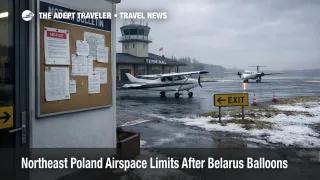
Poland temporarily restricted civil aviation in parts of northeast Poland after balloon like objects crossing from Belarus were detected across multiple nights, prompting precautionary limits in the Podlaskie region near the border. Travelers are most likely to notice the change through flight plan reroutes, short holding, or schedule padding on services that transit nearby airspace, plus uncertainty for small airports and general aviation. The practical move is to treat the area as a short notice NOTAM environment, check your airline app more often than usual, and avoid building an itinerary that only works if every leg runs perfectly.
The Northeast Poland airspace restrictions matter less because they are always long lasting, and more because they can reappear quickly when another incursion is detected. Public reporting described the balloons as part of cigarette smuggling activity, but Polish authorities also framed the repeated incursions as hybrid style events that test response systems, even when the objects themselves are assessed as not posing a direct threat to airspace security.
Who Is Affected
The first affected group is anyone flying in or out of eastern Poland when routings, holding patterns, or air traffic flow restrictions are adjusted to keep traffic away from a temporarily restricted slice of airspace. Large commercial jets cruising at higher altitudes may see limited direct impact, but disruptions still happen when departures are held on the ground, when an inbound arrives late, or when an aircraft has to take a longer track that adds minutes and burns schedule slack.
The second affected group is regional operators, flight schools, and general aviation traffic that operate at lower altitudes where temporary restrictions are most likely to bite. If you are on a small aircraft charter, a regional hop, or any itinerary that relies on a positioning leg into Warsaw, Poland, or Gdańsk, Poland, a short pause in a nearby sector can still matter because it shifts arrival sequencing and can push crews into duty limit territory later in the day.
The third affected group is travelers connecting onward on separate tickets, including people building their own rail plus air chains through Poland. A brief overnight restriction can delay the first flights of the morning, then compress check in lines and rebooking queues when the day's schedule starts off behind. That is how a localized airspace issue becomes a broader network problem, with missed connections and forced overnight stays when remaining seats sell out.
If you want a close recent example of how a short security driven pause can disrupt airport operations and then propagate into later banks, see Rzeszow and Lublin Airports Reopen After NATO Scramble.
What Travelers Should Do
If your trip touches eastern Poland in the next 24 to 72 hours, tighten your monitoring loop. Keep airline app notifications on, and refresh your reservation before you leave for the airport so you catch reroutes, aircraft swaps, and gate changes early. If you are checking a bag, arrive earlier than your personal norm because check in and baggage acceptance delays are a common secondary effect when the first departures of the day start late.
Set a decision threshold for rebooking versus waiting that matches the stakes of your trip. If you have a hard commitment, and you are seeing early signs like rolling delays, new routings, or a published operational notice, move sooner rather than later, because recovery inventory shrinks fast once reaccommodation begins. If you are on a single protected ticket and your airline is still showing same day options, waiting can be reasonable, but avoid any plan that depends on a tight self connection or a nonrefundable onward segment.
Over the next 24 to 72 hours, monitor for three signals that restrictions are back in play. First, look for official security or border service updates tied to new balloon detections. Second, watch for airline waiver language, even a narrow "flexible travel" notice can be the difference between a free change and an expensive one. Third, track whether your flight is part of an aircraft rotation that starts near the affected region, because that is where knock on delays most often originate.
Background
These episodes sit at the intersection of border security and air traffic management. When unidentified objects are detected, authorities may impose temporary restrictions for civil aviation over a defined area as a precaution, even if the objects are assessed as not threatening the safety of the broader airspace. In this case, officials linked the incidents to balloons used in cigarette smuggling from Belarus, and described repeated incursions over multiple nights, including late January events that triggered restrictions over northeast Poland.
The disruption propagates through the travel system in layers. The first order effects are local, aircraft may be rerouted around the restricted area, held for sequencing, or delayed on the ground if air traffic managers need to simplify flows. The second order ripples then show up elsewhere, a late inbound can miss its next departure slot, crews can run up against duty time limits, and airlines may cancel a later leg to protect the rest of the day's rotation, which pushes passengers into alternate hubs and later departures. When diversions or reaccommodation concentrate into a small set of alternates, ground handling becomes a bottleneck, gates, buses, baggage delivery, and hotel inventory near the alternates can tighten quickly.
Frequency matters because repeated nights increase the odds that your flight intersects a restriction window. Reporting from mid January described dozens of objects entering Polish airspace from Belarus, and late January and early February coverage described additional nights of balloon incursions and temporary restrictions in the Podlaskie region. For travelers, that pattern means you should plan for volatility, not a one off event.
Sources
- Balloons from Belarus cross into Polish airspace for a third night
- UPDATE: Smuggling balloons enter Polish airspace from Belarus
- Ujawnienie przemytu papierosów z wykorzystaniem balonów meteorologicznych. Podsumowanie stycznia 2026 r.
- Nocny incydent nad Polską. Kilkadziesiąt obiektów z Białorusi naruszyło przestrzeń powietrzną