

Bologna Rail Sabotage Claim Raises Delay Risk
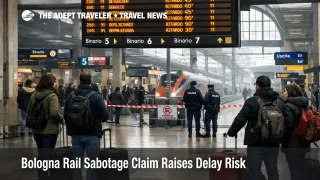
Rail travel across northern Italy faces a higher recurrence risk after an anarchist group publicly claimed responsibility for a coordinated set of sabotage incidents that disrupted high speed and regional train traffic around Bologna, Italy, during the Milan Cortina Winter Olympics period. The travelers most exposed are those using Bologna as a connection node between Milan, Italy, Venice, Italy, Florence, Italy, and Rome, Italy, where a single infrastructure hit can fan out into multi corridor delays. The practical move is to widen buffers now, avoid tight same day handoffs into flights or cruise departures, and decide in advance when a growing delay should trigger a proactive rebook instead of waiting at the platform.
The claim matters operationally even if no new incident occurs today, because investigations and prevention measures can create their own friction. When operators and police shift into a precautionary posture, travelers often see rolling speed restrictions, added track inspections, occasional access controls at the largest stations, and short notice platform changes that ripple for hours. In the Reuters reporting on the incidents and subsequent claim, authorities described disruption around Bologna with delays reaching roughly two and a half hours, alongside multi site activity that signaled coordination.
Who Is Affected
The first tier is anyone transiting the Bologna hub on high speed services, because Bologna sits on the spine of Italy's north south rail trunk and also routes east west flows toward the Adriatic. If the network is forced to reroute traffic, or if a station facility is temporarily constrained, trains can bunch, crews can time out, and equipment rotations can slip, which makes later departures less predictable even after the original issue is cleared. That is the mechanism that turns a two hour incident into an all day reliability problem for travelers trying to stitch together multiple legs.
The second tier is travelers whose rail trip is only one component of a same day chain. Airport positioning is a common failure point, especially when a rail delay pushes arrival past baggage check cutoffs or security peak windows, and airlines may not treat a missed flight as protected when the rail leg was separately ticketed. Cruise, ferry, and tour handoffs have a similar vulnerability, because all aboard times, border processing windows, and timed entry tickets usually do not flex by hours at short notice.
The third tier is travelers moving during the Olympic period, when baseline demand is higher and the inventory for later alternatives can be thinner. When a disruption pushes passengers to the next departure wave, that later train may already be full, or it may sell out quickly, which forces travelers into slower routings or unplanned overnights. That is why hotel inventory pressure often concentrates near Milan, Bologna, Verona, and Turin after major rail irregular operations, even when the triggering event is outside the hotel layer.
For related context on how these Olympics period disruptions have already stacked across transport layers, see Italy Rail Sabotage Hits Bologna Trains Olympics Week and Milan Olympics Protest Roadblocks Near Venues, Stations.
What Travelers Should Do
Take immediate actions and build buffers that preserve options. Check the live status of your exact train number before you leave lodging, again when you arrive at the station, and again just before boarding, because platform assignments and departure slots can change quickly when dispatchers are managing an unstable node. If your trip includes an airport, cruise, ferry, or timed tour handoff, plan a buffer that survives at least a 90 to 120 minute slip without collapsing the rest of the day, or move to an earlier departure that keeps a viable later fallback.
Use a clear decision threshold for rebooking versus waiting. If an arrival that is 60 to 120 minutes late would cause you to miss a flight check in cutoff, a cruise all aboard, a ferry sailing, or a fixed hotel check in window tied to access or staffing, rebook now while seats still exist, even if the alternate is slower. If your schedule can tolerate a late arrival and your lodging is flexible, waiting can work, but only if you have verified that later trains still have capacity and that you can reach your destination without cascading into a forced overnight.
Over the next 24 to 72 hours, monitor three signals that predict whether disruption will recur or widen. Watch operator advisories for your train number and for Bologna station level notices, because those are where reroutes and platform restrictions show up first. Track police and transport ministry statements for investigation updates and any mention of intensified controls or additional incidents, because those often correlate with precautionary inspections that slow the network. Finally, keep an eye on seat availability for your next best alternative, because when later departures begin selling out, the same delay becomes harder to solve, and you should shift your plan earlier rather than later.
Background
Sabotage on a rail network propagates through the travel system differently than a single train fault. The first order effect is at the infrastructure layer, cables, detection systems, switches, or access points are damaged or treated as suspect, and dispatchers respond by holding trains, rerouting them onto surface tracks, or imposing speed restrictions while checks are completed. In reporting around the Bologna incidents, authorities and rail statements described disruption spanning high speed and regional services, with recovery that ramped through the day as operations returned toward normal.
The second order ripple spreads across connections and capacity recovery. A major hub like Bologna is not just a stop, it is a timing engine for crew and trainset rotations, and it is the junction that keeps north south and east west paths from colliding. When trains arrive out of sequence, platforms must be reassigned, dwell times stretch, and equipment that should operate a later departure is out of position, which can trigger secondary cancellations or uneven frequency gaps. That is why travelers sometimes see the worst misconnect risk after the initial incident appears to be over.
Refund and compensation rules are operator specific, but they typically depend on arrival delay thresholds and ticket type. Trenitalia and Italo both publish their delay compensation frameworks, and EU rail passenger rights set additional baseline obligations for assistance and re routing in many cases, especially when disruption creates a missed connection on a through journey. For travelers, the practical step is to document your delay, keep receipts if an unplanned overnight becomes unavoidable, and use the operator's official channel to request the applicable refund or compensation under the published rules.
Sources
- Anarchists claim responsibility for rail sabotage during Italy Olympics
- Suspected saboteurs hit Italian rail network near Bologna, police say
- Fs, gravi danni all'infrastruttura riconducibili ad azioni di sabotaggio
- Sabotaggio treni, sul blog anarchico compare un post di esultanza
- Sabotaggio ai treni, indagine per terrorismo e attentato ai trasporti