

Milan Olympics Protest Roadblocks Near Venues, Stations
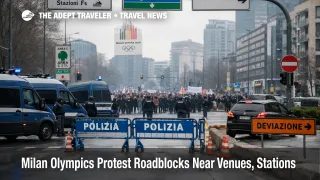
A large anti Olympics demonstration in Milan, Italy, on February 7, 2026, escalated into clashes in areas connected to Winter Games operations after a smaller splinter group broke away from the main march and confronted police. Visitors heading to Olympic venues, major rail stations, and nearby hotel districts are the most exposed because crowd control perimeters can block arterial roads, slow surface transfers, and disrupt last mile access just long enough to cause missed trains and delayed check ins. The practical move is to add buffers, shift taxi and rideshare pickups outside likely closure rings, and monitor official city mobility notices and local transit updates before committing to a tight transfer.
The Milan Olympics protest roadblocks risk is not only about a single afternoon of disruption. During the Milano Cortina 2026 period, the city has also published Olympic mobility measures that can include temporary street closures and circulation limits across multiple districts, which means protest activity can stack on top of an already constrained road network.
Who Is Affected
Travelers moving across the city by car are the first to feel the impact. When police establish safety perimeters, a normal curbside pickup turns into a longer walk to an allowed pickup point, and drivers may be routed onto longer loops that compound delays during peak demand. That is especially punishing near venues where Olympic security and traffic plans already concentrate vehicles onto a smaller set of permitted approaches.
Rail travelers are the next most exposed group, particularly anyone treating Milano Centrale, Milano Porta Garibaldi, Milano Rogoredo, or other hubs as precision timing nodes for high speed rail, airport transfers, or same day event arrivals. A 15 to 30 minute surface delay can be enough to miss a train departure window, and that misconnect can cascade into longer rebooking lines and fewer viable later departures, especially when other rail constraints are already tightening capacity elsewhere in northern Italy. That compounding risk matters if you are also moving on tight timelines across Liguria and Lombardy in early February, when rail works and timetable changes can reduce your margin for error. Related context: Genoa Rail Works Cut Italo Trains Feb 6 to 9.
Hotel and tour timelines are the main second order layer. When station or venue access slows, travelers arrive later, check in windows get compressed, luggage drop plans fail, and timed entries or fixed meeting points become harder to salvage. Even when a property is flexible, late arrival surges can overwhelm front desks and concierge support at the exact moment travelers need help rerouting, rebooking, or securing reliable ground transport.
What Travelers Should Do
Take immediate actions that preserve options. If you have a same day event, a timed venue entry, or a long distance train, move your surface transfer earlier than you normally would, and set a pickup point that is one or two blocks outside the likely perimeter zone rather than directly at a venue curb. If you are staying near Olympic activity areas, plan a walking first leg to a main road where vehicles are less likely to be held at a checkpoint.
Use a clear threshold for rebooking versus waiting. If a missed train would force you onto a much later departure, or if you are on separate tickets, treat early signs of disruption as a trigger to change plans, not a reason to hope traffic clears. For most travelers, the practical decision line is whether you can still reach the station with enough time for platform access, ticket issues, and basic station congestion, if the answer is no, shift to an earlier train, reroute to a different station, or switch modes before queues build.
Over the next 24 to 72 hours, monitor the signals that predict whether disruptions will recur or widen. Watch for official city mobility updates that list closures, time windows, and affected districts, and track transit operator advisories for reroutes and service impacts. If news reporting indicates another large demonstration, assume the highest risk window is the hour before the march moves, the period when it passes major junctions, and the dispersal phase when small groups split off and police reset perimeters near stations and venue corridors.
Background
Protest related disruption propagates through a city travel system in layers. The first order effect is at the street level, police set a moving corridor for the march, then create perimeters and filters around flashpoints, and traffic is diverted onto fewer roads. That immediately slows taxis, rideshares, private transfers, and buses, and it can also interrupt tram operations when vehicles cannot cross a blocked junction.
The second order ripple shows up in connection timing and capacity recovery. When travelers miss a train by minutes, they do not merely arrive later, they move into the next departure wave, which can be full, delayed, or operating under modified stopping patterns. The same timing breakdown hits hotels and tours, because late arrivals compress check in and meeting windows, and operators often have limited ability to delay a departure tied to permits, reserved venue slots, or group logistics. During the Milano Cortina 2026 period, the baseline road network can already be more constrained due to planned Olympic mobility measures, so incremental protest disruption can create outsized delays in the exact corridors travelers rely on to reach stations and venues.