

Chinchero Airport Peru May Crowd Machu Picchu
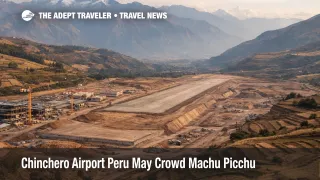
A long delayed airport project in Peru's Sacred Valley is advancing again, with Chinchero International Airport positioned to reshape how travelers reach Cusco, Peru, and onward attractions like Machu Picchu. The project is promoted as a major capacity upgrade that could shift arrivals away from Alejandro Velasco Astete International Airport (CUZ), which operates in a constrained setting near Cusco's urban footprint. For travelers, the practical change is not that Machu Picchu suddenly becomes unlimited, it is that the air side of the trip could become easier while the ground side, and the heritage site itself, stays tightly managed.
Peru's Ministry of Transport and Communications has described the airport as a national scale project with an annual capacity goal of more than 8 million passengers, and it has highlighted thousands of direct construction jobs tied to the build. Independent travel industry coverage has recently echoed a late 2027 target for completion, while noting that the project's timeline has slipped repeatedly over decades. Treat the date as directional until Peru issues a fresh, formal operational readiness milestone, because schedules for complex airports often move in stages, runway works, tower and navigation aids, safety certification, and airline schedule filings.
The bigger strategic tension is that easier flights do not automatically mean easier entry to Machu Picchu. UNESCO's World Heritage Committee has explicitly tied the airport's Heritage Impact Assessment to the wider Machu Picchu management system, asking Peru to harmonize planning documents, visitation regulations, and enforcement capacity before tourism pressure rises. That means the traveler problem is likely to shift from "How do I get there?" to "How do I get the exact timed access and corridor connections I need, at the price and comfort level I want?"
Who Is Affected
Travelers who plan to visit Cusco and the Sacred Valley in a short window are the most exposed, especially those trying to stack a domestic flight, a same day transfer, and a fixed Machu Picchu entry slot. If air access improves, more itineraries will concentrate on the same narrow set of rails, roads, and timed entry systems, which can raise failure rates for tight plans even when aviation runs smoothly.
Airline and tour itineraries that sell "one night in Cusco, Machu Picchu next morning" packages are also exposed because those bundles rely on precise timing across multiple operators. When a single link slips, flight delay, transfer congestion, rail disruption, or queue inflation, the whole day can unravel, and the cost to recover is usually an extra hotel night plus rebook fees.
Local communities and operators across the Sacred Valley face a different type of exposure, and it matters for travelers because it shapes on the ground conditions. If arrivals increase, pressure tends to land first on roads, curb space, and waste and water services, then it ripples into hotel check in timing, guide availability, and price spikes on peak days. Even if the airport opens on schedule, those second order effects can show up earlier as speculation drives investment and demand, and later as visitor volumes test the region's ability to absorb surges.
Finally, travelers should understand that Machu Picchu itself is governed by capacity and route rules. Peru's Ministry of Culture has repeatedly communicated daily capacity limits, citing 4,500 visitors in regular season and up to 5,600 in high season. The existence of a higher capacity airport does not eliminate those caps, it just changes how many people compete for the same constrained supply of entry slots.
What Travelers Should Do
If you are traveling in the next 12 months, plan as if nothing changes on the air side, because Chinchero's timeline is still far enough out that it should not drive near term bookings. Build your trip around the scarce items first, Machu Picchu entry, your preferred circuits or time bands, and your rail or bus legs, then fit hotels and flights around those anchors. When you must connect multiple segments in one day, add buffer time that protects the fixed entry window, not just the flight arrival time.
For 2026 and 2027 travel, use decision thresholds that keep you out of the cascading failure zone. If your plan requires landing, transferring through Cusco, and still reaching an early timed entry, rebook to an overnight buffer when the cost of a missed slot exceeds the cost of one extra hotel night. If you are traveling on separate tickets, treat every connection as fragile, and avoid last flights of the day into the region unless you are comfortable absorbing an unplanned overnight.
Over the next 24 to 72 hours before you lock anything nonrefundable, monitor official channels for two different categories of change. First, watch for Peru transport ministry updates that clarify the airport's construction and commissioning milestones. Second, watch for Ministry of Culture guidance on Machu Picchu capacity, ticket releases, and operational rules, because those are what determine whether an "easier arrival" actually translates into a better visit.
Background
Chinchero International Airport is intended to expand air access to the Cusco region and, over time, shift some demand away from the existing city airport, Alejandro Velasco Astete International Airport (CUZ). For travelers, airports are only the first layer of the system. The next layer is surface connectivity, road transfers into Cusco and the Sacred Valley, then the rail and bus corridors that funnel visitors toward the Machu Picchu gateway. When a new airport increases throughput, those downstream layers tend to become the binding constraint unless capacity expands in parallel.
This is why UNESCO has focused on process, not just infrastructure. In its decision record for the Historic Sanctuary of Machu Picchu, the World Heritage Committee discussed the ongoing elaboration of the Heritage Impact Assessment for the airport and urged Peru to ensure that airport driven tourism pressure is matched by land use planning and effective visitation management. In practical terms, that usually means more formalized access rules, stronger enforcement, and continued reliance on timed entry and capped capacity, even if the journey into the region becomes faster.
For travelers, the actionable takeaway is simple. A new airport can reduce one pain point, flight complexity, while amplifying another, competition for scarce entry inventory and congestion in the last mile. If Chinchero's opening date holds, the winners will be travelers who treat Machu Picchu like a timed event with limited tickets, and who build itineraries with buffers that absorb disruptions across the whole chain.
Sources
- MTC: Aeropuerto Internacional de Chinchero tiene un avance de construcción del 33%
- UNESCO World Heritage Centre Decision 45 COM 7B.100
- Ministerio de Cultura Comunicado
- Ministerio de Cultura aumentó a 5600 aforo en Machupicchu a partir del 1 de junio
- Peru airport near Machu Picchu raises overtourism fears