

Cyprus Airspace Caution Affects Eastern Med Flights
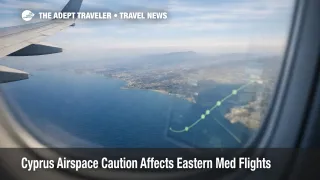
Airlines flying across the Eastern Mediterranean are still operating under a risk environment where U.S. aviation guidance warns that hazards linked to military activity near Syria can extend into adjacent airspace and the eastern Mediterranean Sea. The travelers most likely to notice the effect are those on long haul routes linking Europe with the Gulf, plus some services connecting Europe with North Africa that normally use more easterly tracks. The practical move is simple, assume occasional reroutes or added minutes are possible, build connection buffers, and watch for day of travel updates from your airline and air traffic control.
The Cyprus airspace caution flights issue matters because advisories do not need to be a formal closure to change how airlines operate. Dispatchers can choose more conservative tracks, carriers can pad schedules to protect on time performance, and network control centers can protect aircraft rotations by trimming connection promises rather than gambling on perfect conditions.
Who Is Affected
Most travelers will not see dramatic disruption, but small changes can matter when your itinerary is tight. Flights that typically cross the eastern Mediterranean on routings that pass closer to the Levant may be filed farther offshore or shifted onto alternate high altitude airways, which can add minutes and sometimes change the planned fuel and arrival sequencing at the destination. If your trip includes a tight banked connection, even a modest increase in block time can turn into a missed onward flight when inbound arrival times slide into peak congestion.
The highest practical exposure is on hub based itineraries where one late inbound breaks a chain. Athens International Airport Eleftherios Venizelos (ATH) and Istanbul Airport (IST) sit on major east west flows, and Gulf hubs concentrate connection banks that depend on predictable arrival waves. When a flight arrives late, the first order effect is a missed connection, and the second order effect is reaccommodation pressure, standby lists, and occasional downstream cancellations when crews or aircraft fall out of position later in the day.
Travelers on separate tickets carry the most risk. If your onward segment is not protected by the same carrier or alliance, you can lose the fare and the seat when the first flight runs long. That risk also reaches beyond aviation, because late arrivals can compress hotel check in windows, trigger missed rail departures, and force last minute ground transport changes when you land after planned transfer services end.
What Travelers Should Do
Take immediate steps that reduce fragile timing. Recheck your flight times in the airline app before you leave for the airport, then again after check in, because schedule padding and aircraft swaps can be pushed at short notice when operations teams decide to protect a rotation. If you have an onward connection, treat your minimum connection time as a floor, not a target, and add extra buffer for border control, terminal changes, and bus gates where they apply.
Set a decision threshold for rebooking versus waiting. If your itinerary includes a hard commitment, or a self connection, rebook to a longer connection or a nonstop when you see early signs like creeping block time increases, repeated minor delays on the same flight number, or an inbound aircraft arriving late on its earlier leg. If you are on a single protected ticket and your airline has multiple later options, it can be reasonable to wait, but only if you are comfortable with the possibility of arriving much later and still making your trip work.
Over the next 24 to 72 hours, monitor three signals. Watch for airline notices that mention reroutes, air traffic flow restrictions, or navigation interference, because those often correlate with longer flight times even when airports are operating normally. Track your inbound aircraft, because late positioning is a common cause of delays that feels unrelated to the airspace issue. Finally, keep an eye on your connection airport's arrival and departure boards, because bank congestion can amplify small en route delays into missed flights.
Background
Conflict zone and adjacent airspace guidance is designed to flag risks that can spill across boundaries even when an airline is not flying inside the restricted airspace itself. The FAA has published background information warning of hazards within 200 nautical miles of the Damascus Flight Information Region, including potential GPS interference, communications jamming, and the risk of errant long range surface to air missiles entering adjacent airspace during periods of heightened military activity. That kind of advisory does not automatically ground flights, but it can change airline risk assessments, reroute choices, and contingency planning for aircraft and crews transiting the eastern Mediterranean.
Operationally, the disruption propagates in layers. First order effects show up as longer flight plans, minor route deviations, and occasional arrival sequencing impacts at hubs that sit on east west flows. Second order ripples follow when those minutes consume schedule slack, push crews toward duty limits, and delay aircraft rotations that then operate later departures on completely different routes. When misconnects rise at hub banks, reaccommodation demand concentrates into a small set of later flights, which can tighten seat inventory, raise the odds of involuntary overnights, and create knock on hotel pressure near the hub even though the original cause was en route.
For a recent example of how a short notice airspace issue can create wider network effects, see Northeast Poland Airspace Limits After Belarus Balloons.