

Storm Marta Strait Ferries, Andalusia Roads Still Shut
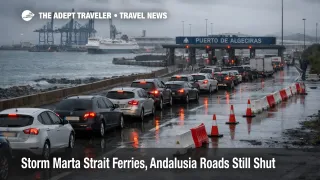
Storm Marta continues to disrupt the Spain to Morocco travel corridor with a split recovery, inland road closures across Andalusia, Spain, remain significant, while Strait of Gibraltar ferry operations are restarting unevenly after days of suspensions. Vehicle travelers, foot passengers, and anyone chaining ferries to flights or trains are most exposed because closures and restart surges can turn a short crossing and transfer into a full day loss. The practical move is to treat both the drive and the ferry as uncertain transport, set hard cutoffs for switching plans, and add an overnight buffer when you cannot miss a downstream connection.
The Storm Marta Strait ferries situation is no longer a simple all stop, several local reports indicate Tarifa and Algeciras have reopened services after repeated storm driven shutdowns, but operational pauses can return quickly when wind and sea state deteriorate. On February 10, 2026, traveler risk is shifting from total cancellation to whiplash conditions, intermittent sailings, metered port access, and capacity crunches when departures resume in bunches.
Who Is Affected
Travelers driving toward southern Andalusia for a crossing are dealing with two simultaneous constraints. First, the road network is still absorbing saturated ground, flooding, and rockfalls, and Spain's traffic authority has continued reporting extensive closures, including primary routes such as the A 48 and A 381 in Cádiz, and the A 44 in Jaén. Those closures force detours that can break tight airport, station, and hotel timing even if ferries are running.
Second, port operations recover in steps. After multi day ferry cancellations, the first few restarted departures often sell quickly, and queues build fast on approach roads and inside holding areas. If you arrive without a confirmed sailing, you can get stuck in a slow moving vehicle line with limited services, and with fewer good alternatives once nearby rooms start filling. This is especially punishing for travelers on separate tickets, for example ferry plus a flight from Málaga Costa del Sol Airport (AGP), or a rail connection deeper into Spain, because reaccommodation is not automatically protected across operators.
Freight and supply chain travelers also remain exposed. The Port Authority of Algeciras has used access controls in recent days, including restrictions on heavy vehicles bound for Tanger Med, to prevent gridlock inside the port during disruption and restart windows. Even if you are a passenger vehicle, freight controls can change terminal flow and lane priorities, which affects how quickly private cars reach check in and staging.
What Travelers Should Do
If you are traveling in the next 24 hours, verify in the right order. Check the road status first, then port authority notices, then your operator's sailing level updates, because a ferry can be technically "operating" while the drive to reach it is broken by closures and detours. If you are driving from Seville, Spain, Málaga, Spain, or inland Andalusia, pad your transfer time heavily, and plan a fuel and food stop before you reach the final approach to Algeciras or Tarifa, where queues can become slow and hard to exit once metering starts.
Set decision thresholds that prevent you from losing the whole day at the terminal. A clean rule is that if you miss one restart window, or you cannot get a confirmed sailing within a few hours, you pivot, either rebook to a later sailing only if you can still protect your downstream timing, or you switch to air, or you add an overnight. If you must be in Morocco by a fixed hour, and you are inside the risk window for another pause, flying is often cheaper than waiting until late afternoon, when restarts can bunch, capacity tightens, and local rooms compress.
Over the next 24 to 72 hours, monitor wind and coastal hazard signals as much as rain totals. The Strait corridor is often decided by sea state and gusts, so conditions can shut high speed craft first, then spread to conventional ferries if the harbor approaches become unsafe. Also watch for follow on systems, several outlets report the next named weather system bringing stronger winds, which raises the chance of fresh pauses even if roads begin reopening.
How It Works
This disruption propagates through layers, and that is why it feels unpredictable for travelers. The first order failure can be inland, when saturated soil produces flash floods, debris flows, and rockfalls that close arterial roads and force detours, slowing transfers into Andalusia and the port approaches. The failure can also be at the waterline, when wind and swell push ferries outside operating limits, prompting port closures, canceled sailings, and phased restarts. When service resumes, the second order ripple is a restart surge, stacked departures and arrivals, and sudden pressure on roads, border processing, taxis, and hotels on both shores, which is how a half day interruption becomes an overnight problem.
For corridor background and what changed earlier in the event, see Storm Marta Strait of Gibraltar Ferries Cancelled.
Sources
- Temporal en España por la borrasca Marta, en directo
- El Puerto de Tarifa reanuda su actividad marítima tras seis días cerrado
- Más de 150 travesías canceladas en el Estrecho
- Restringido el acceso al puerto de Algeciras a camiones con destino a Tanger Med
- MAPA, Qué carreteras están afectadas por la borrasca Marta