

Sydney, Canberra Security Road Closures, Airport Delays
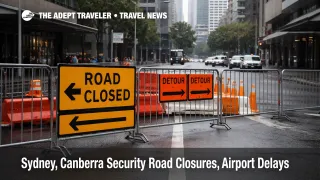
Security operations around Israeli President Isaac Herzog's visit are driving rolling road closures, restricted perimeters, and crowd control measures in Sydney, Australia, and Canberra, Australia. Travelers are the main group exposed, especially anyone relying on airport transfers, central city hotels, or timed reservations in core districts. The practical move is to treat ground access as the constraint, add a larger transfer buffer than you would on a routine day, and keep a backup routing option ready if roads stall near cordons.
Sydney Canberra security road closures matter to travel plans because VIP movements and protest response can trigger short notice access blocks that break airport and city center timing even when flights, trains, and tours are still operating.
In Sydney, reporting and official updates indicate a major event declaration and exclusion zone framework across much of the central area and eastern suburbs, with disruption risk continuing through Thursday, February 12, 2026. Transport for NSW public travel updates also flag road closures in the Sydney CBD and several eastern suburbs and harbor side locations between Sunday, February 8, 2026, and Thursday, February 12, 2026, for a planned police operation. Separately, large demonstrations around Sydney Town Hall on Monday, February 9, 2026, led to clashes and arrests, which is relevant for travelers because it increases the odds of rapid, localized lockouts and detours near rail stations, hotel entrances, and major arterials.
In Canberra, ACT Policing and local reporting have warned that traffic disruptions may occur on roads to and from Canberra Airport, and in and around the Parliamentary Triangle, tied to movements and planned protests. Even if disruptions are brief, the risk for travelers is that arterial slowdowns compress the final miles to the terminal and shrink the time you actually have for bag drop, security screening, and boarding.
Who Is Affected
Departing passengers are the highest risk group in both cities, particularly travelers checking bags, travelers using rideshare pickups, and anyone trying to protect a tight domestic connection on a separate ticket. When a corridor is restricted, the queue can propagate backward fast, and it can take longer to drain than the initial closure lasts, which is how short disruptions become missed flights.
Arriving passengers are also exposed, just in a different way. If curbside pickup points are moved or fenced, rideshare matching can break, taxis can be rerouted, and hotel transfers can become a sequence of detours rather than a direct run. That is most painful for families and groups, and for travelers with mobility needs or bulky luggage, because a last minute change from curb pickup to a walk up pickup point is not always practical.
City center travelers are the next major risk group. In Sydney, restrictions and protest activity around the CBD, eastern suburbs, and specific venue corridors can interfere with museum entries, harbor tours, restaurant bookings, and meeting schedules. In Canberra, the Parliamentary Triangle is a common anchor for visitor itineraries and government district meetings, so even partial restrictions can knock out the last mile and force reroutes that add meaningful time.
Hotels and tours are the secondary layer of impact. Late check ins, missed tour meeting points, and last minute changes to pickup zones can cascade into forfeited deposits and lost timed entry windows, particularly when operators have narrow departure times and cannot hold for late arrivals.
What Travelers Should Do
Take immediate actions that preserve options. For any airport run in Sydney or Canberra through Thursday, February 12, 2026, plan to leave 60 to 90 minutes earlier than your normal pattern, and set your driver route to avoid the most likely cordon corridors rather than the fastest route on a normal day. If you are using rideshare, pre decide a secondary pickup point, such as a major hotel entrance outside the likely exclusion perimeter, so you can pivot without rethinking the plan in the moment.
Use a decision threshold for rebooking versus waiting. If you are still not moving after 15 to 20 minutes in a queue that is approaching a cordoned area, assume conditions will not improve quickly, and switch tactics. That can mean redirecting to a rail option, choosing a different airport access road, changing terminals pickup zones if they are separated, or moving your flight if you are within the airline's same day change rules. The closer you are to bag drop cutoff, the more rational it becomes to pivot early rather than gamble on clearing a choke point.
Monitor two signals over the next 24 to 72 hours. First, track official police and transport operator updates in the morning and again in the late afternoon, because restrictions tend to tighten around scheduled movements and major rallies. Second, watch for protest announcements near Town Hall style meeting points in Sydney and in the Parliamentary Triangle area in Canberra, because those are the setups most likely to trigger fast moving road closures and reroutes that hit transfers hardest. For a similar failure mode and the practical buffer logic, see LAX Protest Blocks Airport Access Roads Nov 25, 2025.
Background
Major event declarations, exclusion zones, and VIP movement planning are designed to manage crowd safety, reduce confrontation risk, and protect official motorcades. For travelers, the operational issue is that these measures reshape traffic flow, sometimes with little warning, by narrowing entry points, towing or restricting curbside access, and redirecting buses and general traffic away from certain streets.
The disruption propagates through the travel system in layers. The first order effect is on road capacity in the affected corridor, which is why airport transfers break even when flights run normally. The second order effect is a misconnect wave, passengers miss departures, airlines rebook onto later flights, and remaining seats compress, especially on domestic trunk routes. A third layer shows up at hotels, tour operators, and venues, where late arrivals cause missed check ins, forfeited timed tickets, or rescheduled pickups that create further knock on delays across the day.
If you are visiting Australia from overseas and this disruption is happening alongside last minute itinerary changes, it is also a good time to confirm you have the right entry documentation and app access for airline and government updates. Adept Traveler's guide, Australia Entry Requirements For Tourists 2025 2026, is a practical reference for keeping border and document issues from becoming a second problem on an already disrupted week.
Sources
- Australia urges calm after violent clashes in Sydney during Israeli President's visit
- The first day of Israeli President Isaac Herzog's visit to Australia - as it happened
- Thousands of police officers deployed, major exclusion zone established ahead of Israeli President Isaac Herzog's Sydney visit
- Minns invokes special powers for NSW police to restrict protests during Israeli president's visit
- Transport News - 2026
- ACT Policing
- Isaac Herzog's Canberra visit will be met by pro-Palestine protest, large police response