

Blue Star Ferries Rhodes Sailings Changed Feb 12 to 22
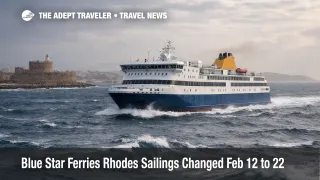
Blue Star Ferries has issued itinerary modifications that directly affect Rhodes based sailings and several onward Aegean links, citing adverse weather conditions. The most traveler critical element is an operator level schedule change for BLUE STAR CHIOS that keeps the vessel in Rhodes from Thursday, February 12, 2026, through Saturday, February 14, 2026, then restacks calls and timings through Sunday, February 22, 2026. This is the kind of disruption that breaks island hopping plans and same day airport transfers, because the sailing you were counting on can move, compress, or vanish, leaving you on the wrong island for a fixed flight departure.
The published plan shows a revised chain that touches Rhodes, Karpathos (Pigadia), Kasos, Sitia, Heraklion, Santorini, Anafi, and Piraeus across multiple days, with additional calls such as Chalki and Diafani appearing in the schedule pattern. Even when your ticket remains valid, the practical impact is that arrival times shift into the night or early morning, and some legs become poor matches for hotel check in windows, rental car pickup times, and flight departure cutoffs.
Within the same advisory window, Blue Star also lists additional adjustments on other services, including a modified BLUE STAR PAROS pattern and a delayed ARIADNE departure from Piraeus, which matters if you are trying to reposition toward the islands after a missed connection. The bottom line is that this is not a single port closure, it is a network reschedule, and the knock on effects are what strand travelers.
A related pattern travelers will recognize is how weather disrupts ferry corridors in waves, where cancellations are followed by restart surges and compressed capacity. A comparable dynamic is described in Storm Marta Strait Ferries, Andalusia Roads Still Shut, even though the geography differs.
Who Is Affected
Travelers starting in Rhodes or transiting through Rhodes are the most exposed, especially anyone relying on BLUE STAR CHIOS to bridge multiple islands on a tight timeline. If your itinerary includes intermediate stops such as Karpathos, Kasos, Sitia, or a Crete leg through Heraklion, you should assume that an apparently small timing change can invalidate your same day connection.
Passengers chaining ferries to flights are the next highest risk group. The most obvious pressure points are Rhodes International Airport "Diagoras" (RHO) for Dodecanese departures and Heraklion International Airport "Nikos Kazantzakis" (HER) for Crete recoveries, because those are common escape valves when sea links are curtailed. Travelers using Santorini International Airport (JTR) as a backup should plan for volatility, because Santorini can be both a reroute target and a pinch point when weather affects the Cyclades.
Finally, anyone traveling on separate tickets across multiple operators should treat the whole chain as fragile. A delay on one leg is rarely protected by the next supplier, and the cost lands on the traveler in the form of new tickets, last minute rooms, and paid changes to tours and transfers.
What Travelers Should Do
If you travel Thursday, February 12, 2026, through Sunday, February 22, 2026, verify the latest status in the most conservative order. Start with the Blue Star Ferries announcement update for your vessel and date, then confirm your specific sailing inside your booking, then check port departure boards and your agent notification feed close to departure. Treat any screenshot, forwarded message, or third party timetable as stale until it matches the operator update.
Use decision thresholds so you do not lose a full day waiting for a sailing that is unlikely to operate as planned. If a moved departure would put you into Rhodes, Heraklion, or Piraeus after your realistic airport cutoff, or if it removes your last viable same day leg, rebook early rather than trying to salvage the chain at the terminal. In practice, that usually means pivoting to a flight from Rhodes International Airport "Diagoras" (RHO), or repositioning to Crete and flying from Heraklion International Airport "Nikos Kazantzakis" (HER), because those gateways tend to have the most resilient schedules when ferries fail, even if seats tighten quickly.
Over the next 24 to 72 hours, monitor wind forecasts and operator updates, not just rainfall. In the Aegean, sea state and gusts are what trigger port restrictions and unsafe approaches, and those conditions can improve and deteriorate within the same day. If you must keep a fixed event or an international departure, build an overnight buffer near a major gateway port, and book refundable options where possible, because the second change is often the one that breaks the itinerary.
How It Works
Weather driven ferry disruption propagates through the Aegean like a system problem, not a single sailing problem. First order impact begins at the ship and port interface, where high winds and rough seas make specific approaches unsafe and force a vessel to hold position, skip calls, or remain in port, which is why BLUE STAR CHIOS can be effectively pinned to Rhodes for a defined window. Once that happens, the timetable for multiple islands stops being a sequence and becomes a backlog.
Second order ripple shows up in three layers. Connections break because revised arrival times no longer match the next ferry, the last bus, or the last check in window for a flight. Capacity tightens because passengers concentrate onto the next operating departures and onto limited domestic flights, which can sell out suddenly and drive expensive last minute fares. Local services then strain, hotels near ports compress, taxis and transfers become scarce, and even unrelated sailings can be affected when crews and ships must be repositioned back into their normal rotations.