

EU EES Biometric Border Queues Could Mean 4 Hour Waits
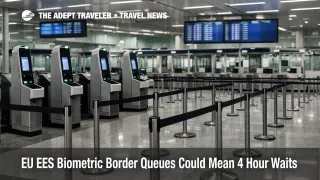
A coalition of aviation trade bodies escalated its warning about the Schengen Entry Exit System, saying current operations already produce long waits and that peak season lines could reach four hours or more without added flexibility. The groups, including Airports Council International Europe, Airlines for Europe, and the International Air Transport Association, urged an immediate review and asked the European Commission to clarify that border authorities can partially or fully pause EES during the busiest period, potentially through the end of October 2026. The trigger for traveler planning is the combination of a specific queue expectation and a policy request to modulate enforcement when volumes spike.
The underlying system change is not new, EES has been progressively introduced since October 12, 2025, and is designed to replace manual passport stamping with an automated record tied to biometric checks for covered non EU travelers. The near term issue is throughput. When first time enrollment requires extra steps at kiosks or staffed desks, processing time becomes less predictable, and that variability is exactly what breaks tight connections and timed plans.
Who Is Affected
The most exposed group is non EU, short stay travelers entering the Schengen Area for the first time under EES, including many visa exempt visitors from the United States, the United Kingdom, Canada, and other third countries. Those travelers can be routed into biometric enrollment steps, then rechecked on exit, which can add friction on both ends of a trip. Families and mixed eligibility groups often feel the slowdown more sharply because the line tends to move at the pace of the slowest enrollment, and regrouping after split processing can be messy in crowded halls.
Queue risk is also concentrated by place and layout. Large arrival banks at major Schengen hubs such as Paris Charles de Gaulle International Airport (CDG), Amsterdam Airport Schiphol (AMS), Frankfurt Airport (FRA), Adolfo Suárez Madrid Barajas Airport (MAD), and Rome Fiumicino Airport (FCO) can overwhelm border halls when staffing and kiosk reliability do not match demand. The same dynamic can show up at juxtaposed controls on UK soil for Channel crossings and international rail, where space constraints can cascade into missed departures even if the transport itself is running normally.
What Travelers Should Do
Build the buffer where it matters most, at your first Schengen entry point. If your itinerary includes onward rail, a separate ticket flight, a cruise embarkation, or a timed tour on arrival day, treat passport control as a variable segment, and shift that commitment later or add an overnight so one bad queue does not collapse the whole trip. When you can choose, favor earlier arrivals that give you recovery time, and keep critical onward travel on the same ticket so reaccommodation is simpler if you miss a connection.
Set a decision threshold now, before you travel, for when you will rebook versus wait. If the cost of missing your onward segment is a same day repurchase, a no show penalty, or losing a nonrefundable booking, it is rational to move to a longer connection or a different routing even if it feels conservative. If your onward plans are flexible and you have margin, waiting can be reasonable, but only if you have a backstop plan that still works when arrival slips by several hours.
Monitor operational signals in the 24 to 72 hours before departure, not just general headlines. Watch your arrival airport, carrier, and relevant government border channels for notices about lane configurations, kiosk outages, staffing surges, or any partial stand down of EES steps. If you want more context on how EES has been affecting throughput already, see EU EES Biometric Border Queues Risk Summer 2026 and EU entry/exit system starts October 12: what to expect.
How It Works
The Schengen Entry Exit System is an EU border technology shift that creates a digital record of entry and exit for covered non EU short stay travelers and links that record to identity checks that can include fingerprints and a facial image at first enrollment. The European Commission has said the system began on October 12, 2025, and is being introduced progressively over a period of months, with full coverage targeted by April 10, 2026.
Operationally, delays propagate in layers. The first order effect is slower passport control throughput when enrollment steps, staffing shortages, or automation issues reduce the rate at which passengers clear the border, which can also block arrivals halls, baggage reclaim access, and curbside pickup flow. The second order ripple hits connections and schedules, airlines respond to volatility by padding schedules, tightening minimum connection times, or limiting the sale of short connections through hubs, and late arrivals spill into missed hotel check in windows, reduced late night rail options, and higher demand for taxis and rooms. The trade groups explicitly pointed to chronic understaffing, unresolved border automation issues, and limited uptake of a preregistration app as compounding factors, which is why their requested policy change focuses on flexible enforcement during peak volume weeks.
Sources
- Warning of four hour EU airport delays this summer
- Airports and airlines warn Entry Exit System delays risk summer border disruption
- Entry-Exit System, Migration and Home Affairs, European Commission
- What biometric border checks mean for non-EU citizens
- Summer travel disruption fears over new biometric checks at European borders