

PortMiami Tunnel Closures Hit Transfers Feb 10 to 12
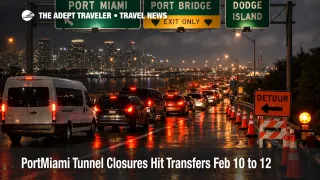
PortMiami said the PortMiami Tunnel will be closed overnight for maintenance during a defined window that runs from Tuesday, February 10, through Thursday, February 12, 2026, with closures posted as 900 p.m. to 500 a.m. The practical traveler impact is not the tunnel itself, it is the reroute and the variability it injects into cruise transfer timing when many people are already moving on tight embarkation or post cruise flight schedules. If you are planning a late arrival into Miami, Florida, a downtown hotel to terminal move, or an early morning port run, treat this as a detour night and add buffer instead of assuming a normal, repeatable drive time.
The Port of Miami Tunnel project site notes that during tunnel closures, drivers should use the Port Bridge to access PortMiami. That guidance is simple, but it also signals the operational reality, traffic that would normally use the tunnel gets pushed into fewer approaches, which increases the odds of stop and go segments, longer rideshare ETAs, and missed timing assumptions for terminal arrival.
Who Is Affected
The most exposed travelers are cruise passengers who plan to arrive in the evening and transfer to a ship the same night, or those positioning for early embarkation windows the next morning after a late hotel check in. The closure window is overnight, which overlaps with late inbound flight banks, late dinner arrivals, and the time when drivers are more likely to rely on navigation apps that may reroute unpredictably when traffic patterns change.
Travelers flying into Miami International Airport (MIA) and heading straight to PortMiami are affected because the transfer chain is only as strong as its weakest segment. Even if your flight is on time, a slow final approach into the port can compress your margin, trigger a faster, more expensive transfer choice, or push you into arrival lines closer to terminal cutoffs.
Downtown Miami hotel guests are also in scope, especially if they are doing a same night reposition to the port or trying to hit an early terminal time without leaving much slack. Downtown traffic is already sensitive to incidents and event spillover, and when a major connector is offline overnight, the system has fewer ways to absorb disruption.
This also affects ground transportation providers, shuttles, taxis, and rideshare drivers, because detours change routing, staging, and pickup timing. When those providers hit variability, the costs show up quickly for travelers as surge pricing, longer wait times, and less predictable arrival time at the terminal gate.
What Travelers Should Do
If you are transferring to PortMiami during the 900 p.m. to 500 a.m. closure window on February 10, February 11, or February 12, build a buffer you can actually spend without stress. Aim to be at the port earlier than you normally would, and avoid "minimum viable" planning where a single delay forces you into a bad choice. If you are landing late, preplan a primary and secondary route, and screenshot your terminal instructions and port address so you can adapt quickly if your driver is rerouted.
Use a hard decision threshold for rebooking versus waiting. If your plan depends on arriving at the terminal near the end of your check in window, do not gamble on a detour night. Move your transfer earlier, shift to an earlier flight, or add a hotel night so you are not relying on everything going perfectly at once. The money you might save by cutting it close is often smaller than the cost of missed sail away consequences, including a forced one way reposition to the next port, added lodging, and last minute airfare.
Over the next 24 to 72 hours, monitor three signals. First, recheck PortMiami updates in case the closure window shifts or is shortened. Second, check live traffic conditions before you leave, Florida's 511 traffic tools are explicitly recommended by the Port Miami Tunnel project site for real time conditions. Third, watch for compounding factors, including weather and major downtown events, because a detour plus a separate incident is what turns a normal transfer into a failure cascade.
For additional cruise disruption context where small operational failures can compound into missed timing, see Carnival IT Outage Delays Cruise Boarding at Ports.
How It Works
The PortMiami Tunnel exists to move port bound traffic off downtown surface streets and provide a more direct connector between the port and major approaches, which is why its closure matters even when it happens overnight. When a connector like this closes for maintenance, the first order effect is straightforward, traffic is rerouted to alternate access points, and the remaining approaches carry more vehicles per minute than they would under normal distribution. The Port Miami Tunnel project site's alternate route guidance points drivers to the Port Bridge during closures, which concentrates flows onto fewer decision points.
The second order ripple spreads across other layers of the travel system. One layer is airport connections and inbound flight planning, because travelers who land late at Miami International can lose their buffer on the ground even if their flight performed well. Another layer is hotel and lodging demand, because missed boarding risks and late night transfer failures often create unplanned hotel nights, which can tighten availability, and increase prices during busy cruise weekends. A third layer is ground transport supply itself, because rideshare and taxi fleets rebalance toward the most profitable demand spikes, and that can degrade service quality for travelers trying to move in less obvious corridors.
The forward looking takeaway is that a published, time boxed maintenance window is manageable if you plan for variability rather than averages. The risk is not that every transfer will be slow, it is that you cannot reliably predict which transfer will be slow, and cruise boarding is one of the few travel moments where missing a cutoff can have outsized consequences.