

Storm Leonardo Strait Ferries Face Closures Feb 12
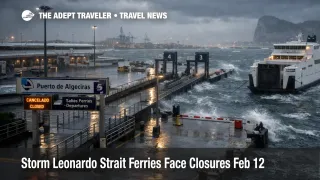
Storm Leonardo is disrupting Strait of Gibraltar ferry travel on the Spain and Morocco corridor, with port closures and operating restrictions reported around Algeciras, Spain, Tarifa, Spain, and Gibraltar. Passengers, vehicle travelers, and freight movements are being affected unevenly because decisions are driven by wind gusts and sea state, so services can pause even when nearby roads look usable. If you are traveling across the strait on February 11, 2026, or February 12, 2026, the practical move is to confirm your sailing status close to departure, add buffer for terminal access controls, and be ready to switch routes or modes if you have a hard arrival deadline.
The Storm Leonardo Strait ferries disruption matters because this corridor often runs as a tightly timed chain, drive to port, check in, border processing, crossing, then onward ground transport on the far shore. When the port closes or high speed craft are pulled first, the whole chain breaks quickly, and the recovery phase can be just as disruptive as the shutdown if departures resume in short bursts that generate queues.
Who Is Affected
Travelers using Port of Algeciras routes to Ceuta, Spain, and Tanger Med, Morocco are among the most exposed because Algeciras is a major gateway for both passenger vehicles and freight flows, and access restrictions for trucks can still reshape how lanes and terminal approaches move. Even if you are traveling by car, freight controls and metering can change how quickly private vehicles reach check in, and can create long, slow moving lines that are difficult to exit once you are committed to the approach roads.
Travelers using Port of Tarifa routes to Tangier, Morocco are also at high risk during wind events because these services can be more sensitive to sea state, and the restart pattern often favors limited windows rather than full day reliability. Foot passengers who planned to walk on and connect immediately to onward transport on the Moroccan side can lose the margin they expected, especially if the first reopened departures sell out quickly.
Anyone attempting a same day chain, for example a ferry followed by a long drive, a timed tour departure, or a fixed event in Morocco, is more exposed than travelers who can absorb an overnight. Separate ticket itineraries, such as ferry plus a separately booked onward leg, tend to fail hardest, because each operator handles reaccommodation only within its own system.
What Travelers Should Do
If you are traveling within the next 24 hours, verify in the right order. Check road conditions for your approach corridor first, then port authority updates for closures or access restrictions, then your ferry operator for sailing level changes. This order matters because a ferry can be listed as operating while access is metered, truck bans are in force, or approach roads are congested enough to make you miss check in.
Set a decision threshold before you leave for the port. If you cannot secure a confirmed sailing within a practical window that still protects your downstream plans, pivot early rather than waiting in a terminal queue that can stretch for hours after reopenings. For many travelers, the cleanest threshold is tied to the last safe arrival time for whatever comes next, hotel check in, a border region transfer, or a meeting time, and once you miss that, an overnight near the port can be cheaper than attempting repeated same day retries.
Over the next 24 to 72 hours, monitor wind and coastal hazard signals at least as closely as rainfall totals. In strait crossings, gusts and sea state decide whether high speed services stop first, then whether conventional ferries can safely maneuver in harbor approaches. Also watch for the recovery surge pattern, because once sailings restart, demand stacks up immediately, and the corridor can flip from total shutdown to capacity crunch, which is when hotels around the ports, taxis, and last minute ground transport tighten fast.
How It Works
Strait ferry disruption propagates through the travel system in layers, which is why it can feel abrupt and inconsistent. The first order trigger is operational safety at the waterline, wind and swell push vessels outside limits, ports halt traffic, and ferry operators cancel sailings rather than risk unsafe departures and arrivals. Access controls, including heavy vehicle restrictions and terminal metering, can be applied even when some sailings return, because ports need space to prevent gridlock inside the facility.
The second order ripple spreads across connections and inventory. When sailings stop, vehicles and foot passengers stack up on the Spain side and the Morocco side, which creates a surge when operations reopen. That surge then pressures hotels near the ports, taxis and private transfers, and any onward transport that depends on timed arrivals. It also pushes some travelers to switch modes, which can tighten short haul flight seats and raise same day pricing, even though the trigger was weather at the port.
For context on how fast this corridor can swing from shutdown to restart surge, and how to time cutoffs when winds return, see Storm Marta Strait Ferries, Andalusia Roads Still Shut.
Sources
- Protección Civil y Emergencias mantiene la alerta por temporal atlántico en gran parte de la Península
- Suspenden la línea Algeciras Tánger Med durante el miércoles y parte del jueves
- Algeciras cancela sus salidas a Tánger Med y opera algunas con Ceuta
- La Aemet activa un aviso por lluvias intensas y persistentes para el miércoles ante la llegada de la borrasca Leonardo
- Autoridad Portuaria Bahía de Algeciras Puerto de Algeciras, Información temporal