

Zakynthos Kefalonia Ferries Canceled Feb 12
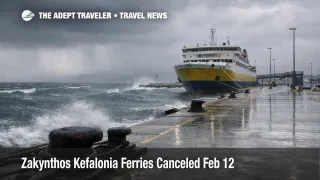
Severe weather in western Greece disrupted Ionian Sea operations and triggered ferry cancellations on routes linking Kyllini with Zakynthos, Greece, and with Kefalonia, Greece. Travelers relying on late day crossings faced a sudden cutoff, with port authorities and operators halting sailings as conditions deteriorated on Thursday, February 12, 2026. If you are trying to protect an onward flight, a rental car pickup, or a same day hotel check in, treat the rest of the day as unstable, and be ready to switch to air, or to add an overnight buffer on either side of the crossing.
The Zakynthos Kefalonia ferry cancellations reduce access through Kyllini on February 12, 2026, which can strand travelers on the islands, or strand travelers on the mainland short of their lodging plans.
Reporting from Greek outlets describes cancellations tied to gale force winds and rough seas, with affected departures centered on the afternoon and evening rotation that many travelers use to connect between island stays and mainland onward transport.
Who Is Affected
The highest risk group is anyone booked on the Kyllini to Zakynthos line, or the Kyllini to Poros, Kefalonia line, during the late afternoon and evening wave on February 12, 2026. Local reporting listed specific pulled departures including a Zakynthos to Kyllini sailing at 630 p.m., a Poros to Kyllini sailing at 730 p.m., plus mainland departures from Kyllini to Zakynthos at 830 p.m. and from Kyllini to Poros at 945 p.m.
Travelers on separate tickets are especially exposed. If you planned to ferry to the mainland, drive onward, and then fly, the ferry disruption pushes the whole chain late, and the airline generally treats that as a missed connection outside its control. The same logic hits cruise and tour embarkations that depend on precise arrival windows, plus rental car desks that may close early in winter hours.
Second order impacts can build quickly even after the weather eases. Once ferries stop, travelers tend to shift to limited domestic flights, which can sell out fast, then spill into hotel nights near ports and airports, which raises rates and reduces choice. Even travelers who do not switch modes can be affected because rebooked ferry loads compress into fewer departures, creating long vehicle queues, slow boarding, and late arrivals that ripple into local taxi availability and check in staffing. Those knock on effects are why a one evening sailing gap can still disrupt plans into the next day.
What Travelers Should Do
Start with confirmation and flexibility. Check your operator, your ticket agent, and local port authority updates before you leave for the port, and again just before your planned boarding window. If your trip depends on arriving the same day, shift your mindset from "wait and see" to "secure a fallback," because the cost of waiting can be a full lost day once flights and rooms tighten.
Set a decision threshold for switching to air versus waiting for the next sailing. If you must be on the mainland by Friday morning, February 13, 2026, it is usually rational to price and hold an air option as soon as you see repeated cancellations, especially if you are traveling with checked luggage, a car booking, or a tight meeting window. Airlines serving Athens International Airport (ATH) from the islands vary by date, so focus on availability first, then optimize price. SKY express publishes booking paths for Zakynthos to Athens and Kefalonia to Athens that can serve as a quick backup check when ferries stall.
Over the next 24 to 72 hours, watch for two things, the weather cadence, and the restart criteria. Greek reporting on the broader storm setup indicates a multi wave pattern across February 11 to 13, 2026, with a second pulse expected late Thursday into Friday morning, which can keep sea conditions marginal even if there is a brief lull. That means the first sailing that looks "possible" can still flip to "canceled" if winds strengthen again, so plan your lodging and onward changes as if you might need one extra night.
Background
Ferry operations in Greece are often constrained by port authority safety decisions that hinge on wind force, gust profile, sea state, and the ability to berth and unberth safely. When conditions push beyond safe limits, cancellations tend to concentrate in the most exposed hours, typically later in the day when forecasts verify and winds peak, and then resume only after conditions stabilize long enough to run a reliable cycle.
This is also why disruptions propagate beyond the harbor. Once a ferry is canceled, passengers and vehicles do not simply vanish, they queue. The next available departure inherits both its original load and the displaced demand, which increases congestion at ticketing, staging lanes, and ramps. That port level friction then ripples into airport and hotel systems as travelers shift modes, add nights, and retime transfers, creating localized surges that can be disproportionate to the number of canceled sailings.
Related travel disruption context: Blue Star Ferries Rhodes Sailings Changed Feb 12 to 22