

El Paso Airspace Closure Reopens Fast, Laser Cited
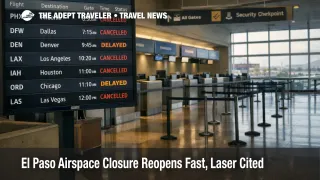
Airspace around El Paso, Texas was abruptly restricted in a way that briefly halted commercial flying at El Paso International Airport (ELP), then reopened within hours after federal officials said there was no continuing threat to commercial aviation. Travelers were most affected if they were scheduled to depart or arrive during the shutdown window, or if they were connecting onward the same day on tight schedules. The practical next step is to verify whether your original ELP flights are operating again, then push your airline to restore you to the safest routing before limited same day seats disappear.
The El Paso airspace closure matters because the initial restriction was communicated as unusually broad for a single metro area event, then reversed quickly, a pattern that can still produce a full day of cancellations, missed connections, and rebookings even after normal operations resume.
Confusion escalated because public explanations did not line up. Transportation Secretary Sean Duffy posted that the FAA and the Department of Defense acted to address a "cartel drone incursion" and that the threat was neutralized, but multiple outlets later reported that the trigger was a counter drone laser system operating near Fort Bliss without enough time for aviation safety assessment. Separate reporting also undercut the idea that a novel surge of cartel drone activity alone would justify a multi day shutdown, because small unmanned aircraft activity along the border is a known, persistent issue that agencies already manage through established processes.
Who Is Affected
The first group is anyone whose itinerary touched El Paso on Wednesday, February 11, 2026, including passengers who were canceled, diverted, or rebooked through other hubs after the restriction took effect. Even if you made it to your destination, you may now be holding a longer or riskier itinerary than what is available again through El Paso, because airlines often push passengers into whatever seats exist during the disruption, not the optimal path.
The second group is travelers with same day onward travel, especially late afternoon and evening connections. A hard stop, even for a few hours, displaces aircraft and crews, compresses gate availability, and shifts arrival banks. That is how an event localized to one airport can create second order misconnects on flights that technically operated, because the inbound aircraft arrived late, the crew ran close to duty limits, or the next leg had to swap equipment at the last minute.
The third group is essential travel users, including medical flights and travelers with fixed arrival needs. Local officials said medical flights had to divert during the shutdown, a reminder that sudden airspace actions can affect more than airline schedules. If your trip depends on arriving the same day for surgery, a cruise embarkation, a court date, or similar hard commitments, your tolerance for waiting out uncertainty should be lower than a discretionary leisure trip.
What Travelers Should Do
Start with confirmation and documentation. Check your flight status in the airline app, cross check El Paso's departures and arrivals, and save screenshots of any cancellation, reinstatement, or waiver language tied to the disruption. If you were rerouted away from El Paso during the halt, ask the airline to compare your current routing against the best available option now that flights are operating, and request restoration if your current plan adds an overnight, introduces a tight connection, or depends on the last flight of the day.
Set decision thresholds so you do not lose inventory while you watch events unfold. If you must arrive on February 11 or February 12 and you see renewed irregular operations, rolling delays that compress your connection margin, or a sign your inbound aircraft is running late, treat that as your trigger to rebook immediately onto a routing with a larger buffer, even if it costs convenience. If your trip is flexible by a day, shifting travel to February 12 or February 13 can be the cleaner fix than chasing scarce same day seats during recovery.
Over the next 24 to 72 hours, monitor signals that predict real operational risk, not online speculation. Watch for FAA updates that indicate restrictions or review activity, watch for airline travel waivers that mention El Paso or nearby Southern New Mexico airspace, and watch your aircraft's inbound leg on the day of travel because late inbound equipment is a common driver of follow on delays after a restart. If your itinerary includes separate tickets, consider consolidating onto a single ticketed path, because disruption protection is materially weaker when you self connect.
For related continuity coverage and traveler specific recovery guidance, see El Paso Airspace Shutdown Tied to Drone Laser System and El Paso Airport FAA Halt Ends, Flights Resume Feb 11. For broader structural context on why airspace actions can cascade quickly when coordination and capacity are tight, see U.S. Air Traffic Control Privatization: Reality Check.
Background
A Temporary Flight Restriction is the FAA's mechanism to restrict aircraft operations in a defined area for a defined time, typically for safety, security, or special events, and it is distributed through official notices and pilot briefings. In the El Paso case, reporting described an initial restriction that would have grounded departures and arrivals, then a rapid reversal after officials said there was no continuing threat to commercial aviation.
Disruption propagates through the travel system in layers. First order effects at the source are immediate, departures cancel, inbound flights divert or hold, and passengers are rebooked or refunded. Second order ripples spread when aircraft and crews end up out of position, rotations break, and duty time limits force additional cancellations. A third layer hits the ground system, because passengers who suddenly lose flights book hotel nights, one way car rentals, or transfers to alternates, then attempt to unwind those workarounds once flying resumes, tightening inventory in both air and ground channels at the same time. That is why a fast reopening is good news, but it does not guarantee an instant return to normal for travelers moving through El Paso over the following day.
Sources
- What caused the sudden closure of El Paso's airspace (PBS NewsHour)
- Texas airport shutdown shows troubling FAA-Pentagon disconnect, senators say (Reuters)
- El Paso airspace reopened after FAA quickly rescinds 10-day flight restrictions (The Texas Tribune)
- FAA closes El Paso airspace for 10 days (Flightradar24)
- Congresswoman Escobar Statement on Closure of El Paso Airspace (House.gov)
- The FAA and DOW acted swiftly to address a cartel drone incursion (X)
- Laser weapon that shut down El Paso's skies was LOCUST system (Axios)