

El Paso Airport FAA Halt Ends, Flights Resume Feb 11
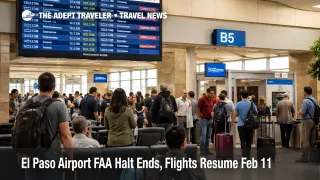
Flights at El Paso International Airport (ELP) resumed after the Federal Aviation Administration briefly halted all traffic for "special security reasons," then reversed course on Wednesday, February 11, 2026. The FAA said the temporary closure had been lifted, that there was no threat to commercial aviation, and that flights would operate normally again. What is new for travelers is the reversal itself, because it shifts the best decision from rerouting out of the region to quickly reaccommodating back onto El Paso departures and arrivals, before limited same day seats disappear.
The earlier restriction was unusually broad for a single airport event, and public reporting described it as a Temporary Flight Restriction tied to "special security reasons," with an expected end date later in February. The whiplash matters operationally because airlines often cancel, move aircraft, and reassign crews when they believe an airport will be unavailable for multiple days, and those decisions do not instantly unwind when the airspace reopens.
Who Is Affected
The most affected group is anyone whose itinerary touched El Paso during the shutdown window on February 11, 2026, including passengers who were canceled, rebooked through other hubs, or switched to a nearby airport by a travel advisor or airline agent. Even if your new routing "worked," it may now be inferior to what is available again at El Paso, especially if you were pushed into long connections, overnight stops, or separate ticket workarounds.
A second group is travelers connecting onward the same day on tight schedules, because a brief halt can create a rolling wave of late inbound aircraft and crews that arrive out of sequence. That is how a local pause turns into missed connections across the network, even after flights resume, particularly for travelers who need a last flight of the day, or who hold separate tickets.
A third group is anyone who pivoted to ground alternatives while flights were paused, including one way car rentals, hotel nights, and bus transfers to alternate airports. The closest major alternate frequently cited in public reporting was Albuquerque, New Mexico, which can be a long reposition for stranded passengers and can run out of practical same day options once reaccommodation begins.
What Travelers Should Do
Start by confirming what is operating now, not what was scheduled yesterday. Check your flight status in the airline app, then check the airport departure and arrival listings, and take screenshots of any cancellation or reinstatement messages for your records. If you were rebooked away from El Paso during the halt, call or message the airline and ask two direct questions, is my original El Paso flight operating again, and can you restore me to the best available routing under any disruption policy tied to the FAA restriction.
Set a decision threshold for when to keep an alternate routing versus switching back. If your current routing already has comfortable buffers, and you are within 24 hours of departure, it may be smarter to avoid another change unless you can clearly improve arrival time or reduce misconnect exposure. If your current routing adds an overnight, creates a tight self connection, or depends on the last flight of the day, push harder to switch back to El Paso now while seats are still available, because recovery inventory tends to vanish quickly once cancellations cascade through multiple flights.
Over the next 24 to 72 hours, monitor for renewed restrictions and for second order recovery effects. Watch for airline waiver language that mentions El Paso, and watch whether your aircraft is arriving late from earlier legs, because that is a common cause of new delays after an airport reopens. Treat this as a short notice security driven environment, similar in traveler impact, though not in cause, to other airspace volatility episodes such as Cyprus Airspace Caution Affects Eastern Med Flights and Northeast Poland Airspace Limits After Belarus Balloons. For broader context on how FAA system constraints and operational resilience shape disruption recovery, see U.S. Air Traffic Control Privatization: Reality Check.
Background
A Temporary Flight Restriction is a legal airspace tool the FAA can use to restrict aircraft operations over a defined area for specific reasons, including security. In this case, public reporting described a security related restriction around El Paso that would have grounded commercial operations, then an FAA reversal within hours that reopened the airspace and restarted flights.
Operationally, the disruption propagates in layers. The first order effects are immediate, departures cancel, inbound flights divert or do not depart, and passengers are rebooked or refunded. The second order ripples spread across the network when aircraft and crews are displaced, which can force later cancellations on unrelated routes as rotations break, and can push crews toward duty time limits as airlines try to recover the schedule. On the ground, the same whiplash can tighten hotel availability and one way car rentals as travelers switch to road repositioning, then reverse again when flights restart, leaving a short period where both air demand and ground demand spike at once.
For travelers, the practical lesson is that a reversal is good news, but it is not an instant return to normal. The fastest path back to a stable itinerary is usually to lock in a protected airline rebooking that restores a reasonable buffer, then stop changing plans unless the airline signals new instability.
Sources
- FAA lifts temporary closure of airspace over El Paso, Texas, saying all flights to resume (AP News)
- US lets flights resume at Texas's El Paso airport after brief security halt (Reuters)
- US officials abruptly close airspace in El Paso, Texas, for 10 days in unusual move (The Guardian)
- FAA grounds all flights into and out of El Paso until late on Feb. 20 for special security reasons (CBS News)
- El Paso flights grounded 10 days for 'special security reasons' (The Verge)