

Lötschental Avalanche Disrupts Road, Car Shuttle Access
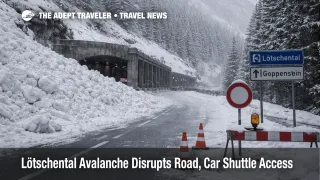
An avalanche near the Rotloiwi gallery by Goppenstein, Valais, Switzerland, disrupted access into the Lötschental valley and forced operational changes that matter for winter travelers using the valley road and the BLS Lötschberg car transport. The slide was reported shortly before noon on Thursday, February 12, 2026, and authorities described the valley road as closed in both directions during the initial response, with car transport operations suspended on the Lötschberg route while the portal area was impacted. For travelers, the practical consequence is that the first mile into the valley can fail abruptly, and even when services reopen, a high avalanche danger backdrop can keep conditions unstable through the next travel bank.
The key nuance is that this is not only a road problem or only a rail problem. The avalanche affected the same choke point where drivers stage for the Goppenstein car transport station, so a disruption can remove both the direct drive option and the car shuttle shortcut in the same window. That combination raises the odds of vehicles being stranded on the wrong side of the valley approach, and it increases the chance of late arrivals to resort bases that normally assume a predictable transfer time.
Who Is Affected
Winter travelers driving toward the Lötschental valley for ski stays, weekend breaks, or multi base itineraries are the most exposed group, especially those planning Saturday, February 14, 2026, arrivals with fixed hotel check in times. Anyone relying on the BLS Lötschberg car transport between Kandersteg and Goppenstein as a time saving link is also exposed, because a stop can force longer reroutes and can create queue pressure when service resumes.
Travelers arriving by rail and then switching to local buses, taxis, or pre booked transfers face a different failure mode. Even if mainline trains continue to run, access constraints on the valley road can delay the last mile into Wiler, Kippel, and other valley points, which then cascades into missed dinner reservations, ski school check ins, gear rental appointments, and paid activities that assume on time arrival. If you are on a tight chain with separate tickets, for example a flight into Switzerland, a train onward, and then a timed transfer, the misconnect risk is concentrated at the last road segment, not only at the airport or the main station.
Local businesses and lodging inside the valley can see a compression effect when travelers are forced to pause outside the valley, then attempt to enter during a narrow reopening window. That can translate into late check ins, same night rebook demand, and limited availability near the valley mouth when drivers decide to stop and wait rather than reroute far.
What Travelers Should Do
If you are traveling on Saturday, February 14, treat the valley approach as a condition based corridor, not a guaranteed segment. Confirm both the valley road status and the BLS car transport status early in the morning, then check again before you depart your last major town, because the difference between an easy arrival and a forced overnight is often one closure posted after you commit to the approach. If you are using a rental car, take screenshots of any operator advisories, and be ready to adjust without penalty where your booking terms allow.
Set a decision threshold for waiting versus rerouting that matches your downstream costs. If your lodging is non refundable, your ski program starts the next morning, or you have a tight return schedule, rerouting earlier is usually cheaper than waiting in a queue that may not clear before evening. If you can absorb a later arrival and you have flexibility on meals and activities, waiting for a controlled reopening can work, but only if you also have a realistic backup night outside the valley in case the corridor closes again.
Over the next 24 to 72 hours, monitor the avalanche danger context alongside the transport updates. High danger conditions can prompt repeated control work and temporary closures even after debris is cleared, so do not treat one reopening notice as the end state. Watch for official avalanche bulletin updates, local road authority advisories, and BLS operational notices, then align your departure timing with the calmest window rather than aiming for the most popular mid afternoon arrival bank.
How It Works
Avalanche disruption propagates through the travel system in layers that recover at different speeds. The first order effect is physical access loss at the source, snow and debris blocking the road corridor near the gallery, plus safety restrictions that can halt traffic until the slope is stabilized. When that same corridor is also the staging approach for the car transport station, the disruption becomes multi modal, drivers cannot reach the loading point reliably, and the operator may suspend service to keep vehicles out of an unsafe approach area.
The second order ripple is timing and capacity distortion. Once a closure lifts, demand concentrates into a narrower window, which can create queues for the car shuttle and congestion on the valley road as pent up arrivals push through at once. That wave then spills into downstream layers, missed rail connections, missed local bus links, and higher demand for short notice lodging near the valley mouth when travelers choose to stop rather than risk a night drive under changing conditions. In parallel, the elevated avalanche danger backdrop increases the chance of additional preventive actions, including controlled blasting and temporary stoppages, which can reset the cycle even after a corridor appears operational.
This pattern resembles other winter weather disruptions across Alpine corridors, where the headline event is one closure, but the traveler pain comes from repeated short notice holds and the queue waves that follow. Travelers who are also moving through broader Alpine regions this week may want to review how avalanche risk can translate into transport interruptions during major storm cycles, including in nearby networks, using Storm Nils France Red Alerts Disrupt Travel Feb 12.
Sources
- Avalanche cuts off traffic to Swiss Lötschental valley
- Traffic in the Lötschberg region paralyzed, blasting planned
- The A6 cantonal road into the Lötschental is passable again
- Current car transport service traffic situation
- Avalanche bulletin and snow situation
- Full avalanche bulletin, February 13, 2026
- Latest news, Lötschental Tourismus