

UK ETA Enforcement Feb 25 Raises Denied Boarding Risk
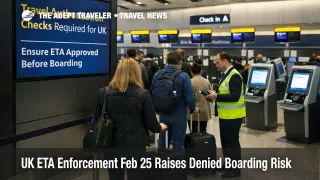
UK ETA enforcement Feb 25 is the point when carriers become the hard gate for eligible visa free travelers headed to the United Kingdom. Instead of finding out at the border that you should have secured permission, you can be stopped before departure at online check in, bag drop, or the counter, and that can happen even if your passport is valid and your ticket is confirmed. Travelers transiting the UK are also in scope when the itinerary requires UK passport control. The practical move is to treat February 25, 2026 as a carrier document check deadline, not a policy headline.
The UK Home Office has framed the shift as "no permission, no travel," and it is designed to push screening upstream so that airlines, rail operators, and ferry companies verify travel permission before boarding. For travelers, that means the most common failure mode is not a tough conversation with a border officer after landing, it is a denied boarding decision you cannot fix at the airport on the day of travel.
Who Is Affected
The highest risk group is travelers from countries that are used to short, visa free visits to the UK, because many of those passengers historically boarded with little more than a passport and a booking reference. Under full enforcement, eligible visitors without an approved Electronic Travel Authorisation cannot legally travel, and carriers are expected to block boarding rather than leave the decision for arrival.
Transit travelers are the second major risk group, because the requirement is not simply "final destination UK." If your connection requires you to pass UK passport control, the UK can treat you like any other arriving visitor for document purposes, even if you intend to depart the same day for a third country. Airside transits that never pass border control can be exempt in certain airports and routings, but that exemption can collapse fast if irregular operations force a terminal change without an airside route, an overnight, a baggage claim and recheck, or a rebooking that sends you landside.
Dual nationals add a separate failure mode. British and Irish citizens are exempt from the ETA, but that exemption is not helpful if you cannot prove it at boarding. UK guidance for dual citizens emphasizes traveling on a valid British or Irish passport, or the relevant entitlement document, because presenting a different passport can trigger carrier uncertainty and additional checks at the border, and it can surface as a boarding problem rather than an arrival problem. This is also why U.S. Embassy London messaging has leaned hard on "denied boarding" language for travelers who show up without the right documentation.
What Travelers Should Do
Treat this like a document matching problem, not an app download problem. First, confirm whether your passport needs an ETA, then apply using the exact passport you plan to present at boarding, and ensure your booking details align with that document. If you have renewed a passport recently, are traveling on a second passport, or are managing travel for a child whose document changed, assume mismatch risk until you verify it.
Use a clear threshold for rebooking versus waiting when approval is pending. If you are within 72 hours of departure without a decision, or you learn that your ETA is tied to a different passport than the one you will travel on, it is usually smarter to move to a later departure or reroute away from the UK than to gamble on an airport day solution. With full enforcement, carriers are not positioned to "override" missing permission at the counter, and travel insurance often treats denied boarding from missing documents as a preventable event.
Over the next 24 to 72 hours before travel, monitor your ETA status, your itinerary's border control path, and your exposure to rebooking. If you are transiting London, assume that an otherwise tidy plan can become landside during disruptions, especially on separate tickets, self transfers, or mixed airline itineraries. Build buffer in the first UK touchpoint, because a denied boarding or even a lengthy manual document review can break the rest of the trip, including Eurostar segments, ferry departures, first night hotel check ins, and timed tours. For a deeper UK entry checklist, use UK Entry Requirements For Tourists In 2026, and for the operational boarding workflow view, see UK ETA Feb 25 Boarding Rule, Avoid Denied Boarding.
How It Works
An Electronic Travel Authorisation is a digital permission to travel, it is not a visa, and it does not guarantee entry on arrival. The system links permission to the passport used in the application, which is why passport changes and last minute document swaps can trigger a negative outcome at boarding. The UK has positioned the scheme as part of a broader digital border effort, and it is explicitly shifting enforcement to carriers so that a passenger without advance permission does not travel in the first place.
That design choice changes airport and terminal operations. First order effects show up as more passengers being routed to staffed counters for document checks, more manual exceptions handling, and longer transaction times in busy departure banks. That slows down processing, increases the odds of missed flights on tight itineraries, and can reduce same day recovery options when flights are full.
Second order ripples travel through hub connections and rolling disruptions. If a passenger is blocked at departure, they miss the first leg, which can cancel onward segments on protected itineraries, or strand them entirely on separate tickets. When that happens through a London hub, it can amplify hotel demand near airports, shift demand to alternate routings via Dublin, Paris, Amsterdam, or Brussels, and inflate rebooking queues across airlines, rail, and ferry operators at the same time.
Third order effects hit prepaid land arrangements. A one day slip can mean losing the first night of a hotel stay, missing a tour that cannot be rescheduled, or arriving too late for a fixed embarkation. That is why the best traveler posture is not simply "apply," it is also "reduce cascade risk," by adding connection buffer, avoiding UK routings when approval is uncertain, and ensuring every traveler in the party, including children, has their own approved permission when required.
Sources
- No permission, no travel: UK set to enforce ETA scheme
- Electronic Travel Authorisation (ETA) factsheet - January 2026
- Get an electronic travel authorisation (ETA) to visit the UK
- Apply for an ETA
- Entering the UK: Layovers and transiting through a UK airport
- Electronic travel authorisation (ETA): guide for dual citizens
- ROUTINE MESSAGE: Important changes to UK entry requirements as of February 25, 2026