

Delhi Summit Traffic Diversions Pragati Maidan Feb 16 to 20
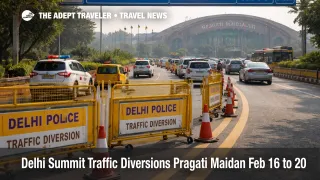
Delhi summit traffic diversions are in effect across central New Delhi from February 16 to February 20, 2026, with traffic regulations, rolling diversions, and checkpoint slowdowns concentrated around Bharat Mandapam at Pragati Maidan. Visitors are most likely to feel the impact on hotel transfers, airport runs, and cross city drives that cut through New Delhi district. The practical next step is to treat any trip that touches central corridors as time sensitive, plan a metro fallback early, and build a buffer that assumes at least one unexpected diversion loop.
The Delhi summit traffic diversions mean your "normal" route may not be available at the moment you depart, even if it looks clear on a map. Police guidance centers on avoiding a long list of central roads during the event window, with special attention to corridors that connect Pragati Maidan, ceremonial and diplomatic districts, and major junctions that feed Ring Road.
Who Is Affected
Travelers staying near Pragati Maidan, Connaught Place, Janpath, and the broader New Delhi district footprint face the most direct disruption because barricades and regulated turns can force long detours even for short distances. Visitors moving between central hotels and major rail terminals, including New Delhi Railway Station and Hazrat Nizamuddin, should assume that approach roads can bottleneck at chokepoints where traffic is filtered and redirected.
Airport bound travelers can also be affected even when the airport itself is operating normally. Indira Gandhi International Airport access is mostly a road problem during these windows, not an aviation problem, so the risk is missing your check in cutoff or arriving too late for baggage drop. The impact can be sharper for travelers on separate tickets, for families with multiple bags, and for anyone with a tight rail to air connection where a single slow segment collapses the whole plan.
Second order effects spread beyond the immediate cordon. When central arteries slow, drivers shift onto Ring Road segments and feeder routes, which can create stop and go conditions far from the venue. That ripple pushes up ride hail wait times, complicates tour operator routing, and can make station approaches unpredictable, which in turn increases missed trains, rebooking demand, and last minute hotel night extensions for travelers who decide not to risk a late night cross city transfer.
What Travelers Should Do
If you have a flight or a long distance train during February 16 to 20, 2026, build a larger buffer than you think you need, then protect it. For flights, many travelers will be safer treating the road leg as the variable, leaving early enough that one major detour plus a checkpoint queue does not force a sprint at the terminal. For rail, aim to arrive early enough that a diverted approach still leaves time to find the correct platform and coach position.
Set a clear decision threshold before you leave your hotel. If your driver reports repeated barricades, if map speeds collapse across central corridors, or if your ride hail pickup time keeps slipping, switch to Delhi Metro rather than gambling on another road attempt. For airport trips, the Airport Express Line for Terminals 2 and 3, and the Magenta Line for Terminal 1, can be a practical backup when roads into the airport zone slow, even if you still need a short last mile transfer.
Over the next 24 to 72 hours, monitor official traffic updates, not just navigation apps. Rolling VIP movements can create sudden, short duration closures that apps only reflect after congestion forms. Confirm with your hotel concierge, driver, or tour operator whether your pickup point should move to a less restricted road, and recheck your route plan before each major transfer rather than reusing yesterday's timing.
Background
Large, high security summits change road performance in two ways. First, police restrict specific corridors near the venue and along VIP movement routes, which forces regular traffic onto a smaller set of remaining roads. Second, the timing of VIP convoys is not optimized for commuter flow, so a corridor can swing from normal to constrained quickly, creating waves of congestion that propagate into Ring Road, station approaches, and airport feeders.
For many visitors, this disruption stacks on top of other trip critical requirements, like entry paperwork and check in rules. If you are also planning India logistics this week, India Entry Requirements And New E Visa is a useful refresher so traffic does not become the final problem on top of a document surprise.
Sources
- AI Impact Summit 2026: Delhi Police issues traffic advisory for Feb 16 to 20; check alternate routes for airport, railway stations
- Delhi Airport issues advisory amid possible traffic disruptions during India AI Summit, advises use of metro
- From OpenAI to Google, India hosts global AI summit
- Traffic Advisory In view of AI Impact Summit 2026 to be held from 16 Feb 2026 to 20 Feb 2026