

China Visa Free Entry for Canada, UK Travelers 2026
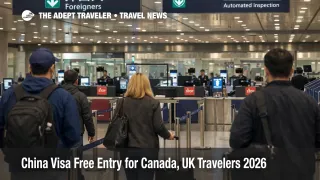
China has started a new visa waiver that lets eligible travelers from Canada and the United Kingdom enter mainland China without a visa for stays of up to 30 days. The change affects leisure travelers, business visitors, families visiting relatives, students on short exchanges, and passengers using China as a transit stop on longer itineraries. The practical next step is to validate that your trip fits the allowed purposes and stay length, then travel with the same supporting documents airlines and border officers typically request even when a visa is not required.
The China visa free entry change is that ordinary passport holders from Canada and the United Kingdom can enter for up to 30 days, for specified purposes, during a defined window that runs through the end of 2026.
Chinese embassy notices describe the policy window as beginning at 1200 a.m. Beijing time on February 17, 2026, and ending at 1200 a.m. Beijing time on December 31, 2026. They also spell out the covered purposes, business, tourism, family and friends visits, exchange, and transit, and clarify that travelers who do not meet those conditions still need to obtain a visa before traveling.
Who Is Affected
The biggest beneficiaries are Canada and UK travelers who previously had to plan around visa appointment availability, processing times, and the risk that paperwork timing would not match a late fare sale or a last minute work trip. For spring and early summer bookings, the friction reduction can materially change whether a short trip is viable, especially for travelers who want to depart on short notice or who need flexibility to move dates.
This also affects travelers who connect through major China gateways because a visa requirement can be the difference between choosing a routing with a longer stopover versus avoiding a country entirely. With the visa step removed for eligible stays up to 30 days, more itineraries become plausible, including open jaw trips that arrive in one city and depart from another, as long as the stay and purpose remain within the waiver terms.
Edge cases matter. If you plan to work, study long term, report as media, perform, volunteer in ways treated as employment, or stay beyond 30 days, this waiver likely does not apply, and you should assume you still need the correct visa category before you fly. Travelers who have complex citizenship situations, prior immigration issues, or itineraries that do not clearly match a tourist, business, visit, exchange, or transit pattern should expect closer scrutiny at the border, because visa free does not mean guaranteed admission.
What Travelers Should Do
Start by building a clean document stack even though you are not applying for a visa. Bring a passport with strong remaining validity, your confirmed onward or return ticket, and proof of where you will stay for at least the first part of the trip. If you are traveling for business, carry a simple invitation or meeting confirmation that matches the allowed purpose description, and keep it consistent with what you tell airline staff and border officers.
Use decision thresholds when booking nonrefundable travel. If your trip might run long, or if you may need multiple entries, treat that as a likely visa case and do not assume you can fix it on arrival. If you are close to the 30 day limit, build margin for schedule disruptions, because a delay that pushes departure past your permitted stay can create fines, overstay complications, or future entry problems.
Over the next 24 to 72 hours, monitor for implementation details that affect real travel, not just the headline. Watch for airline check in messaging about acceptable documentation under the waiver, and check whether consular sites publish additional FAQs that clarify how the 30 day clock is counted and how repeated entries are treated in practice. If you are still working on core documents for international travel, the planning logic is similar to other paperwork shocks, the bottleneck is often the document, not the flight, and U.S. Nonprofit Library Passport Fees Blocked is a reminder that document access constraints can shift quickly when rules start being enforced differently.
How It Works
Visa waivers change travel behavior fast because they remove a gating step that sits outside airline schedules and pricing. When a visa is required, travelers must plan around consular appointments, processing lead times, and uncertainty about approval. When the visa is waived for short stays, demand shifts from delayed intent to immediate bookings, and the travel system responds through capacity, pricing, and inventory rather than through consular throughput.
First order effects show up at the border and at airline check in. Airlines still have to verify that passengers meet entry rules before boarding, and border officers still determine admission on arrival. The Chinese embassy notices emphasize eligibility, purpose, and the 30 day maximum, and they make clear that travelers who fall outside those requirements still need a visa before traveling. In practice, that means the traveler problem shifts from getting a visa appointment to proving your trip fits the waiver category, and staying within the permitted time window.
Second order ripples spread through at least two other layers of the travel system. On the airline side, easier entry tends to lift near term demand on trunk routes and common connection banks, which can tighten seats on peak departures and push fares upward on the most convenient timings. On the ground side, incremental inbound demand often concentrates first in major gateway cities where international flights arrive, then flows onward through domestic flights and China's rail network, which can tighten hotel inventory and change availability for short stays during already busy domestic travel periods.
There is also a network effect for global routings. Authoritative reporting has framed the move as part of a broader expansion of China's unilateral visa free list, and it notes that the policy is currently described as running through the end of 2026. That end date matters operationally because it can influence how airlines and tour operators build products, and how travelers price the risk of a rule changing before a late 2026 trip.
Sources
- Notice on China's Visa Waiver Policy for the UK and Canada
- Notice on Visa-free Policy for Canada and the UK, Embassy of the People's Republic of China in Canada
- Foreign Ministry Spokesperson's Remarks on Including Canada and the UK in the Visa-Free Program
- China grants UK and Canada visa-free entry, raising total to 79 countries