

Nairobi Strike Ends, JKIA Recovery Delays Feb 17
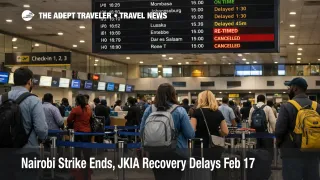
Airport worker strike action affecting Nairobi, Kenya's main air hub has ended, and operations at Jomo Kenyatta International Airport (NBO) are restarting on February 17, 2026. Airlines and airport authorities say services are resuming after a return to work agreement, but travelers should still plan for recovery friction today as the operation clears backlogs and re sequences aircraft, crews, gates, and baggage. If you are connecting through Nairobi, the safest move is to protect your onward links by shifting into later departure banks, adding connection time, and avoiding separate tickets where a missed flight becomes your problem to re buy.
The Nairobi airport strike recovery is now a stabilization story, not a go or no go decision, because travel can proceed, but the schedule can remain uneven while the network unwinds.
Who Is Affected
Connecting passengers are the highest risk group on February 17, because Nairobi functions as a hinge hub for long haul arrivals and regional departures across East Africa. When a hub is recovering from a labor disruption, a flight that looks fine at booking can still fail at the margin if its inbound aircraft arrives late, if the gate sequence compresses, or if crews hit duty time limits after earlier delays. That is why travelers with tight same day onward links to regional destinations should assume elevated misconnect probability until the day's banks run on time.
Travelers checking bags are also more exposed than carry on only passengers during recovery. Backlog clearing tends to show up in counter throughput, baggage acceptance, and arrival belt timing, and those frictions can stack, even after the core labor action ends. If you have a protected itinerary on one ticket, your airline can usually reaccommodate you, but if you stitched flights together across separate tickets, the second carrier may treat a missed departure as a no show, which is how a disruption becomes an expensive last minute repurchase.
Passengers who planned same day arrivals for tours, safari departures, cruises, weddings, or permits have a different risk profile than flexible travelers. In a recovery window, the operational question is not whether something might slip, it is whether your trip can tolerate the slip without breaking the first fixed commitment on the ground. If it cannot, you should act earlier, because recovery seats can disappear quickly once reaccommodation demand concentrates.
For additional context on how the disruption developed before the return to work agreement, see Nairobi Airport Strike Delays Flights Feb 16, 2026.
What Travelers Should Do
Start with immediate actions and buffers. Check your flight status directly with your airline before you leave for the airport, then take screenshots of any waivers, rebooking prompts, or schedule change notices tied to your reservation. Plan extra time for check in and bag drop, and keep medication, chargers, a change of clothes, and critical documents in hand luggage, because a recovery day is when a short delay can quietly turn into an overnight.
Use decision thresholds for rebooking versus waiting. If your onward connection is tight, if you are on separate tickets, or if missing the link would break a fixed commitment on arrival, rebook into a later connection window now, even if it is less convenient, because reliability is the scarce resource during recovery. If you are on a single protected ticket, and you still have multiple same day options behind your original itinerary, waiting can be reasonable, but the moment you are down to the last same day bank, your odds of an overnight climb fast.
Over the next 24 to 72 hours, monitor the right indicators, not general chatter. Watch whether the early wave of departures and arrivals is leaving close to schedule, because if the first bank runs late, the rest of the day often inherits the same delay pattern. Track your aircraft's inbound leg and the airline's targeted recovery messaging, because normalization claims are usually network wide averages, while your flight is constrained by one tail number, one gate sequence, and one crew duty clock.
How It Works
When a strike or work slowdown hits an airport hub, the first order impacts are visible, queues at check in, slower baggage acceptance, and reduced throughput in ground handling and operational services. Even after staff return, the airport does not instantly snap back, because the backlog must be worked down in the correct order, and that takes time, gates, and staffing. On the airside, departure slots and arrival sequencing can remain uneven as flights that were held or canceled re enter the system, and as aircraft positioning is corrected.
The second order ripple is what traveling passengers feel most, missed connections and cascading delays across an airline's network. Aircraft and crews operate multi leg rotations, so a delay at the hub does not stay at the hub, it pushes later departures out of sequence at other stations, and it can trigger crew legality issues that force retimes or cancellations later in the day. In a regionally connected network, a Nairobi disruption can also concentrate demand onto fewer remaining seats for regional departures, which raises misconnect stakes and increases the chance of an unplanned hotel night near the airport.
A useful stability test is whether the hub can run a full bank on time, then repeat it. If one bank clears but the next does not, that usually signals hidden constraints such as baggage backlog, gate congestion, or aircraft out of position. On February 17, the practical traveler play is to act like you are flying during a controlled recovery window, building slack into connections, and preferring later departures until the system demonstrates sustained on time performance.