

WestJet Winter Storm Waivers for Canada Flights Feb 17
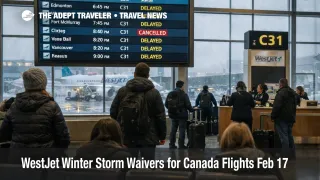
WestJet has posted winter storm travel advisories covering multiple Canadian regions, and it is offering one time fee waivers to let affected travelers adjust plans during a live disruption window. The practical change for travelers is that WestJet is explicitly encouraging proactive rebooking for flights scheduled between February 16 and February 19, 2026, depending on the advisory region. If your itinerary touches Prairie airports such as Winnipeg James Armstrong Richardson International Airport (YWG) or WestJet hubs such as Calgary International Airport (YYC), the combination of snowfall, deicing demand, and reduced arrival rates can turn a small delay into a missed connection quickly.
The waiver language is specific, and travelers should read it literally. WestJet's advisory framework offers a $0 one time fee waiver for eligible changes and cancellations on flights booked directly through WestJet, including UltraBasic, but fare differences still apply if you move to a higher priced flight, change cabin, or change destination. WestJet also includes operational guardrails such as completing travel within 60 days of the original departure date and making change or cancellation requests more than 2 hours before departure.
Who Is Affected
The highest exposure is concentrated in the airports WestJet lists under its winter storm advisories, because those are the stations most likely to see runway, visibility, and deicing constraints that lower departure and arrival throughput. In the Prairie and western sets shown on WestJet's advisory page, that includes Brandon Municipal Airport (YBR), Winnipeg James Armstrong Richardson International Airport (YWG), Calgary International Airport (YYC), Edmonton International Airport (YEG), Fort McMurray International Airport (YMM), Medicine Hat Regional Airport (YXH), Lethbridge Airport (YQL), Regina International Airport (YQR), and Saskatoon John G. Diefenbaker International Airport (YXE).
A second group is travelers with itineraries that touch Eastern Canada airports that are listed alongside the Southern Ontario advisory context on WestJet's page, including Montréal Trudeau International Airport (YUL) and Ottawa Macdonald Cartier International Airport (YOW). Even if your departure airport looks fine at the moment you check in, the inbound aircraft and crew may be arriving from a constrained city, and that is how delays propagate into later banks.
A third group is anyone trying to protect an international connection, cruise departure, or fixed time event on the same day. Winter operations compress schedule slack, and once reaccommodation starts, the bottleneck is often seat inventory rather than the waiver itself. During that phase, call center and airport desk queues can become the limiting factor, which is why early, self service changes usually outperform waiting for a cancellation notice.
What Travelers Should Do
Start with immediate actions and buffers. Pull up your reservation in WestJet's Manage Trips, confirm that your travel date and region match the advisory window, and then price out at least two alternates, one earlier and one later, so you can move fast if your original flight begins drifting. If you are departing Calgary International or Winnipeg, plan extra time for winter curbside conditions, check in lines, and deicing related gate holds, and add a hotel backup if you cannot miss the next day.
Use clear decision thresholds for rebooking versus waiting. If your trip includes an international connection under about 2 hours, any separate ticket onward segment, or a same day cruise or tour departure, the smarter play is usually to rebook as soon as you see sustained delay expansion in your inbound aircraft, or when weather warnings suggest a multi hour deicing queue is likely. If you are on a single ticket with a long buffer and multiple same day alternatives, waiting can be rational, but stop waiting once you are down to the last viable same day option.
Over the next 24 to 72 hours, monitor three signals. First, watch whether Environment Canada updates snow and blowing snow guidance for the corridor you are traveling through, because visibility and wind often drive runway acceptance rate cuts even when snowfall totals are manageable. Second, watch your aircraft and crew positioning, because a late inbound from a storm impacted city is one of the best predictors of a late outbound. Third, watch for WestJet to expand or split advisory windows by region, because that often signals that disruption is spreading east or that recovery is taking longer than the initial forecast.
For broader context on how weather constraints cascade across rotations and connections, compare this pattern with Flight Delays and Airport Impacts: February 16, 2026. If your itinerary connects onward through the United States after rebooking, also account for compounding terminal friction in US DHS Shutdown TSA Delays Raise Airport Line Risk.
How It Works
WestJet's travel advisory waivers are designed to reduce pressure on the day of travel by pulling demand forward into voluntary changes. The first order operational problem in a winter storm is throughput, aircraft need deicing, taxi times lengthen, and arrivals may be metered when visibility, braking action, or staffing reduces capacity. That shows up as gate holds, missed slots, and cancellations when the airline cannot recover a rotation inside crew duty and rest limits.
The second order ripple spreads beyond the storm footprint. When a WestJet aircraft misses a morning arrival bank into a hub such as Calgary, it can strand connecting passengers, break the aircraft's next legs, and force last minute swaps that leave some later flights without an aircraft in position. That is why travelers who are not starting in the storm region can still be impacted if their aircraft or crew is coming from it. Once reaccommodation begins, the constraint shifts again, call centers fill, airport service lines grow, and hotel inventory around hub airports tightens as more travelers are pushed into next day departures.