

US DHS Shutdown TSA Delays Raise Airport Line Risk
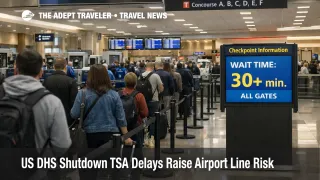
A partial shutdown at the U.S. Department of Homeland Security is underway, and Transportation Security Administration screening is continuing with many frontline officers working without pay. For travelers, the practical risk is not that checkpoints close, it is that staffing strain over multiple days can reduce the number of open lanes and slow throughput at the exact times airports are most congested. Anyone flying domestically, connecting through a hub, or traveling with checked bags can be affected. The smart move is to add time buffers, tighten your decision rules for rebooking, and monitor airport alerts rather than relying on normal day patterns.
The DHS shutdown TSA delays issue is that airport security lines can lengthen even when flights are operating, because screening throughput depends on lane staffing, secondary screening capacity, and how reliably shifts are covered as the funding lapse continues. The coverage has shifted from a "risk if it happens" story to an "active period" planning problem as of February 16, 2026, with the shutdown having begun on February 14, 2026.
If you covered this ahead of the lapse, the key difference now is operational uncertainty during a live shutdown window, not just the policy headline. For continuity, see DHS Shutdown Risk Hits TSA Lines Feb 14, 2026.
Who Is Affected
Any traveler departing a U.S. airport is exposed, but risk is uneven across airports and itineraries. The most fragile trips are early departures and tight connections, especially when you also have to meet a checked bag cutoff. When security queues jump, you cannot "make up" that lost time later in the process, and missed boarding windows turn into same day inventory problems quickly on high load flights.
Large hubs are the classic pressure point because they compress demand into departure banks. If a small staffing gap forces lane consolidation, the line does not just get longer, it gets bursty. That matters for families, group travel, and anyone with special assistance needs, because the cost of a last second sprint or a gate change is higher, and rebooking often requires more coordination.
Second order effects show up beyond the checkpoint. When more passengers miss flights, airlines absorb extra reaccommodation work at gates, call centers, and customer service desks, and seats on later departures disappear faster. Missed connections then ripple into forced overnights, hotel demand around hubs, and downstream aircraft and crew positioning decisions that can create additional delays later in the day. This is one reason a security lane problem can become a network performance problem, even though air traffic control funding is not the constraint in this specific shutdown.
What Travelers Should Do
Start with immediate buffers that match the airport you are using and the time of day. If you typically arrive with a slim margin, expand it, particularly for morning peaks and holiday or long weekend patterns. Build extra time for bag drop and for walking to the gate, not just for the checkpoint itself, because a missed bag cutoff can break the trip even if you later clear security quickly.
Use clear thresholds for rebooking versus waiting so you do not gamble on a collapsing margin. If you are inside a tight window and you see public airport messaging about long security lines, reduced lane availability, or unusually heavy queues, it is often smarter to move to a later flight while seats remain, rather than betting on a best case clearance time. If you are on separate tickets, treat any missed first leg as a likely chain reaction and be more aggressive earlier, because protection is limited and reaccommodation can be expensive.
Over the next 24 to 72 hours, monitor indicators that conditions are worsening. One signal is the quality of official information, because TSA has said its website and tools will not be actively managed during the funding lapse, which can reduce the usefulness of familiar official channels for real time planning. Another signal is airports and airlines adjusting recommended arrival times or issuing waivers, which tends to happen when they anticipate persistent misconnects and long terminal lines.
For broader operational context on how delays propagate across the system, compare your plans against current airport and airline conditions in Flight Delays and Airport Impacts: February 13, 2026.
How It Works
A shutdown at the Department of Homeland Security does not automatically shut down airports. Most TSA screening functions continue because aviation security is treated as essential, and many employees are required to work even when pay is delayed. The travel risk is that prolonged unpaid work can increase unscheduled absences and make staffing harder to stabilize, which can reduce open checkpoint lanes and slow screening throughput, especially at peak periods.
Throughput is the core concept travelers should understand. A checkpoint clears a surge only if enough lanes are staffed and the system can absorb secondary screening without bogging down. When lane count drops, the queue can grow quickly, and it can take a long time to unwind because demand arrives in waves tied to airline schedules. That is why the same airport can look normal at midday and feel overwhelmed in a 60 to 90 minute peak window.
The ripple spreads outward fast. Passengers who miss flights reenter the system as reaccommodation work, and that adds friction at gates and service desks. When rebookings pile up, later flights fill, standby lists grow, and airlines may have to make choices that protect the rest of the schedule, including aircraft swaps and crew legality adjustments. Those second order actions are how a staffing problem at a checkpoint can contribute to late departures and cascading network delays later in the day.