

Antarctica Circumnavigation Ushuaia Le Commandant Charcot
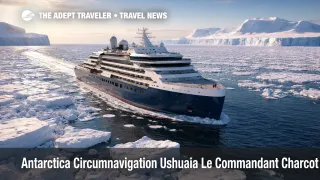
PONANT EXPLORATIONS has opened bookings for a rare long form polar itinerary, a complete Antarctica circumnavigation aboard its luxury icebreaker, Le Commandant Charcot. The sailing is scheduled to depart from Ushuaia, Argentina, on January 11, 2028, and return to Ushuaia after 62 days and 60 nights on board. Travelers looking at the full voyage are shopping an advertised starting fare of $147,360.00 (USD) per person, with two shorter options available for those who want only part of the route.
The itinerary is structured as a westward passage from Ushuaia to Hobart, Tasmania, Australia, followed by a three day stopover, and then an eastward return to Ushuaia. Ponant describes the concept as tracing nearly 23,000 km of coastline, which is about 14,300 miles, along some of the least visited sectors of the continent. The line is also emphasizing the ship's PC2 ice capability as the operational enabler for staying close to the Antarctic coast in heavier ice conditions when feasible.
Who Is Affected
This voyage is aimed at travelers who want an expedition style product with a long time horizon, a high per night cost, and a significant logistics footprint before and after the cruise. The first group affected is anyone trying to connect into Ushuaia, because Malvinas Argentinas International Airport (USH) has limited schedules and is vulnerable to weather disruptions that can cascade into missed embarkation when flights are delayed or canceled.
The second group affected is anyone considering the half circumnavigation legs instead of the full trip. The Ushuaia to Hobart segment is listed from $74,470.00 (USD) per person, and the Hobart to Ushuaia segment is listed from $83,520.00 (USD) per person, which means the pricing, the embarkation city, and the exit plan are materially different depending on which half is chosen. Travelers ending in Hobart will likely route through Hobart Airport (HBA), and should plan for an extra buffer because the ship's arrival timing can still be weather and ice dependent in the far south.
A third group affected is travelers who assume this is a fixed route cruise in the conventional sense. Even with an ice capable ship, Antarctica operations are still condition driven, and the farther the itinerary pushes into rarely visited waters, the more a voyage plan can shift around sea ice, wind, and safety constraints. That matters for anyone stacking tight onward flights, hotels, or tours immediately after the cruise.
What Travelers Should Do
Start by building the trip around buffers, not around the brochure. For Ushuaia embarkations, plan to arrive at least one full day early, and consider two nights if flights into USH require multiple connections or separate tickets. For Hobart embarkations, treat Hobart as a weather sensitive gateway in its own right, and hold refundable lodging until the cruise line confirms final arrival timing and transfer details.
Set a decision threshold now for rebooking versus waiting, because this product is long, expensive, and inventory constrained. If the trip only works for you as the full 62 day loop, prioritize the cabin category you actually want and the cancellation terms you can live with, rather than chasing a small fare difference. If the trip works as either half, price both legs with realistic airfare and hotel costs, and pick the one with the cleanest flight network for your home market, because that is often what determines stress levels at the gateway.
Over the next 24 to 72 hours, monitor the details that change total trip cost, not just the headline fare. Watch for what Ponant includes in the package elements tied to these voyages, confirm deposit and final payment dates in writing, and verify the cancellation schedule, medical requirements, and insurance expectations for a polar itinerary of this length. If you book through an advisor, ask for an itemized quote that shows what is bundled, what is optional, and what penalties apply if you need to shift dates or cancel.
Background
An Antarctica circumnavigation is not simply a longer peninsula cruise, it is an operational puzzle that depends on ship capability, weather windows, ice conditions, and a route plan that can flex without breaking the end to end schedule. Ponant is positioning Le Commandant Charcot as uniquely suited for this because it markets the vessel as the only passenger ship with PC2 icebreaking capability, which can expand routing options in heavier ice when conditions allow.
The first order effects show up on the ship itself, where speed, fuel planning, and safe navigation margins determine how close the vessel can track the coastline and how much time remains for landings, zodiac operations, or scenic sailing on any given day. The second order ripples hit the rest of the travel system, especially the gateways. When a long expedition arrives late, hotel inventory in Ushuaia or Hobart can tighten fast, rebookings can become expensive, and limited flight seats can turn a one day slip into multiple days of disruption during peak travel periods.
There is also a booking system ripple that matters right now. Because this is a single departure window, pricing, cabin availability, and promotion rules can move quickly, and terms matter as much as the itinerary. Travelers comparing this to other premium expedition products should treat it like a Wave Season purchase decision, where the best move is usually to lock terms that match risk tolerance, not just to chase a marketing headline. The most useful framework is the same one that applies across cruise deal cycles, understand what is truly included, what is refundable, and what changes if flights or timing shift. Wave Season can help travelers evaluate those terms consistently across high cost sailings.
For travelers who want more context on how Le Commandant Charcot is used in science forward expedition cruising, and what PC2 capability can enable in polar regions, related coverage includes Ponant WHOI partnership launches Antarctic research. For a broader caution on why Antarctica itineraries remain condition driven even on premium expedition ships, see Seabourn Venture Antarctica Record Voyage Reaches 70°S.
Sources
- Antarctic Circumnavigation 2028, PONANT United States
- 2028 Antarctica Circumnavigation offer page, PONANT United States
- 2028, unprecedented, first circumnavigation of Antarctica aboard Le Commandant Charcot, PONANT International
- Ponant launches 62 day Antarctica circumnavigation for 2028, Seatrade Cruise News
- PONANT opens bookings 62 day Antarctica circumnavigation 2028, Travel Market Report