

Strike Risk at Brussels Airport Flights March 12
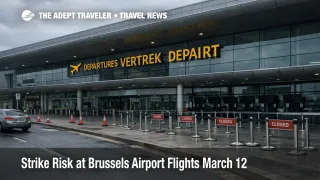
A nationwide strike notice in Belgium is driving a high risk day for Brussels Airport departures on Thursday, March 12, 2026, with aviation reporting citing airport warnings that a normal departure program may be impossible if security screening, baggage handling, and other critical services participate. The practical outcome for travelers is that many airlines are likely to cancel outbound flights in advance, then consolidate remaining operations around whatever staffing and aircraft positioning is still workable. You can treat this as a day where showing up and hoping is the wrong strategy, because when an airport cannot process departing passengers at scale, the schedule typically collapses into mass cancellations rather than manageable delays.
Airlines are already signaling that March 12 is a known disruption date by publishing change flexibility for Brussels itineraries. Air Canada, for example, has activated a flexible rebooking policy for Brussels flights tied to the March 12 strike risk, which is an early indicator that carriers expect meaningful operational constraints rather than a minor slowdown.
Who Is Affected
Travelers booked to depart Brussels Airport on March 12, 2026 are the most exposed group, especially anyone on morning departures, tight Schengen connections, or long haul flights that rely on a same day aircraft rotation. When departures are reduced or cancelled, the first order effect is that outbound seats disappear and rebooking queues spike, while the second order effect is that inbound flights are often cut too, because airlines avoid sending aircraft into a station where they may not be able to turn the plane, service bags, or operate the next sector.
Travelers transiting Brussels are also exposed, even if their final destination is not Belgium. If you are connecting via Brussels to another European hub bank, a cancellation in the first leg can strand you at origin, push you into later days, or force reroutes through other hubs where inventory may already be tight. This is where the disruption propagates beyond Belgium, because the reaccommodation demand does not stay local, it spills into Paris, Amsterdam, Frankfurt, London, and other connection nodes as airlines try to rethread passengers onto remaining capacity.
Finally, anyone relying on ground transport inside Belgium on March 12 should plan for reduced reliability. Even if your flight is moved to another day, airport access plans that depend on last mile buses, trams, or a perfectly timed station transfer can fail during strike days. Rail operators and local transit agencies usually post strike specific plans closer to the date, which means the risk window for travelers is not just the flight, it is the entire chain to the terminal and onward from the airport area.
For additional background on how Belgian strike days tend to degrade airport access and local mobility, see Belgium Strike Days Hit Brussels Airport Transfers Feb 10 and Brussels Airport cancels all departures October 14.
What Travelers Should Do
If you are booked to depart Brussels Airport on March 12, 2026, act early while options still exist. Check your airline's travel advisory page, confirm whether a waiver applies to your ticket, and use self service tools to move to March 11 or March 13 where possible, or to reroute via another hub before inventory compresses. If you must travel on March 12, prioritize routings with fewer moving parts, and avoid self made connections that require perfect timing.
Use a clear decision threshold for rebooking versus waiting. If your trip includes a long haul segment, a cruise embarkation, a nonrefundable tour, or any deadline where a one day slip causes cascading losses, treat March 12 as a rebook now situation rather than a monitor situation. If your plans can absorb a one day delay, you can wait a bit longer, but only if you are willing to accept that you may be rerouted indirectly, or pushed to the next day when reaccommodation demand peaks. The risk is not just cancellation, it is being forced into scarcity after everyone else is rebooked first.
Over the next 24 to 72 hours before departure, monitor operational signals rather than headlines. Watch the Brussels Airport departures board for broad cancellations, then cross check your airline's app, and set notifications so you see schedule changes immediately. Also keep an eye on Belgian rail and local operator strike pages, because even if you move your flight, you still need a reliable way to reach the airport area, your hotel, or Brussels Midi if you pivot to high speed rail toward Paris or Amsterdam.
How It Works
Airport shutdown risk on strike days is less about airframes and more about the human systems that allow departures to flow. Security screening, baggage sortation, ramp handling, and passenger processing are capacity chokepoints, and when staffing drops, the airport cannot safely run normal volumes. That produces the first order effects, cancellations, long lines for any remaining services, and knock on delays as airlines triage which flights are even possible.
The second order ripples travel outward through network timing. If an aircraft cannot depart Brussels on time, it is not in position for its next sector, and the crew may time out, which forces schedule changes elsewhere. Airlines then pull capacity from other routes to recover rotations, and that is why a Brussels departure collapse can tighten inventory across multiple European hubs within hours. On the ground, when local transport is degraded, travelers arrive in pulses, taxi demand spikes, and the margin for error on check in cutoffs shrinks, which increases missed flight rates even for flights that technically still operate.
Sources
- Departures, Brussels Airport
- Strikes and union actions, SNCB NMBS
- Strikes and trade union actions, De Lijn
- Brussels Airport poised to halt departures on 12 March amid nationwide strike threat, Aviation24
- Nationwide strike could halt departures at Brussels Airport on 12 March 2026, Travel Tomorrow
- Air Canada activates flexible rebooking policy for Brussels due to strike, Pax Global Media