

Eurostar London Cancellations Hit Routes Feb 20, 2026
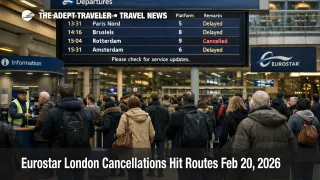
Eurostar is flagging date specific disruption risk for travel to and from London, United Kingdom on Friday, February 20, 2026, and at least one London departure is already tagged for an early termination rather than a full route. Rail Europe's disruption bulletin says Eurostar 9152 from London to Amsterdam is expected to terminate at Brussels, Belgium, rather than continuing onward to Rotterdam, Netherlands, and Amsterdam, Netherlands.
Travelers are affected differently depending on whether they are on a direct London to Paris, France leg, a London to Brussels leg, or one of the longer London to Netherlands services where a partial run can still strand you in the wrong city at the wrong hour. The practical next step is simple but time sensitive, verify your exact train status, then decide whether you are rebooking earlier, shifting to a different day, or switching modes if you must arrive on February 20.
The bigger issue is that this is not an isolated single train problem. Eurostar's own travel updates page lists ongoing operational restrictions across parts of February and March 2026, which is exactly the kind of backdrop that produces late timetable edits and crowded rebooking inventory when a specific day goes sideways.
Who Is Affected
Passengers departing from London St Pancras International are the obvious front line, especially anyone booked late in the day on services that continue beyond Brussels into the Netherlands. If your plan is London to Amsterdam or London to Rotterdam, your risk is not only a cancellation, it is also a forced end at Brussels that turns your trip into a last minute scramble for onward seats on other operators, or an unplanned overnight.
Travelers using Eurostar as a positioning leg for air travel are the second group that tends to get hurt the most. When a rail leg slips by even an hour or two, the downstream flight does not wait, and separate tickets are usually where people lose money. If you are rail to air the same day, treat the rail segment like a volatile input, and do not assume you can "make it up" later in the day once rebooking queues start.
There is also a quiet, predictable third group, travelers with tight hotel check in, event tickets, or onward European rail connections in Paris, Brussels, or Amsterdam. Even when Eurostar can move you part of the way, a termination or cancellation pushes you into peak hour local inventory, which is when the system is least forgiving. If you miss a connection on a protected rail itinerary, Eurostar points customers to established reaccommodation frameworks like Railteam's Hop On The Next Available Train approach for certain high speed connections, but that only helps when your onward journey is actually eligible and integrated.
What Travelers Should Do
If you travel on February 20, start by checking your train status directly with Eurostar and then reconciling it with any third party seller message, because the seller may be the first to highlight a specific train number while Eurostar is still summarizing the disruption category. If your service is cancelled or materially changed, Eurostar's standard guidance is that you can exchange to another train or request a refund through Manage Booking or its disruption workflow.
Next, set a hard decision threshold based on what you can tolerate. If you must be in the Netherlands the same night, or you have a time critical commitment, you should treat an afternoon or evening disruption as a reason to move to the earliest viable train you can secure, even if that means paying a fare difference on a new itinerary outside a protected exchange, or changing cities. If you are flexible by half a day or more, waiting for an official update can be rational, but only if you have a place to sleep and you are not trying to protect a flight, an international connection, or a fixed appointment.
Over the next 24 to 72 hours, watch for two operational signals: additional trains added to the affected list, and knock on delays that change station flows at Brussels Midi or London St Pancras. The reason is straightforward, disruptions do not stay contained to one train, they cascade into security and border processing queues, platform crowding, and a shrinking pool of rebookable seats that disappears fast at peak times. If you need a safer plan than "hope it works," a flight can be the correct call for February 20, especially if you are trying to protect a same day departure from London Heathrow Airport (LHR) or London Gatwick Airport (LGW), because those airports will not care why your rail leg failed.
Background
Eurostar disruption days tend to be misread as a single operator problem, but the mechanics are broader. When operational restrictions or infrastructure constraints force timetable changes, the first order effect is obvious, trains are cancelled, retimed, or terminated early, and passengers are pushed into a smaller number of remaining departures.
The second order ripples are what make this a travel system event rather than a station event. A disruption at London St Pancras pushes rebooking demand into later departures and into alternate routings via Paris or Brussels, which in turn stresses connection reliability and the ability to secure reserved seats on short notice. When trains terminate early, the problem moves from a controlled international rail journey into a patchwork of domestic and cross border segments, where eligibility for assistance, refund handling, and passenger rights can change depending on who issued your ticket and whether the itinerary is protected end to end.
This is also why hotel pressure shows up quickly in London, Paris, and Brussels. A relatively small number of cancellations can still strand a large number of travelers in the evening, when same day alternatives are scarce and station to hotel transport is already peaking. If you have been watching broader rail reliability issues this week, this pattern rhymes with the way rail system disruptions propagate when information systems, schedules, or capacity get constrained, as covered in Germany Deutsche Bahn Booking Outage After DDoS.