

Italy Rail Sabotage Delays on High Speed Routes
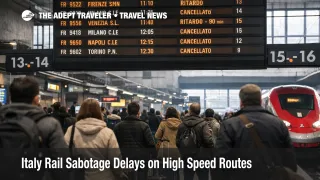
Italy's high speed rail network has taken repeated hits during the Milano Cortina Winter Games period, with authorities opening investigations into suspected sabotage after damage to signalling infrastructure triggered severe disruption and multi hour delays on key north south corridors. Reporting has cited burnt cables and vandalism around lines linked to Rome, including the Rome to Florence and Rome to Naples high speed routes, with delays spilling into the broader national timetable. For travelers, the important change is not the existence of delays, it is the elevated recurrence risk, because deliberate interference can reappear with little warning, and recoveries can be abrupt once repairs are completed.
The most exposed city pairs are the ones that depend on a single high speed trunk to keep a tight day on the rails, Rome to Florence, Florence to Bologna, Bologna to Milan, and the Olympic corridors that ride those same junctions. When signalling is compromised, operators may cancel high speed services outright, reroute onto conventional lines, or hold trains to rebuild safe spacing, and all three outcomes create missed connections into flights, hotels, and timed activities. A normal congestion day tends to degrade predictably, a sabotage day can flip between near normal and heavily constrained within the same travel window.
Who Is Affected
Travelers moving by rail between Rome, Florence, Bologna, and Milan are the core exposure set, because those legs sit on the country's highest volume high speed spine, and that spine also feeds Olympic demand toward Milan area venues and onward alpine transfers. Travelers continuing beyond those hubs are often hit harder than point to point riders, because a two hour delay early in the day can wipe out a later reserved connection, such as a Frecciarossa to a regional feeder, an airport rail link, or a last train to reach a smaller town.
International travelers are also exposed through knock on effects. When high speed rail collapses, some demand shifts to short haul flights, and that can tighten seats, raise walk up fares, and push more people into long airport dwell times. At the same time, roads absorb a surge of one way rentals and private transfers, which can drain availability and push up prices on the exact corridors visitors rely on to reach resorts, ski towns, and satellite cities. The second order layer is hotels and tours, because late arrivals trigger midnight check ins, no show policies, and missed timed entry slots in Rome, Florence, and Milan, which then forces travelers to rebook scarce inventory during an already high demand event period.
If you are a U.S. citizen traveling during the Games window, note that U.S. government messaging has pointed to sabotage incidents on multiple Italian rail lines and has urged added caution around rail travel during the event period.
What Travelers Should Do
Act like recurrence is possible until proven otherwise, because that is the operational reality of intentional damage. If you are traveling February 19, 2026, through February 22, 2026, add buffer at every seam, station to station, station to hotel, and rail to air. If your day depends on a hard cutoff, such as a flight departure, a cruise boarding time, or a nonrefundable timed entry, shift the risk earlier by departing sooner, or by moving the commitment to the next day.
Set decision thresholds that force action before you get trapped in scarcity. If your route requires a same day connection, treat any early advisory that references signalling restrictions, safety checks, or infrastructure damage as a trigger to rebook, not a trigger to wait. Waiting can work on routine delays because the timetable usually degrades gradually, but sabotage driven outages can produce sudden cancellations and forced downgrades to slower trains, which then eats the rest of the day.
Over the next 24 to 72 hours, monitor the sources that actually move the timetable. Start with the rail infrastructure real time updates, then cross check your operator app for train specific replatforming, cancellations, and reroutes, and do not rely on a single station board snapshot. If your plan also depends on city transit in Rome or Milan, you should stack that risk too, especially around late February disruption clustering, and you can use Feb 24 Italy City Transit Strike, Rome and Milan as a reference for how last mile failures can break otherwise workable intercity plans.
Background
High speed rail in Italy runs on tightly timed blocks where signalling, switching, and control room systems regulate train spacing and safe speeds. When signalling infrastructure is damaged, operators either reduce speeds, hold trains to re establish safe separation, or reroute services onto conventional lines that have lower capacity and different stopping patterns. This is why a localized incident near a junction can turn into a national problem, because the high speed network is scheduled like an airline bank, and once a few rotations break, equipment and crews are no longer where the next departures assume they will be.
The first order effects are straightforward, cancellations, late departures, and forced reroutes. The second order ripples propagate across at least two other layers fast. Connection risk rises because station dwell time grows and platforms change, which causes missed reserved onward trains and missed airport links. Capacity shifts happen next as travelers abandon rail for air and road, which stresses seats, cars, and transfers, and then the commercial layer tightens, because hotels near major stations fill with stranded travelers and tour operators face missed timed entry slots that cannot always be recovered same day. During the Olympics period, those ripples matter more because baseline demand is higher and recovery inventory is thinner.
Sources
- Trains in Italy delayed by latest suspected sabotage attack during Olympics (Reuters, February 14, 2026)
- Suspected sabotage hits rail line to Italian Olympic venues, no service disruption (Reuters, February 11, 2026)
- Infomobilità (Rete Ferroviaria Italiana, RFI)
- Sabotaggi a treni dell'Alta Velocità, cosa è successo e il piano sicurezza (Sky TG24)
- Advisory Summary: Italian officials announced railway sabotage incidents, February 14 (U.S. Embassy Italy)