

Feb 24 Italy City Transit Strike, Rome and Milan
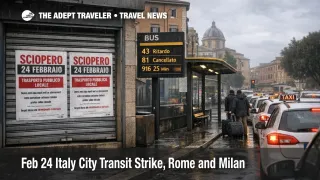
A nationwide 24 hour public transport strike call has been widely discussed for Tuesday, February 24, 2026, and it would mainly hit local buses, trams, and metro systems inside Italian cities rather than shutting down the entire travel network. City travelers are the most exposed, because an urban transit gap can break airport transfers and station connections even when flights and long distance trains are still operating. The practical next step is to treat February 24 as a higher risk local mobility day, then keep checking the official strike calendars and your city operator alerts as the date approaches, because confirmations and the real service plan often firm up late.
The key nuance for travelers is that strike information can be fragmented. As of February 17, 2026, Italy's transport ministry public strike listings do not clearly show a nationwide local public transport action on February 24, which means either the action is not filed in that portal, is categorized differently, or is still evolving. A separate strike calendar source indicates a listing for 24-02-2026 in the relevant transport categories, but that page has been difficult to access consistently, which is another reason travelers should plan for risk rather than rely on a single confirmation point.
Who Is Affected
Travelers staying in Rome, Milan, Naples, Turin, Bologna, Florence, Venice, and other cities where the metro and surface network is the default way to move between hotels, stations, and attractions should assume the biggest impact, because a partial shutdown changes the entire day's pacing. The highest stakes cases are airport and station transfer chains where a local leg is the glue that makes everything else work.
In Rome, travelers connecting through Leonardo da Vinci Fiumicino International Airport (FCO) or using Roma Termini station are exposed if their plan depends on the metro or buses to hit a check in cutoff, a timed museum entry, or a same day onward rail departure. In Milan, the risk concentrates around Milan Malpensa International Airport (MXP), Milan Linate Airport (LIN), Milano Centrale station, and any itinerary that assumes the metro will be available at predictable headways for cross city moves.
The first order disruption starts on the platforms and streets, fewer vehicles in service, uneven headways, and the possibility of sudden suspensions when staffing drops below thresholds. The second order ripples show up fast in at least two other layers. Road congestion builds as riders shift to cars and taxis, which slows private transfers and airport taxis, and the delay load then propagates into long distance travel because late arrivals at stations and airports create missed departures and rebooking surges.
This city transit risk also stacks with Italy's late February disruption cluster, including the shifted aviation strike window on February 26, 2026, and the national rail strike window spanning late February 27 into February 28, which can turn one missed transfer into a multi day itinerary rewrite if you are moving across multiple cities. For that broader context, see Italy Airport Strike Feb 26, Flights Disruption Risk and Italy Rail Strike to Hit Trains Feb 27 to 28.
What Travelers Should Do
If you have an airport transfer, treat February 24, 2026, as a day when local transit might not be dependable even if your flight or intercity train is on time. Build buffers that assume you may need to switch to a taxi, NCC, or a longer walk, and avoid scheduling a timed entry or tour start immediately after an arrival. If you are landing in Rome or Milan, decide in advance which paid backup you will take if the metro is suspended, because choosing on the curb is where time and money disappear.
Set decision thresholds for when to rebook versus when to wait. If you have a nonrefundable timed commitment, such as a museum entry window, a wedding, a cruise check in, or the last viable train of the night, you should replan the local transfer layer early, even if the strike still reads as "possible," because the backup capacity is what sells out first. If your day is flexible, you are staying centrally, and you can absorb late arrivals without financial penalties, it can be reasonable to wait for the operator's final service bulletin, but only if you still have a working alternative that does not depend on metro reliability.
Over the next 24 to 72 hours before travel, monitor the sources that actually change outcomes. Start with the official strike portals for confirmation and legal framing, then check the city operator channels for the minimum service windows and any line by line notices, because those are what determine whether a specific transfer is feasible. Also watch road conditions in real time on the morning of travel, because even with partial service running, congestion can be the real trip killer when demand shifts to cars and taxis.
Background
Italy's local public transport is an essential service, so strikes typically operate under rules that preserve minimum service bands, and those protected windows are implemented city by city. In practice, that means you often see service that is more reliable early morning and late afternoon, then much less reliable in the middle of the day and late evening, with the exact hours set by the local operator and local agreements. For example, during a prior national USB 24 hour transit action, Rome's mobility authority communicated service that was regular until 830 a.m. and again from 500 p.m. to 800 p.m., while widely cited Milan guidance for similar actions has used an early window up to about 845 a.m. and an afternoon window roughly 300 p.m. to 600 p.m. Those examples are not a guarantee for February 24, 2026, but they illustrate the structure travelers should plan around, which is why the safest approach is to design a travel day that still works if the only dependable service is inside the protected bands.
From a travel systems perspective, the disruption propagates in a predictable way. First order effects hit vehicle availability, station staffing, and control room capacity, which reduces frequency and increases the probability of partial line closures. Second order effects then spread into road transfers as demand spikes for taxis and private cars, which slows airport approaches and station drop offs. The third layer is commercial, because missed timed entries, missed check ins, and missed departures create rebooking fees and inventory compression, especially in high demand periods where alternate seats and rooms are already constrained.
Sources
- Scioperi, February 2026 Disruptions Overview (Sky TG24)
- Italy Transport Ministry Strike Listings Portal (MIT)
- Filtered Strike Calendar Showing 24-02-2026 Listing (Commissione di Garanzia)
- Rome Mobility Notice for a Prior National Transit Strike Window (Roma Mobilità)
- Febbraio 2026, Sciopero Trasporti Dates And Context (LA7)