

Palm Beach Airport Rename to Trump Name, July 2026
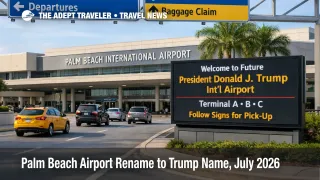
Florida lawmakers advanced a plan to rename Palm Beach International Airport as "President Donald J. Trump International Airport," a change that would primarily affect branding, signage, and how the airport is referenced in traveler communications. The Florida Senate passed the bill 25 to 11 after the Florida House passed it 81 to 30, and the measure now goes to Governor Ron DeSantis for signature or veto. For travelers, the practical issue is not the politics, it is the transition period where wayfinding, ground transportation instructions, and third party booking tools can briefly fall out of sync while operators update names across systems.
The bill analysis and bill text frame the rename as taking effect July 1, 2026, and they also tie implementation to Federal Aviation Administration approval and the execution of required agreements. That means travelers should think of this as a conditional rebrand with a defined target date, not an immediate overnight switch.
Who Is Affected
Anyone flying into or out of Palm Beach International Airport is affected first, because the visible changes are exactly where travelers make mistakes: curbside signs, terminal directions, app labels, shuttle instructions, and hotel or cruise transfer paperwork. If you are arriving for an event weekend, connecting from a nearby airport, or coordinating pickups with family, the mismatch risk is higher because people often communicate the airport name verbally while ground operators rely on precise pickup zones.
Travel advisors and corporate travel desks are the next group, because they live in templates. A rename forces updates across confirmation emails, traveler instructions, travel policy documents, and supplier profiles. The immediate friction shows up as confused passengers and extra calls, even if flights operate normally.
There is also a second layer that is not really about flying, it is about commercial rights and incentives. Reporting says a Trump Organization affiliate, DTTM Operations, filed trademark applications for variations of the airport name, which critics argue creates a profit incentive or, at minimum, the appearance of one. Even if no money changes hands, the optics can trigger litigation threats, licensing debates, and implementation delays, and those are the kinds of bureaucratic fights that slow down simple operational changes.
What Travelers Should Do
Treat this like a label change with a messy rollout, not a functional airport change. When you book, save your itinerary details with the airline flight number, the airport identifier shown on the ticket, and the terminal and curbside pickup instructions, and do not rely on the airport name alone in texts to drivers, hotels, or family.
Use a decision threshold for action versus waiting. If you are traveling near the proposed effective date of July 1, 2026, or during the first few weeks after, confirm ground transfers in writing, and ask operators to reference terminal, airline, and pickup zone. If your plans are not time sensitive, there is no reason to rebook anything just because of a rename, because it does not change runways, terminals, security, or airline schedules.
Over the next 24 to 72 hours, watch for two updates that matter operationally. First, whether Governor DeSantis signs the bill, because that is the real go, no go gate. Second, whether any implementing agency language clarifies how the FAA facing step works in practice, because that will tell you how quickly airlines, map providers, and travel apps can synchronize. If you want a related example of how policy changes, not weather, can still create real friction for travelers, see ESTA Social Media Data US, Senators Push Back.
Background
Airport naming looks superficial, but it propagates through the travel system because travelers navigate through layers of intermediaries. First order effects land at the source: the airport authority and its contractors must replace physical signs, update websites, refresh forms, and push new naming into vendor systems that power parking, shuttles, and customer service. Second order effects hit airline communications and distribution, because many travelers learn an airport name from booking tools, confirmation emails, and calendar invites, and those tools do not all update at the same time. Third order effects show up in ground logistics, where a driver, a hotel shuttle, or a tour operator may have an old name cached, and that can cause missed curbside pickups or long, avoidable calls while the traveler is standing outside in the wrong zone.
The political dispute is also part of the mechanism, because it changes the risk of delay. Reuters reported Democratic objections focused on lack of local input, and related coverage has pointed to cost estimates, as well as concern that trademark filings could be used to monetize the change. The Florida Senate's published analysis describes the measure as a state preemption of naming for major airports, and includes the Trump rename while retaining other airport names in statute. That combination, state naming power plus trademark pressure, is exactly where implementation can bog down in negotiations and amendments, including proposed language that would have barred payments tied to the name.
If you want a deeper explainer on the FAA layer that sits behind a lot of airport traveler pain, staffing, modernization, and operational constraints, see U.S. Air Traffic Control Privatization: Reality Check.
Sources
- Florida lawmakers vote to rename Palm Beach airport after Trump (Reuters)
- CS for CS for HB 919 Committee Analysis (Florida Senate PDF)
- HB 919 Introduced Bill Text (LegiScan PDF)
- Trump Wants His Name Trademarked For Airports (Forbes)
- Trump business files for trademark rights on any airports using president's name (Los Angeles Times)
- Bill to rename a Florida airport after President Trump heads to Gov. DeSantis (WUSF)