

ESTA Social Media Data US, Senators Push Back
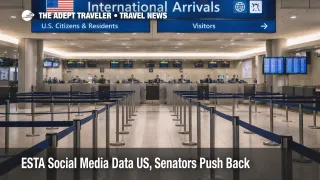
The U.S. Customs and Border Protection proposal would make ESTA social media data mandatory, requiring Visa Waiver Program travelers to disclose social media identifiers used in the prior five years. That change matters because ESTA is a gating control that can stop a trip before boarding, and adding mandatory fields increases both completion time and denial uncertainty for travelers who apply close to departure. The practical next step is to treat ESTA as a lead time item, keep entries consistent across accounts and documents, and avoid building an itinerary that collapses if authorization is delayed.
The proposal sits inside a Paperwork Reduction Act process, and CBP's notice set a public comment deadline of February 9, 2026. The notice also describes a broader expansion of data elements CBP says it may add when feasible, including more phone and email history, more family member details, and other data points tied to identity and screening. In parallel, two U.S. senators have now publicly urged CBP to drop the social media requirement, turning what was mostly a technical paperwork notice into a visible political fight that travelers should track.
Who Is Affected
This primarily affects citizens of Visa Waiver Program countries who use ESTA for short visits for business or tourism, including travelers who are only transiting through a U.S. airport on a single itinerary. The second group is families and groups, because one incomplete or delayed authorization can break shared flights, hotels, tours, and ground transfers, and it tends to surface at the worst moment, the airport counter, when options are scarce.
The policy also has a second layer of impact that looks like pure airline operations, even though it starts as paperwork. When more travelers are in pending status closer to departure, carriers see more document check exceptions, more call center volume, and more day of travel escalations. That creates a knock on effect into misconnects, rebooking queues, and unplanned hotel nights near gateway airports, especially during peak periods when seat inventory is tight.
It is also important to separate ESTA from visas, because the disclosure baseline is already different depending on which path a traveler uses. Since 2019, the U.S. Department of State has requested social media identifiers from most immigrant and nonimmigrant visa applicants via updated application forms. The new fight is about pushing a similar disclosure expectation into the Visa Waiver pipeline, which has historically sold itself as lower friction for trusted partner countries.
What Travelers Should Do
If you need to apply for ESTA soon, do it earlier than you normally would, and do not treat it as a day before departure task. The failure mode here is boring, not dramatic, missing a handle you used years ago, entering it inconsistently, or triggering a review that eats the buffer you thought you had. Build slack into your plan, and keep your first U.S. touchpoint, even a connection, treated like a hard eligibility checkpoint.
Use a clear decision threshold for rebooking versus waiting. If you are inside 72 hours of departure without an approved authorization, or if your itinerary contains nonrefundable components that cannot survive a one day slip, switch to a flexible fare, a refundable hotel, or a routing that preserves same day recovery. If you are more than a week out, the better move is to lock down the paperwork first, then lock down the trip, because that reverses the usual leisure traveler behavior that creates the airport day crisis.
Over the next 24 to 72 hours, monitor two things, the policy track and the operational track. The policy track is whether DHS or CBP signals a retreat, a narrower scope, or a new implementation timeline after the February 9, 2026 comment window. The operational track is whether airlines and travel document check tools start messaging new fields or longer completion flows, because that is often the first place travelers see reality before an official consumer facing announcement lands. For context on how this evolved from proposal to public fight, see Social Media Handles in U.S. ESTA Proposal. For broader U.S. entry friction that can still trigger denied boarding even when travelers think they are fine, see Canada Advisory: US Entry Limits, 30 Day Rule.
Background
ESTA is not a border booth problem first, it is an airline boarding control problem first. Carriers have to validate eligibility before transport, and their systems are designed to be conservative, which means an unclear case becomes a refused boarding pass more often than it becomes a discretionary discussion at arrival. That is why adding mandatory fields, even if the screening logic is unchanged, still increases denied boarding risk, because more fields create more mismatch opportunities, and mismatches tend to surface at check in.
The senators' pushback focuses on privacy, speech, and effectiveness, arguing that mandatory social media collection is a broad surveillance move that can suppress lawful expression and deter visitors. Their letter targets CBP directly and calls for reversing course, and it frames the Visa Waiver Program as a security partnership that also produces substantial economic benefit that should not be undermined by friction that is not clearly justified. The administration's posture, as described in public reporting and in the underlying notice, is that these data elements support heightened vetting goals, and that the mechanism is expanding what the ESTA form collects, not changing the basic concept of pre travel authorization.
The travel system ripple is straightforward. First order, more data fields and more sensitive questions push travelers to apply earlier, create more abandonment, and raise the share of applications that need correction or follow up. Second order, airlines see more edge cases at check in, rebooking pressure rises when approvals arrive late, and hotels near gateway airports see more stranded demand when missed departures cluster. Third order, if enough travelers decide the U.S. is not worth the hassle, carriers and tour operators adjust capacity and marketing toward easier entry markets, and that changes fares and inventory availability in ways travelers feel months later, not the same week.
Sources
- Agency Information Collection Activities; Revision; Arrival and Departure Record (Form I 94) and Electronic System for Travel Authorization (ESTA) (Federal Register)
- ESTA Social Media Screening Letter (Markey and Wyden PDF)
- Markey, Wyden Urge Trump's CBP to Reverse Course on Proposed Rule (Sen. Markey)
- Senators urge Trump to scrap social media vetting for foreign tourists (Reuters)
- Collection of Social Media Identifiers from U.S. Visa Applicants (U.S. Department of State)