

UK ETA Enforcement Tightens Boarding Checks Feb 25
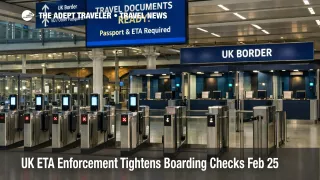
UK bound travelers should treat carrier document screening as the real enforcement point from late February, not the border desk. Full Electronic Travel Authorisation, ETA, enforcement is expected to harden on February 25, 2026, and airlines, ferries, and international rail operators are warning passengers that they may be refused boarding if they cannot prove they have the right permission to travel. That shifts the practical risk from a secondary border conversation to a hard stop at check in, where staff have limited time, and strong incentives, to say no.
The UK ETA boarding checks change is that carriers are expected to verify travel permission before departure, and to block passengers who do not have it. For many travelers, that means an ETA approval linked to the passport used to travel. For a smaller, high risk group, it means understanding that British citizens do not use an ETA, and some dual British nationals cannot fix the problem by applying for an ETA on a non British passport.
Who Is Affected
Most affected are visa exempt visitors who previously could show up with just a passport and a ticket. Under the ETA model, travelers who need an ETA must have it approved before travel, and it is linked to the specific passport they applied with. If you change passports, renew, or use a different document than the one tied to the ETA, a carrier check can fail even when you are otherwise eligible to visit.
Families get caught here because every traveler needs their own permission. Children and infants who require an ETA need their own approval, tied to their own passport. If you are traveling as a group, one person missing an ETA becomes the bottleneck that turns a simple departure into a rebooking scramble.
The second group is dual citizens, specifically British dual nationals. The UK's guidance has been explicit that British and Irish citizens do not receive an ETA. From February 25, 2026, some British dual nationals risk being denied boarding if they present only their non British passport without a way for the carrier to verify British status, typically a valid British passport or a certificate of entitlement to the right of abode. The point is mechanical, not philosophical, carriers are being pushed into a yes or no decision at departure, and they will default to whatever avoids liability.
There are also edge cases that can break in boring ways. Name mismatches between a booking and a passport, especially after marriage or when different countries handle surnames differently, can trigger manual checks. So can last minute passport renewals, damaged documents, or using a different passport for travel than the one used to apply for an ETA. If you are transiting through the UK, or positioning into London for a cruise, rail trip, or onward flight, the downstream cost of a denied boarding event is usually larger than the cost of fixing documentation early.
If your UK travel plan involves the Channel Tunnel or London rail terminals, the same reality applies. Eurostar has been flagging February 25, 2026 as a date when travelers who need an ETA cannot travel to the UK without one, and it is framing this as a boarding requirement, not a nice to have warning. If you are already dealing with tight rail inventory around London, disruptions like Eurostar London Cancellations Hit Routes Feb 20, 2026 show how quickly options vanish when plans slip even a few hours.
What Travelers Should Do
Start with a ruthless pre travel audit. Confirm which passport you will actually present at boarding, then confirm whether you need an ETA for that passport, and whether the ETA is approved and linked to the same document. If you are not sure, do not gamble on airport staff solving it. The practical standard from February 25, 2026 is simple, if the system cannot verify permission quickly, you do not board.
Use clear decision thresholds. If you are inside 72 hours of departure and your ETA is still pending, your risk is no longer theoretical, because carriers are explicitly telling travelers to apply well in advance. If you cannot move the trip, shift your routing or timing to reduce the cost of a failed departure, meaning fewer same day connections, refundable lodging, and a buffer night near your point of departure or arrival. If you are a dual British national and you do not have a valid British passport, treat that as an urgent document problem, not an admin task, because an ETA on your other passport may not be accepted as a workaround.
Over the next 24 to 72 hours, monitor only the sources that control outcomes. Watch your carrier's document requirements page, your ETA status, and any official UK guidance updates aimed at dual citizens. If you have any mismatch, name, passport number, passport renewal in progress, or uncertain citizenship documentation, fix it now, not at the counter. For broader planning context on UK visitor documentation, including how the ETA fits into short stay entry, refer to UK Entry Requirements For Tourists In 2026.
How It Works
The UK's ETA is a pre travel permission model similar in shape to other countries' electronic authorisation systems. The key operational detail is that enforcement happens where it is cheapest for the state and most disruptive for the traveler, at boarding. Carriers are already the choke point because they control the seat, the manifest, and the boarding pass, and governments can impose penalties when carriers transport someone who lacks the required permission. That incentive structure makes check in agents the de facto first line of immigration enforcement.
This is why the first order effect is denied boarding and longer check in queues when documents do not match. Staff need to resolve edge cases in real time, with imperfect tools, and the safest call for the carrier is often to refuse boarding when the record is unclear. The second order effects propagate fast. A denied boarding event breaks tight onward connections, it forces new ticket purchases at walk up prices, and it pushes stranded passengers into hotel markets around London gateways and Channel terminals. That then feeds back into the system as crowding at rebooking desks, call center load, and operational delays for trains, flights, and ferries when passenger processing slows.
For dual British nationals, the failure mode is more specific. If you are British, you are not a visitor, so the ETA path is not designed to solve your status. That creates a hard gap for travelers who relied on a non British passport in the past, especially those who never held a British passport, whose passport is expired, or who have complex name histories. The certificate of entitlement exists to prove right of abode, but it is slower and more expensive than most travelers expect, and it is not something a carrier can improvise at check in.
Sources
- Important changes to UK entry requirements as of February 25, 2026 (U.S. Embassy in the United Kingdom)
- Electronic travel authorisation (ETA): guide for dual citizens (GOV.UK)
- Electronic Travel Authorisation (ETA) factsheet (UK Home Office Media Blog)
- Apply for a certificate of entitlement (GOV.UK)
- Travel documents for Eurostar journeys (Eurostar)
- Dual nationals could use expired UK passports to prove they are British, Home Office says (The Guardian)