

Italy Aviation Strike Hits Flights February 26, 2026
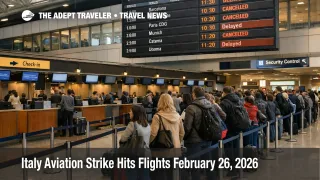
A nationwide aviation strike is set for Italy on Thursday, February 26, 2026, and it is now specific enough that travelers should treat it as an avoidable risk day rather than a vague labor headline. The strike calendar published by Italy's transport ministry lists a 24 hour action affecting aviation, airport, and airport linked services, alongside separate work stoppages involving airline staff at ITA Airways and easyJet, plus additional four hour actions for segments of easyJet, ITA, and Vueling personnel. Travelers holding domestic Italy flights and short haul Europe hops face the highest exposure because these rotations depend on fast airport turns and thin spare capacity.
The planning nuance that gets missed is the difference between "some flights operate" and "the system is healthy." ENAC notes two protected time windows, 700 a.m. to 1000 a.m. and 600 p.m. to 900 p.m. local time, when flights must still be operated. That helps, but it does not restore normal staffing at check in, baggage, gate handling, and ramp operations, so even protected window flights can inherit long lines and last minute retimes. For background on how this strike date landed and why late February sequencing matters, see Italy Aviation Strike To Hit Flights Feb 26, 2026.
The second marker is early March. Public strike reporting and ministry level discussions have also referenced additional aviation action around Friday, March 7, 2026, which matters because it overlaps the front edge of Milano Cortina 2026 Paralympics travel demand and staffing strain. If February 26 breaks aircraft and crew positioning, and March 7 adds another stressor, the result is a longer period of elevated disruption probability rather than a single bad day.
Who Is Affected
Travelers flying into, out of, or transiting Italy on February 26 are the obvious group, but the more fragile cohort is anyone trying to stitch together separate tickets or same day connections through Italy's hubs. Leonardo da Vinci Fiumicino International Airport (FCO), Milan Malpensa Airport (MXP), Milan Linate Airport (LIN), and Venice Marco Polo Airport (VCE) are where the operational stack is tightest, because they concentrate handling resources and they absorb misconnected passengers from all directions when the schedule starts collapsing.
Domestic and near Europe flights are often the first to be trimmed because they can be consolidated, reaccommodated, or pushed onto later services more easily than long haul. That creates a trap for travelers who planned a domestic feeder into a long haul departure, or who booked the last flight of the day into a cruise embarkation, a tour meet point, or a prepaid hotel with no show penalties. A strike day is rarely a clean cancellation and refund story, it is a cascade story, where one broken sector destroys the timing of everything downstream.
There is also a second order impact window that hits travelers who are not flying on February 26 at all. When flights cancel, airlines reposition aircraft and crews, and they run into duty time limits, gate constraints, and maintenance sequencing. That is why February 27 and February 28 can stay messy even after the formal strike period ends, especially on routes that depend on aircraft coming in from elsewhere in Italy earlier the same day.
What Travelers Should Do
Act now, not at the airport. If the trip is important, move it off Thursday, February 26, 2026, even if that costs a modest fare difference, because the expensive failures are missed onward connections, forced hotel nights, and buying replacement tickets when inventory is thin. If you must fly that day, choose flights inside the ENAC protected windows, then add buffer anyway, because protected windows do not guarantee a normal airport processing tempo.
Set a rebooking threshold before you are standing in a line. If you are on separate tickets, or if your first leg is delayed enough that you would land with under two hours to make a short haul connection, or under three hours to make a long haul connection, treat that as a reroute trigger, not a wait and hope moment. The earlier you switch, the more routing options exist, and the fewer people you are competing with for the same limited seats.
Monitor the next 24 to 72 hours like an operator. Watch for airline schedule changes, strike confirmations or modifications, and airport advisories that often land the evening before. For early March trips, do not assume the system "recovers" after February 26. With March 7 referenced as an additional action point, and with Paralympics travel beginning March 6, 2026, the smart posture is to keep itineraries flexible, avoid last flight of day segments, and pre plan an alternate hub routing if your itinerary depends on tight Italy connections.
Background
Italy strike disruption propagates through the travel system in layers, and the first layer is not always the flight itself. When airport and airline work groups stop work, the immediate choke points are check in, baggage acceptance, baggage delivery, gate handling, and ramp sequencing. Even if a flight operates, the airport can behave like it is under capacity restriction, which turns ordinary steps into long queues and missed connection chains.
The second layer is network recovery. Airlines rely on aircraft and crews being in the right place at the right time, and a one day disruption can strand both. That creates knock on cancellations the next day, because crews time out, aircraft miss maintenance windows, and inbound aircraft that were supposed to operate your flight never arrive. This is why late February trips should be planned with a two day blast radius in mind, and why travelers should treat February 27 and February 28 as part of the risk window if the itinerary relies on Italian domestic repositioning.
The third layer is spillover into hotels, ground transfers, and event travel demand. When passengers get stuck overnight in Rome, Italy or Milan, Italy, hotel inventory tightens, airport rail and taxi demand spikes, and rebooking counters get saturated. Add a major event cadence in early March, with Milano Cortina 2026 Paralympics opening on March 6, 2026, and you have a realistic scenario where both transportation capacity and lodging capacity are constrained at the same time. That is the scenario where "I will figure it out on arrival" becomes the wrong strategy.