

Italy Aviation Strike To Hit Flights Feb 26, 2026
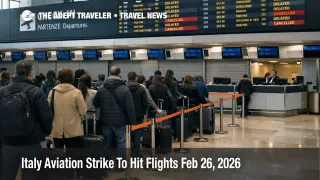
Italy is heading into a late February disruption cluster after a postponed nationwide aviation action was moved onto Thursday, February 26, 2026, pushing the risk into a normal workday travel bank instead of staying confined to the Olympics window. Travelers moving through Italy, or connecting onward to Europe, North Africa, and long haul routes, should plan for cancellations, retimes, and slower airport processing that can linger after the walkout ends. The practical move is to protect your itinerary now by shifting critical flights off February 26 when you can, padding every same day connection, and treating ground transport as a constrained backup, not a guaranteed escape hatch.
The change that matters for planning is that the aviation disruption is no longer a maybe, it is now on calendars travelers actually use, and it sits next to a separate national rail risk window that starts Friday night, February 27, and runs through Saturday, February 28. That pairing increases the odds that one failure forces you into a second stressed system.
Who Is Affected
Travelers flying into, out of, or connecting within Italy on February 26 carry the highest exposure, especially on domestic trunk routes where same day rebooking inventory is thin and where one canceled morning sector can break an entire itinerary. The big hubs, Leonardo da Vinci Fiumicino International Airport (FCO), Milan Malpensa Airport (MXP), Milan Linate Airport (LIN), and Venice Marco Polo Airport (VCE), are the places where delays compound fastest because they concentrate handling, gate turns, and onward connections.
The second group is travelers who intend to "solve" a flight problem by switching to rail on Friday or Saturday. Italy's transport strike calendar shows a national rail action beginning at 900 p.m. on Friday, February 27, 2026, and ending at 859 p.m. on Saturday, February 28, 2026, which is exactly the window many travelers would try to use to reposition after a Thursday aviation mess.
A third group is anyone with hard cutoffs, cruise departures, event tickets, prepaid tours, or lodging with strict no show policies. Strikes are not only about the canceled segment, they are about the knock on timing failures that make the rest of your day impossible to execute.
What Travelers Should Do
First, decide if you are protecting an essential trip or a discretionary one. If you have a must attend commitment, shift the primary risk off Thursday, February 26, 2026, even if it costs you a small fare difference, because the expensive failures are missed connections, forced overnights, and buying last minute replacement tickets. If you must travel that day, prioritize departures inside the protected windows that Italy's civil aviation authority highlights during strikes, then add buffer anyway because airlines can still consolidate flights and retime schedules around staffing limits.
Second, set decision thresholds before you are standing in a line. If your airline has not issued a waiver, or if you are on separate tickets with a tight connection, act earlier than you think you need to. A good rule is that if your first leg is delayed enough that you would land with less than two hours before a short haul connection, or less than three hours before a long haul connection, you should pursue a voluntary reroute immediately. Waiting is how you get trapped when the rebooking queue turns into a capacity problem.
Third, monitor the next 24 to 72 hours like an operator, not like a hopeful passenger. Watch your airline's app for flight specific retimes, gate changes, and reaccommodation messages, and cross check the official strike listings so you understand whether you are dealing with a narrow workgroup stoppage or a broader system slowdown. For rail, check guaranteed service guidance before you commit to a fallback ticket, because "there will be some trains" is not the same as "there will be a train that matches your connection."
Background
Strike disruption in Italy usually propagates in layers. The first order effects hit at the source, reduced staffing for airport handling, slower check in and baggage flows, and fewer available aircraft and crews to run the published schedule. Even if your flight operates, the airport can run like it is under capacity restriction, which means longer time to clear basic steps and more missed connection chains.
The second order effects show up when travelers mode shift. A canceled domestic flight pushes people to high speed rail, and a delayed long haul arrival pushes people into late evening airport rail links, taxis, and hotel check ins. When the rail network is itself under stress, whether from labor action or infrastructure incidents, the system loses the pressure valve travelers normally rely on. If you want an example of how quickly Italy rail disruption can flip from localized to national, see Italy Rail Sabotage Delays on High Speed Routes, because the planning logic is the same, protect the seams where one delay erases your last workable option.
On passenger rights, the core structure is consistent even when compensation eligibility can vary by cause. In the EU, when a flight is canceled or heavily delayed, you generally have rights around rerouting or reimbursement, and you also have care obligations that the airline must meet in many disruption scenarios. The mistake travelers make is assuming they must accept the airline's first offer, or that a refund ends the story even when the replacement ticket price spikes. Use the rights framework to push for the outcome you need, a workable reroute on comparable conditions, or reimbursement if travel no longer makes sense.
Sources
- Scioperi (Ministero delle infrastrutture e dei trasporti)
- Voli garantiti in caso di sciopero (ENAC)
- Sciopero del trasporto aereo, deciso il rinvio al 26 febbraio (Sky TG24)
- In case of strike (Trenitalia)
- Air passenger rights (Your Europe, European Union)
- Trains in Italy delayed by latest suspected sabotage attack during Olympics (Reuters)