

PIT Universal Design Certification Improves Terminal Access
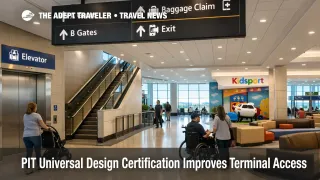
Pittsburgh International Airport (PIT) has been awarded Universal Design Certification by the University at Buffalo's Center for Inclusive Design and Environmental Access, known as the IDEA Center, and the airport says it is the first airport to receive that designation. For travelers, this is not a vanity badge, it is a signal that the new terminal's layout, information cues, and support spaces were evaluated against an inclusion framework meant to work for more people by default. The practical outcome is a terminal that should be easier to navigate independently, especially when you are moving fast, managing kids, traveling with mobility aids, or dealing with sensory overload.
The PIT universal design certification matters because it formalizes what many travelers can only judge anecdotally, whether an airport is built to reduce friction, or to push passengers through a maze and hope staff fills the gaps. PIT's recognition puts that traveler experience into a measurable standard, and it also gives other airports a benchmark that can be copied, and audited.
Who Is Affected
The most direct beneficiaries are travelers who routinely face hidden costs in airports, families with strollers and young kids, older travelers, pregnant travelers, travelers with temporary injuries, wheelchair users, and travelers with non visible disabilities who need calmer, clearer, and more predictable spaces. When wayfinding is intuitive and information is perceptible, you spend less time scanning for clues, and more time moving with confidence, which is the difference between arriving at a gate composed or arriving already depleted.
Airlines and airport operations teams benefit too, even though the certification is framed as a passenger experience story. Universal design reduces the number of micro failures that create macro delays, like passengers bunching at choke points because signage is unclear, missed turns that cause late arrivals at gates, and inconsistent lighting or acoustics that makes public address announcements less effective. The first order effect is smoother passenger flow inside the terminal. The second order ripple is fewer customer service interventions, less gate area congestion during irregular operations, and less pressure on staff to provide ad hoc assistance when the built environment should have done that work.
There is also a broader industry audience. Airports are in a multi year rebuild cycle, and the places that can prove inclusive design outcomes will pressure peers to match them. Dubai's long horizon accessibility roadmap shows the same direction of travel at mega hub scale, but PIT is making the case that standards driven design can be applied in a U.S. terminal build too, see Dubai Airports accessibility strategy: 2035 push. And because the Hidden Disabilities Sunflower program is spreading across airports and airlines, standard cues matter more when you connect between systems, see Lufthansa Hidden Disabilities Sunflower Support Onboard.
What Travelers Should Do
Start by deciding which supports you might actually use, before you arrive. If you or someone you are traveling with has a non visible disability, PIT's Sunflower identifiers are available free at information desks, and the program is meant to signal that you may need extra patience or help, not expedited screening. If you need physical assistance such as wheelchair service, request that through your airline in advance, because airports and carriers treat that as a service workflow, not a walk up convenience.
Use a clear threshold for how much uncertainty you can tolerate on the day of travel. If your trip depends on a tight schedule, for example a last flight of the day, a time sensitive meeting, or traveling with a child who melts down under long waits, treat that as the trigger to arrive earlier than you normally would and to pre locate the spaces that lower stress, including the sensory room, nursing rooms, and family areas. If you can travel with flexibility, you can rely more on the terminal's built in clarity, but if you cannot, your best move is to buy back control with extra buffer and pre planned support.
Over the next 24 to 72 hours, monitor PIT's accessibility and terminal information pages for any updates to where services are located, and how to access them, especially if you have not flown the new terminal yet. PIT has also tied this certification to its redesigned Kids Play Area, which is useful intelligence for family travelers deciding where to spend layover time, and for caregivers trying to keep kids regulated before boarding. For broader context on planning trips around disability and access variables, see Accessible Travel.
Background
Universal design is a framework that aims to make spaces usable by the widest possible range of people without requiring special adaptation. The IDEA Center's certification evaluates environments using seven principles, including equitable use, flexibility, intuitive operation, and perceptible information, then scores how well a space performs against those ideas. In PIT's case, coverage around the certification points to particularly strong performance in wayfinding, lighting, sensory inclusion, and mobility access, which are the variables that most often determine whether an airport feels navigable or hostile.
This is also a systems story about where accessibility breaks in real travel. Even when airlines provide assistance, the airport environment can undermine it, signage that is hard to parse under time pressure, long walks with limited rest options, bright, noisy gate areas that overwhelm sensory sensitive travelers, and inconsistent cues that force people to ask for help repeatedly. Universal design, when done competently, shifts the load from people and staff to the environment itself. That means fewer "special cases," fewer points where independence collapses into dependence, and fewer moments where stress escalates into missed flights, conflict at checkpoints, or unsafe rushing across terminals.
PIT's decision to pair certification with programs like the Hidden Disabilities Sunflower and facilities like nursing rooms and a sensory room is the right pattern, because accessibility is not one feature. It is a chain, and the chain fails at the weakest link. A terminal can be physically accessible, but still functionally inaccessible if information is confusing, lighting is harsh, or quiet decompression space does not exist. The certification is a claim that PIT measured those links, improved them, and then invited outside evaluation to validate the result.
Sources
- PIT First Airport To Be Awarded Universal Design Certificate From IDEA Center, PIT Transformed
- PIT First Airport To Be Awarded Universal Design Certificate From IDEA Center, Blue Sky News
- How UB's IDEA Center Helped Pittsburgh Build an Airport for Everyone, University at Buffalo
- Sunflower Program, Fly Pittsburgh
- Pittsburgh International Airport opens new Kids Play Area, Fly Pittsburgh
- Pittsburgh Airport Becomes First to Achieve Universal Design Certification, TravelPulse