

France 2025 Tourism Record Hits 102M Visitors
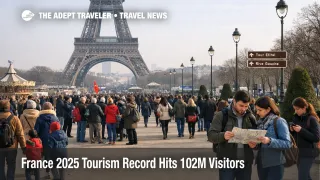
France again led the world by international arrivals after officials reported a new national record for 2025 visitor volume. The change matters most for travelers planning spring and summer 2026 trips into the country's busiest gateways, because higher baseline demand usually compresses hotel availability, raises the odds of sell out dates, and reduces the number of "cheap mistake friendly" options for late planners. The practical move is to treat popular city stays as capacity constrained, book earlier with flexible cancellation, and build itineraries that can shift between neighborhoods or nearby day trip bases if prices jump.
France's economy and tourism officials said the country welcomed 102 million international visitors in 2025, up from 100 million in 2024. They also reported 743 million overnight stays across merchant and non merchant lodging, with 76 percent of foreign visitors coming from elsewhere in Europe, and a 7.5 percent rise in hotel and other commercial accommodation nights versus 2024. International tourism revenue reached a record €77.5 billion (EUR), about $91.5 billion (USD), and officials reiterated a goal of reaching €100.0 billion (EUR), about $118.0 billion (USD), in annual tourism revenue by 2030.
Who Is Affected
Travelers are not "affected" in the disruption sense, but they are affected in the capacity sense. When a destination sustains record demand, the first order effect is straightforward, more arrivals competing for the same finite inventory of rooms, timed entry tickets, tables, and high speed rail seats, especially on Friday and Sunday shoulder days. That is why the most price sensitive travelers, families tied to school calendars, and anyone trying to plan Paris on short notice usually feel the squeeze first.
The second order ripple shows up across the rest of the travel system. Airlines and airports can handle large annual totals, but peaks are what break plans, because concentrated demand amplifies line times, taxi and rideshare congestion, and irregular operations recovery when weather or strikes hit. At the same time, higher occupancy in core cities pushes travelers into secondary bases, which shifts pressure onto regional rail, car rentals, and smaller hotel markets that have less slack. Tour operators and museums also respond to demand concentration by tightening timed entry and group allocation, which can turn a "we will decide when we arrive" trip into a trip that requires advance reservations for the same experience.
Competition matters here, too. Spain reported 96.8 million foreign visitors in 2025, and Spain's official releases show foreign visitor spending reached €134.7 billion (EUR), about $158.9 billion (USD), which is materially higher than France's reported international tourism revenue figure. The takeaway is not that one country is "better," it is that demand is strong across Western Europe, and travelers should expect fewer last minute deals across the whole region during prime periods.
What Travelers Should Do
If travel dates are fixed, treat lodging as the anchor decision. Book a refundable hotel early in your target neighborhood, then keep watching for price drops or better options, rather than waiting and hoping availability improves. If you are building a multi city France itinerary, lock the long distance rail segments once dates are firm, because peak trains can sell out or become expensive in ways that force awkward departure times.
If travel dates are flexible, set decision thresholds that justify shifting rather than grinding through high prices. A useful rule is to move travel off the most compressed weeks when your preferred hotel set is either sold out or priced beyond your comfort level, because that is a signal the destination is operating near capacity and the rest of the trip, dining, tickets, and day trips, will feel the same. Shoulder season weeks, and midweek arrivals, often produce a step change in value without giving up the experience.
Over the next 24 to 72 hours, watch for signals that actually change your plan, not generic headlines. Monitor hotel inventory trends for your dates, airline schedule changes into Paris and other gateways, and any official messaging tied to sustainability or crowd management, because those can affect access, timed entry rules, and transport patterns. If you have plans in regions currently dealing with weather disruption, keep a buffer for surface transport reliability, because local impacts can still break a national itinerary even when the core cities are operating normally. Southwest France Flooding Disrupts Roads and Trains
Background
Annual visitor records are a blunt metric, because arrivals do not equal capacity stress. What matters for trip planning is concentration, where demand lands by week, by city, and by transport corridor, and how much slack the system has when something goes wrong. High baseline demand reduces slack. When slack is low, minor disruptions create outsized knock on effects, missed connections lead to forced overnight stays, and sold out hotels make recovery more expensive.
France's 2025 figures also highlight composition. Officials said roughly three quarters of foreign visitors came from Europe, which helps explain why short break travel, weekends, and school holiday patterns can dominate occupancy in predictable pulses. For U.S. travelers, exchange rates and airfare capacity matter more at the margin, and reporting around 2025 demand noted strong U.S. visitation even with currency and political noise, which is a reminder that the top end of demand is resilient.
If you are planning a first trip, the practical way to avoid the worst of the crowd and price compression is to plan structure before details, pick a base, pick your must do timed entries, then fill the gaps around them. Paris Travel Guide: The Ultimate 7-10 Day First-Timer's Itinerary
Sources
- Bilan touristique 2025 : la France confirme sa place de première destination touristique mondiale (Direction générale des Entreprises)
- Bilan touristique de l'année 2025 : Avec 102 millions de touristes internationaux (Ministère de l'Économie, des Finances et de la Souveraineté industrielle et numérique)
- Tourisme : la France reste la première destination mondiale en 2025 (info.gouv.fr)
- France welcomed record visitor numbers in 2025, retaining its title as world's most visited country (Euronews)
- Spain sets a tourism record with 96.8 million foreign visitors in 2025 (AP News)
- Ministry of Industry and Tourism press releases (Spain, English)