

El Paso Airport Closure Reversal Raises Sudden Stop Risk
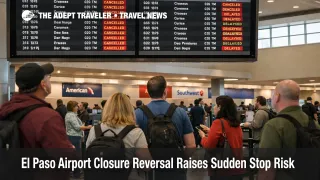
El Paso airport closure reversal is now the real traveler takeaway from an early February incident that was announced as a multi day shutdown, then rolled back within hours. The stop started as an unusually broad Federal Aviation Administration action that effectively halted operations at El Paso International Airport (ELP), and it ended quickly enough that many flights eventually resumed, but not quickly enough to prevent cancellations, diversions, and downstream aircraft and crew positioning issues. The new development is political and procedural, Transportation Secretary Sean Duffy said the decision was not a mistake and the Department of Transportation plans to brief Congress, keeping scrutiny alive for travelers who use airports near sensitive border, military, or test ranges.
El Paso Airport Closure Reversal: What Changed for Travelers
The core sequence, as reported, is stark. The FAA issued a shutdown that was communicated as a 10 day closure window, then lifted it after roughly eight hours, allowing flight operations to restart. Duffy publicly defended the move and tied it to reports of a drone incursion, while other reporting pointed to concerns connected to military counter drone activity near Fort Bliss, which sits next to the airport. The immediate traveler risk is not just the hours of disruption, it is the whiplash effect when an airport goes to zero, then returns to service while airlines are still unwinding cancellations, repositioning aircraft, and rebuilding schedules.
For travelers, the reason this matters beyond El Paso is precedent. If authorities are willing to publish a sweeping closure for "special security reasons," then reverse quickly, it increases the odds of short notice constraints elsewhere where threat reporting, defensive testing, or interagency coordination issues collide. That is the difference between a normal weather delay day and a true sudden stop risk day, you may not get a long runway of public warning, and your best outcomes come from how you build alternates into the booking itself.
Which Southwest Itineraries Are Most Exposed
Exposure is highest for travelers who are time bound and for itineraries with limited same day backup capacity. The first group is anyone departing El Paso late in the day, anyone connecting onward to a cruise boarding cutoff, a last train, a medical appointment, or a same night event, and anyone on separate tickets where a missed first leg can strand the rest of the trip. The second group is anyone flying on routes with only a handful of daily frequencies, because once the schedule breaks, reaccommodation choices vanish fast.
The next tier is travelers who never intended to touch El Paso but can get pulled into the blast radius. When flights cancel and aircraft divert, airlines often reroute passengers through their nearest practical alternates, which can load up nearby hubs and spike last minute fares and hotel demand. That is why a brief shutdown can still create a one to two day aftershock in rebooking inventory, even if the airport itself looks "open" again. If you want continuity on the earlier operational tail risk framing, see El Paso Airspace Shutdown Reroute Risk for Flights.
What Travelers Should Do Now
Start with alerts and verification before you move. Use your airline app push notifications, then cross check airport status and your inbound aircraft's prior leg on the day of travel, because post restart days often fail when the airplane, or crew that should operate your flight arrives late from a disrupted rotation. Save documentation as you go, screenshots of waivers, schedule changes, and rebooking offers, because those details can matter for refunds, insurance claims, and employer travel policy exceptions.
Use decision thresholds, not hope. If you have a connection under about 90 minutes, if you are on separate tickets, or if you are on the last viable departure that still meets a hard constraint, rebook as soon as you see any renewed restriction signal, repeated rolling delays, or a carrier advisory tied to the airport, or surrounding airspace. The reason is inventory, the longer you wait, the more you are competing for fewer remaining seats, and the more likely you are to be forced into an overnight stay in an alternate city.
Book defensively when your trip is still in the planning stage. For airports near sensitive facilities, avoid building itineraries that only work if everything is on time. Favor earlier departures, pad connections, and consider refundable hotels for the first night if you are arriving for something time bound. If you can tolerate a slightly higher fare, flexible change terms can be the cheapest form of insurance on days where an airport status can flip quickly with limited public narrative.
Why This Happened, and How Sudden Stops Spread
Public explanations have diverged, and that is part of the traveler risk story. One line of official messaging described the trigger as a drone incursion, while other reporting suggested the FAA acted out of safety concerns related to military counter drone testing, including a laser based system near Fort Bliss. Separate reporting also described interagency friction and unclear coordination, and local officials said there was little, or no advance notice to airport stakeholders. Until a classified briefing, or formal documentation resolves the discrepancy, travelers should treat cause claims as contested, while treating the operational lesson as confirmed, the system can impose a near total stop with little lead time.
Mechanically, a full stop creates two layers of disruption. First order effects are obvious, departures halt, arrivals divert, and cancellations surge. Second order effects are where most traveler pain hides, aircraft and crews end up out of position, rebooking demand compresses into fewer flights, and alternates fill up, pushing stranded passengers into hotels, car rentals, and ground transport that were never sized for a sudden wave. Even when flights resume, airlines may keep trimming schedules for a day or two to rebuild reliable rotations, which is why "reopened" does not mean "normal." For deeper structural context on why these constraints can ripple beyond one airport, see U.S. Air Traffic Control Privatization: Reality Check.
Sources
- US official says closing El Paso airport was not a mistake, will brief Congress (Reuters, February 20, 2026)
- FAA lifts airspace shutdown over El Paso after announcing 10 day closure hours earlier (PBS NewsHour, February 11, 2026)
- Congresswoman Escobar Statement on Closure of El Paso Airspace (February 11, 2026)
- Airspace closure followed spat over drone related tests, sources say (CBS News, February 11, 2026)
- AeroVironment's LOCUST counter drone laser used by US Army near El Paso airport, sources say (Reuters, February 12, 2026)
- Duffy Will Brief Congress Next Week on El Paso Shutdown (Bloomberg, February 20, 2026)