

Iran NOTAM Launch Window Triggers Middle East Reroutes
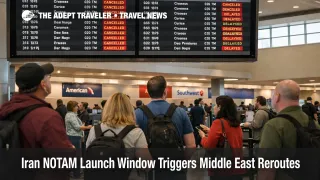
Long haul travelers transiting the Middle East should plan for longer routings and occasional schedule changes when rocket launch notices, and wider regional tensions, push airlines to adjust flight paths. This week's trigger was a concrete launch window NOTAM tied to Iran, which the U.S. Federal Aviation Administration surfaced for aviation awareness, a type of hazard notice that can prompt tactical reroutes, fuel planning changes, and small schedule shifts that become big problems when you are connecting on a tight bank. The main traveler risk is not a dramatic diversion, it is block times creeping up enough to flip a legal connection into a misconnect.
Middle East Airspace Reroutes: What Changed
Iran issued a NOTAM warning of planned rocket launches over parts of southern Iran during a defined window, which reporting said ran from 0330 GMT to 1330 GMT on February 19, 2026, and was published on the FAA website for awareness. That matters because airlines treat time boxed hazard notices as a routing and risk management problem, even when the activity is planned and geographically bounded. In practice, many carriers respond by moving tracks south or north of the affected area, adding distance, adding fuel, and sometimes slowing turn times downstream if the aircraft arrives late.
If you are crossing the Middle East as part of a Europe to Asia itinerary, a North America to South Asia itinerary, or a Europe to Gulf connection, you should assume your planned block time is not a hard promise during active notice windows. A 10 to 40 minute airborne increase can be enough to break a tight connection, and it also raises the odds that your second flight departs on time without you.
Which Itineraries Are Most at Risk
The most exposed itineraries are the ones that stack multiple time sensitive steps on top of one another. Travelers connecting through major Middle East hubs, such as Hamad International Airport (DOH) and Dubai International Airport (DXB), should pay attention to connection length and the time of day their flight crosses the region, because banks are built on synchronized arrivals and departures. When several inbound flights arrive late together, the system can absorb some of it, but not all of it, and the overflow shows up as missed connections, rebookings, and overnight hotel needs that were not in the original plan.
Ultra long haul flights are also vulnerable because they run close to crew duty and aircraft utilization limits. When an airline adds distance or chooses a more conservative routing, the first order effect is a longer flight. The second order effect is schedule fragility across the rest of the day, because the aircraft is now late to its next sector, and the crew may hit duty limits that force a swap, a delay, or, in the worst cases, a cancellation if a replacement crew is not positioned.
Cargo heavy flights can see knock on impacts too. When routings change and arrival times slip, baggage and cargo connections are more likely to miss their planned transfer, especially on itineraries that rely on a fast sort window at the hub.
What Travelers Should Do Now
If you have a connection in the Middle East within 48 to 72 hours of an active notice window, the practical move is to buy time. Travelers should avoid minimum legal connections on itineraries that depend on one specific onward flight, and should treat an extra 60 to 90 minutes of connection time as cheap insurance against reroute driven block time creep. If you are already inside 24 hours of departure, use your airline app to watch the "estimated time en route" and the inbound aircraft status, because those two signals often move before a formal schedule change posts.
Rebooking strategy should be driven by how costly a misconnect would be. If you have a cruise embarkation, a wedding, or a same day domestic connection after landing, a longer layover or a different hub is usually the safer choice than gambling on a tight bank. If your trip is flexible and the airline is not offering waivers, waiting can still make sense, but only if you have slack at the end of the itinerary and a plan for an overnight if the connection breaks.
Over the next 24 to 72 hours, monitor three things: whether additional hazard windows are issued, whether your airline files a schedule adjustment for your specific flight number, and whether hub congestion starts showing up as longer connection times at check in or at the gate. For travelers who are risk sensitive, it can be worth choosing a nonstop where possible, or routing through a hub whose alternatives are frequent enough that a single misconnect does not end your trip.
For a deeper look at how air traffic system constraints, staffing, and resilience issues can amplify small timing shocks, see U.S. Air Traffic Control Privatization: Reality Check.
What A NOTAM Means for Passengers, and How Reroutes Happen
A NOTAM is a formal notice containing information essential to flight operations that is not known far enough in advance to be published by other means, and it flags abnormal conditions that crews and dispatchers must account for. In a passenger context, think of it as an operational warning label that can change how a flight is planned, even if you never hear the word at the gate. When the hazard is time boxed and geographic, airlines have several options: they can route around the area, they can change altitudes and tracks to keep separation, and they can load extra fuel to preserve diversion options.
Those choices have predictable travel consequences. First order, the flight can take longer, and that increases delay risk, especially when arrival slots or gate schedules are tight. Second order, longer flights disturb the airline's rotation plan, which can misalign crews and aircraft across multiple legs, and the disruption can cascade into later departures, not because the later flight was "affected" by the NOTAM directly, but because the airplane and crew got there late.
For travelers, the key is to treat Middle East overflight risk as a connection planning problem more than a safety headline. You cannot control geopolitical risk, but you can control how much schedule slack you give yourself, and whether your itinerary has a single point of failure. When hazard windows pop up, the smart play is simple: add buffer, watch your block times, and avoid tight downstream commitments that assume everything will run to the minute.