

Munich Airport Snow Delays, 600 Stuck on Planes
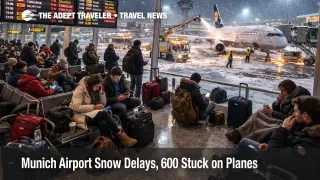
Munich International Airport (MUC) had a winter operations failure that went beyond cancellations. After heavy, wet snowfall on the night of February 19 to 20, 2026, six outbound flights with around 600 passengers ended up parked remotely, and many passengers stayed onboard for hours, in some cases overnight, after the aircraft missed a late departure cutoff and ground logistics could not reset fast enough. Munich Airport apologized, and said the outcome did not meet its standards.
What is new, compared with a normal snow day, is the passenger handling failure mode. This was not just a deicing queue and a wave of canceled flights, it was a situation where stand availability, bus capacity, and late night staffing collided with curfew constraints, leaving people stuck in the least comfortable place to wait, an aircraft cabin.
Munich Airport Snow Delays, What Happened
Munich Airport says winter services were deployed with all available resources, but runway closures for snow clearance, longer than average deicing times, and late hour constraints drove delays and cancellations. The airport says six aircraft that were ready to depart did not receive takeoff permission in the early morning hours, and ultimately missed a special allowance that, in this case, extended operations to 1:00 a.m.
The airport's explanation ties the passenger experience to a stack of operational constraints. When the affected aircraft had to return unexpectedly, terminal stands were already occupied by earlier disrupted flights, so the aircraft were parked at remote positions. Munich Airport also cited restricted bus service and communication problems at the late hour, which limited the ability to move passengers back to the terminal.
Reporting across German and international outlets converges on the same core facts, severe snowfall, extensive cancellations, and hundreds of passengers stuck onboard multiple aircraft after departure plans collapsed late in the night.
Which Connections and Departure Times Are Riskiest
The highest risk itineraries at Munich are late evening departures and tight winter connections that push you into the last viable departure window. The airport's night flight rules include a core period from midnight to 500 a.m. when only limited categories are automatically permitted, and other flights require individual approval by the responsible Bavarian authority. That means weather delays that would be annoying at 600 p.m. can become a hard stop problem near midnight, even if the aircraft and crew are physically present.
Travelers connecting through Munich face an additional exposure that is easy to miss when you are only watching a departure board, stand and gate congestion. When snow and deicing slow departures, arriving aircraft do not clear gates on time, diversions may occupy remote stands, and the airport's ability to park, tow, and service aircraft becomes the binding constraint. Once stands fill, the system has fewer places to put disrupted aircraft, and passenger handling becomes dependent on buses, stairs, and staffing that may already be thinned late at night.
If you want a nearby comparison of how winter operations bottlenecks become connection risk at a major European hub, see Schiphol De Icing Delays Raise Winter Connection Risk. For a recent Munich focused reminder that hub disruptions propagate quickly across partner networks, see Lufthansa Strike Frankfurt Munich Flights Feb 12, 2026. For general planning context when Germany is part of the trip, start with Germany.
How To Reduce Exposure Before You Book or Connect
At booking time, treat Munich in winter as a reliability choice, not just a map pin. The simplest move is to avoid itineraries that depend on the last departure wave of the day, especially if your trip has a hard constraint the next morning. Earlier departures buy you time for deicing queues, runway snow clearance, and rebooking, while late night schedules compress options into the exact window where curfews and staffing levels can turn a delay into an overnight problem.
If you must connect through Munich, build buffer that matches winter realities, not minimum connection time marketing. Longer connections reduce the chance that you arrive after gate capacity has already been consumed by earlier delays, and they give you a better shot at being reprotected onto a later bank before inventory collapses. If your itinerary includes a long haul segment that operates once daily, or a protected onward connection that you cannot miss, the tradeoff is usually worth it, choose the longer layover, or route via an alternative hub with more same day backup frequency.
Once you are traveling, use decision thresholds instead of waiting for the situation to become obvious. Rebook early if your inbound flight into Munich is already delayed, if you are scheduled on a last wave departure, or if you see deicing and snow clearance causing repeated runway slowdowns. Wait only when you still have multiple later options on the same ticket, and when an overnight would not break the trip. The moment you are down to one last departure option, you are no longer deciding between flights, you are deciding between controlling the reroute now, or being assigned whatever is left later.
Why Snow Days Can Turn Into Onboard Holds
An onboard hold is usually not a single decision, it is the outcome of several constraints arriving at the same time. Snow slows aircraft turn times, deicing takes longer, and runway closures for snow clearance reduce movement capacity, so departures bunch up. As a result, aircraft miss planned departure slots, crews approach duty limits, and gates stop turning over, so the airport has fewer places to park aircraft that should have already left.
Curfews and night flight rules sharpen that problem, because they turn delay into prohibition. Munich's core night period runs from midnight to 500 a.m., and additional restrictions apply in the late evening and early morning shoulder periods. In this incident, the airport says it obtained a special permit that allowed operations until 100 a.m., but heavy snowfall and longer deicing times still prevented the affected aircraft from meeting that deadline.
The last link is ground logistics. When aircraft are parked remotely, passengers generally need mobile stairs and buses to get back to a terminal. If bus service is restricted late at night, if staffing is limited, or if communications fail between airport operations and service providers, passengers can end up waiting onboard far longer than anyone expects, even when the flight itself is canceled. That is why winter planning at snow prone hubs is not only about whether a flight takes off, it is also about whether the airport can still move people humanely when the plan breaks.
Sources
- Press: Statement on the incident on the night of February 19-20, 2026
- Night flight, Strict rules for a quiet sleep
- 600 airline passengers faced the weirdest sleepover ever, when heavy snow left them stuck on stationary planes overnight
- 500 Passengers Forced to Spend Night on Grounded Planes After Heavy Snow Cancels Flights and Airport Staff Go Home
- 500 Passagiere sitzen wegen Schnee nachts in Flugzeugen fest