

Lufthansa Strike Frankfurt Munich Flights Feb 12, 2026
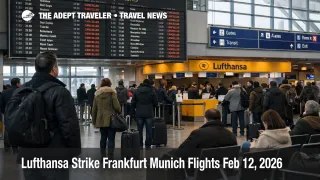
A one day strike by Lufthansa pilots and cabin crew is driving widespread cancellations across Germany on Thursday, February 12, 2026, with the worst impacts centered on Frankfurt Airport (FRA) and Munich Airport (MUC). Lufthansa said the walkout triggered close to 800 cancellations and disrupted travel for about 100,000 passengers, moving the situation from a planning risk to an operational shutdown for many departures. If you are traveling today, your best move is to confirm whether you were automatically rebooked, and then decide quickly whether to accept that option, reroute via a different hub, or switch a short segment to rail.
The Lufthansa strike Frankfurt Munich matters because the cancellation wave is not confined to travelers who start in Germany. Lufthansa's hubs function as timed connection banks for Europe to long haul flying, so when a bank collapses, misconnects spike, partner inventory tightens, and reaccommodation becomes a competition against the clock across multiple airlines.
Who Is Affected
Passengers booked on Lufthansa operated flights departing Germany on February 12, 2026 are the primary impacted group, especially anyone starting at Frankfurt or Munich. Travelers connecting through either hub are also exposed even when the long haul segment itself is not departing Germany, because a canceled short haul feeder can strand you away from the intercontinental departure.
The strike is also spilling into the broader Lufthansa Group network because reaccommodation often routes travelers onto Swiss, Austrian Airlines, and Brussels Airlines, and that demand surge can erase remaining seats quickly. Even if your ticket is on a partner, gate changes, baggage handling delays, and longer customer service queues can follow when thousands of disrupted passengers are reinserted into a live schedule.
Business travelers and event travelers have the highest downside today because missed arrivals can collapse fixed commitments, and because the strike overlaps with major Germany based events that concentrate demand on the same corridors once flights resume. Leisure travelers with flexible timing still face a real cost, because last minute hotel nights and rail or alternative air fares tend to spike when a hub day is effectively removed from the network.
What Travelers Should Do
Start with confirmation, not speculation. Check your flight status, then check your booking for an automatic rebooking, because Lufthansa has been directing customers to rely on app and email notifications, and to verify status before heading to the airport. If you have a workable protected rebooking that still lands the same day, lock it in quickly, because waiting for a better option can backfire once remaining partner seats are consumed.
Use a simple threshold for rerouting versus waiting. If missing arrival today would break a cruise embarkation, a tour start, a meeting you cannot move, or a separate ticket connection, treat February 12, 2026 as a day to reroute, not a day to hope. In practice that usually means moving to Friday, February 13, 2026, or shifting to a different hub on a non Lufthansa itinerary, even if it is less direct, because the strike has removed too much capacity for same day fixes to be reliably available.
For short haul and domestic Germany moves, consider a mode swap to preserve the rest of the trip. High speed ICE service can connect Frankfurt and Munich in roughly the mid three hour range on the fastest runs, which can be useful if you need to reposition between cities without relying on a heavily canceled flight bank. Over the next 24 to 72 hours, monitor recovery messaging for Friday morning banks, because Lufthansa has said it expects operations to be largely normal from February 13, 2026, but real world recovery can lag when aircraft and crews are out of position.
Background
Airline strikes propagate through the travel system in layers, and hub carriers amplify the second order effects. The first order impact is the visible one, flights cancel, passenger loads are redistributed, and airport customer service systems choke on reaccommodation volume. The next layer is network geometry, Lufthansa's schedule is built around timed arrival and departure banks at Frankfurt and Munich, so removing a bank does not just cancel one city pair, it erases connection chains across Europe to long haul routes, and it forces last minute aircraft swaps that can cascade into more delays.
The second order ripple extends beyond aviation. When cancellations strand travelers in Frankfurt, Germany, and Munich, Germany, hotel demand rises for unplanned night adds, and rail demand rises for same day mobility between cities when flying is no longer dependable. In parallel, partner airlines absorb rebooked passengers, which can drive tighter loads and fewer day of departure alternatives across the Lufthansa Group orbit, even after the strike window ends.
If you want the pre strike planning frame and scope context, see Lufthansa Germany Flight Strike Disrupts Feb 12, 2026. For a related transfer reliability layer in Germany earlier this week, see Germany Strikes Hit Local Transport Feb 10 11.
Sources
- Current travel information | Lufthansa
- Strike announcement at Lufthansa by Vereinigung Cockpit and UFO for 12 February 2026
- Hundreds of Lufthansa flights cancelled as pilots, cabin crew walk out
- Strikes by German pilot and cabin crew unions force Lufthansa to cancel flights
- ICE Sprinter
- Frankfurt (M) Airport Long-Distance to Munich Hbf by Train