

Munich Airport Snow Disruption: Curfew, Deicing Risks
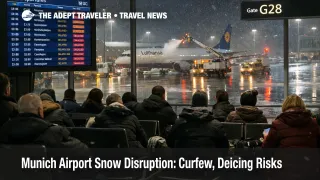
Munich Airport (MUC) has issued a formal statement on the February 19 to 20, 2026 snow disruption that left roughly 600 passengers stuck overnight on six aircraft, and the operational details matter for anyone booking late evening departures through early March. The airport confirmed that heavy, wet snowfall drove longer than average deicing times and forced short notice runway closures for snow clearance, and that a late night curfew window turned delay into a hard stop once aircraft could not meet an exceptional 1:00 a.m. operating deadline. This is the key change versus routine winter disruption, it shows how curfew rules, stand saturation, and late night ground transport limits can trap passengers onboard when an airport is already in recovery mode.
The practical takeaway is not just "snow causes delays." It is that Munich's late bank becomes a higher cancellation and misconnect risk when snow and deicing capacity collide near the curfew boundary, and that the worst case failure mode is no longer only a canceled flight, it is an extended onboard hold because remote stands require buses and stairs that may not be available at scale late at night. That risk profile is especially important right now because late February and early March itineraries often compress connections to protect price or maximize same day arrival, and Munich is a major Lufthansa Group hub where a single disrupted bank can ripple into next day long haul and partner rotations.
Munich Airport Snow Disruption: What Changed for Travelers
The airport's statement fills in the chain of constraints that produced the overnight onboard holds. Munich said it obtained a special flight permit to support operations beyond normal restrictions, allowing aircraft to head to the runway until 1:00 a.m., but the combination of longer deicing times and runway closures meant six flights could not meet that deadline, and they returned unexpectedly. Five of the affected flights were operated by the Lufthansa Group, and one was operated by Air Arabia, with around 600 passengers total.
Once those aircraft returned, the passenger handling problem shifted from airside capacity to stands and ground transport. Munich said terminal capacity was already occupied by earlier canceled flights parked during the day, so the late returning aircraft had to park at remote positions. The airport also cited the late hour and communication problems, and said bus service was "severely restricted," which limited the ability to move passengers back to the terminal quickly. Munich added that passengers were not in danger, and said airlines provided care onboard, while also stating the outcome did not meet its standards and that it is working with partners on immediate process improvements.
Which Itineraries Are Most Exposed Near Munich Curfew
The highest risk itineraries are the ones that depend on the last viable departure wave, especially when a delay pushes you into the curfew boundary. Munich's statement reiterates that between midnight and 500 a.m., flights are subject to night flight regulations and require individual approval, which is why the airport sought a special permit for late operations in the first place. That tells travelers exactly where the cliff is, delays that are manageable at 700 p.m. can become non recoverable close to midnight because the rules change, and options collapse quickly once you miss the last permitted departure window.
Connections amplify that exposure. Munich is built around banked hub waves, and when snow slows departures, arriving aircraft do not clear gates on time, cancellations occupy stands, and the airport's ability to park and service aircraft becomes the binding constraint, not just runway friction. In this incident, stand saturation pushed aircraft to remote parking, which then made buses, stairs, staffing, and coordination the critical path for getting people off the aircraft and into normal rebooking channels. That is why late evening travelers can face a double hit, higher cancellation probability, and worse passenger handling when the day's disruption load is already high.
The second order effects matter just as much as the first order cancellations. When five of the six affected flights are within one hub carrier group, recovery is not isolated to a single route. Aircraft and crews are out of position the next morning, protected long haul connections are missed, and partner itineraries can break a day later when rotations do not reset cleanly. Separately, when cancellations cluster at a hub late at night, hotels in the Munich area can tighten fast, not because every traveler needs lodging, but because reaccommodation concentrates into a narrow overnight window.
How To Book and Rebook Around Late Winter Snow Risk
Start by treating late departures through Munich as a reliability tradeoff, not a convenience. If you have any flexibility, avoid the last departure bank on days with active snow forecasts, or when deicing is likely, because the cancellation probability rises sharply when delays collide with curfew rules and limited recovery time. The upside of moving earlier is not only that your flight is more likely to depart, it is that if something breaks, you still have later same day rebooking options while call centers, desks, and airport systems are operating at full capacity.
When choosing alternates, prioritize hubs with multiple later frequencies to your destination, not just geographic proximity. In practice, the best rebooking option is often the one that gives your airline more same day inventory to reaccommodate you, even if it adds a connection, because the real risk is getting stranded overnight with limited seats left across the network. If your itinerary includes a once daily long haul, protect that segment by building more buffer before it, or by routing through an airport where the carrier has multiple long haul departures, because a missed once daily flight can become a two day problem in peak winter disruption.
If you are already traveling and your flight is delayed late in the evening, use a decision threshold instead of waiting for the airport to declare a full stop. Rebook proactively when your flight is sliding toward the last operational window, when deicing queues are lengthening, or when runway closures are announced or implied by repeated ground stops. Waiting can be rational only if you still have multiple later options on the same ticket and the downstream consequences of an overnight, missed meetings, missed cruises, or lost hotel nights, are acceptable.
For onboard holds specifically, ask for the things that change outcomes, not generic apologies. Request clear information about whether the flight is still intended to depart, and if not, ask when deplaning will be possible and whether buses or stairs have been ordered. If you are held onboard for extended periods, document times, announcements, and any expenses you incur once you are offloaded. In the EU, compensation depends on cause, but care obligations and reimbursement for reasonable assistance costs can still matter, and your ability to claim anything improves when you have written details of what happened and when.
Why This Failure Mode Happens at Snow Prone Hub Airports
Munich's statement is valuable because it outlines the mechanism that turns ordinary snow disruption into an abnormal passenger experience. Heavy, wet snowfall increases deicing time, and snow clearance can require short notice runway closures, both of which reduce movement capacity and push departures later. As delays compound, aircraft miss the window when they can legally depart under night flight rules, even if they are physically ready, and once the curfew boundary is crossed, a delay becomes a prohibition unless special approvals exist.
Then the system hits a second constraint, parking and passenger logistics. When cancellations earlier in the day occupy terminal stands, late returning aircraft cannot dock at gates, so they park remotely. Remote parking is workable when buses, stairs, staffing, and coordination are abundant. It breaks down when disruption peaks late at night, when bus service is reduced, staffing is thinner, and communication between airport operations and multiple service providers is strained. Munich explicitly pointed to restricted bus service and communication problems as part of what limited passenger movement back to the terminal, which is the operational explanation for why passengers ended up waiting onboard rather than in a terminal with services.
This is why the recovery lessons matter now. Late February and early March can deliver fast moving snow events that do not look extreme on a forecast map, but still produce heavy, wet precipitation that is slow to clear and slow to deice against. At a hub like Munich, the traveler facing risk is not only whether the runway is open. It is whether the airport can keep stands turning, keep ground transport flowing, and keep passenger handling humane when curfew rules remove the last hour of recovery margin.
Sources
- Press: Statement on the incident on the night of February 19-20, 2026
- Munich Airport apologises after snow disruption leaves 600 passengers stranded overnight
- 600 airline passengers faced the weirdest sleepover ever, when heavy snow left them stuck on stationary planes overnight
- 500 Passengers Forced to Spend Night on Grounded Planes After Heavy Snow Cancels Flights and Airport Staff Go Home
- München: 600 Passagiere sitzen wegen Schnee nachts in Flugzeugen fest
- Munich Airport Snow Delays, 600 Stuck on Planes
- Europe Airport Strikes: Compensation and Re-Routing Guide