

ROTOR Act Fails in House, ADS B Safety Mandate Stalls
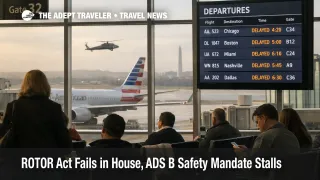
The ROTOR Act House vote failed in Washington, D.C., on February 24, 2026, stalling a bipartisan push to expand cockpit traffic awareness near busy airports after the January 29, 2025, crash near Ronald Reagan Washington National Airport (DCA) that killed 67 people. The bill drew a majority, 264 to 133, but it did not reach the two thirds threshold required under the procedure used for the vote. The practical traveler takeaway is not a new rule you need to follow this week, it is that a safety upgrade advocates call urgent is now delayed, and lawmakers are likely to pivot toward a different, broader package that may move more slowly or mandate less.
One sentence summary, the ROTOR Act House vote fell short, which delays a nationwide deadline to add ADS B In to aircraft operating where ADS B Out is already required, including limits on military helicopter carve outs.
ROTOR Act House Vote: What Changed For Travelers
The immediate change is legislative, not operational at the airport curb. The House did not pass the Senate approved ROTOR Act under a fast track process, after the Department of Defense withdrew support and warned about costs and operational security. That matters to travelers because the bill's core mandate would have forced wider use of ADS B In, a cockpit system that helps pilots "see" nearby traffic electronically, rather than relying only on controller instructions and visual spotting in complex airspace.
The vote also signals a political fault line that affects how quickly safety mandates can become real world equipment on aircraft. Supporters argue the technology would reduce the chance of a repeat of the DCA area midair collision, critics argue universal broadcasting creates unacceptable risk for sensitive military missions. Until Congress resolves that tradeoff, travelers should expect incremental procedural changes, not an across the board technology requirement with a hard deadline.
This is also an update in momentum. The ROTOR Act cleared the Senate unanimously in December 2025, then hit resistance in the House once the Pentagon objected. That combination, a unanimous Senate vote followed by executive branch reversal, is a strong indicator that the next version will be rewritten around military exemptions, funding, or both.
Who Feels The Delay Most, Even If You Never Notice It
Most travelers will never directly interact with ADS B, and that is the point. The benefit is "quiet safety," fewer close call conditions in airspace where helicopters, regional jets, business aircraft, and airline arrivals mix at low altitude and high workload. The travelers most exposed to the debate are those who routinely fly into constrained, complex metro airspace where helicopter corridors and airline approach paths sit close together, including Washington, D.C., and other high density regions with special use airspace and heavy government and medical helicopter activity.
There is also a second order travel consequence that is easy to miss. When regulators and operators treat risk by adding spacing, reducing arrival rates, or tightening routing, the "safety margin" often gets purchased with time. That can show up as more air traffic flow holds, longer taxi queues, more conservative spacing in marginal weather, and a higher chance that an already tight connection becomes a misconnect during peak periods. Even if you never hear the words ADS B In, you may feel the operational knock on effects when the system runs more conservatively.
Finally, flight crews and smaller operators sit in the blast radius of any mandate. Airlines can retrofit at scale, smaller fleets and certain helicopter operators face higher per aircraft costs and scheduling constraints. That reality is part of why the Pentagon framed the bill as a budget burden, and why any future bill is likely to include a long runway for compliance plus carve outs and funding language.
What Travelers Should Do Now
For most people, this is a "monitor, do not panic" story. Your near term flight plans do not change because a bill failed. The decision value is in setting expectations about what will, and will not, happen next. If you are a frequent flyer into the Washington, D.C., region, treat the current environment as one where procedure changes and local restrictions can tighten quickly after incidents, even without new federal equipage mandates. Build a little slack into same day trips, because conservative air traffic handling tends to compound into delays during peak arrival banks.
If you are planning travel that must be on time, same day connections to cruises, weddings, international departures, or court dates, prioritize earlier arrivals and longer buffers over assuming "normal" ops. The tradeoff is simple, you can save time by cutting buffers, or you can save the itinerary by buying margin. When airspace constraints bite, airlines can usually reroute a passenger, but they cannot reroute your event start time.
Watch the next legislative step rather than the headline. Supporters are already signaling they will keep pushing the ROTOR Act concept, but House leadership is also moving a competing, broader aviation safety package that may focus on studies, rulemaking, routing design, and FAA process reforms rather than a hard ADS B In mandate. If the alternative package advances, the traveler relevant question becomes whether it includes enforceable deadlines, or whether it mainly schedules future decisions.
If you want the most practical proxy for "is anything changing on the ground," follow FAA route and procedure updates for the DCA area. After the January 2025 crash, the FAA adjusted helicopter routes and buffers around DCA, Washington Dulles International Airport (IAD), and Baltimore Washington International Thurgood Marshall Airport (BWI). Those local changes are the kind that can affect delays and arrival rates before any national equipage mandate ever arrives. FAA updates D.C. helicopter routes and zones
Why The Bill Stalled, And What ADS B In Actually Does
ADS B is a surveillance and broadcast system that lets aircraft transmit their position, and receive traffic information, using GPS based data rather than traditional radar alone. ADS B Out is the "I am here" broadcast, ADS B In is the "I can receive and display traffic" capability in the cockpit. Advocates for the ROTOR Act argue the missing link is that aircraft may be required to broadcast but not required to receive and display traffic in the cockpit, which leaves an uneven safety picture in busy, mixed airspace.
The Pentagon's objection is not that the technology is useless, it is that universal broadcasting and receiving requirements can create mission exposure for sensitive operations, and that forcing compliance across large fleets creates funding and procurement pressure. House opponents echoed the national security argument during the vote, warning that mandatory broadcasting could expose the location of high value military assets. Supporters counter that near major airports, the system should not tolerate "invisible" aircraft sharing the same airspace. That is the core tradeoff Congress now has to arbitrate, safety standardization versus operational secrecy.
What happens next is likely a legislative merge, not a clean retry of the same fast track vote. Expect lawmakers to keep the "all aircraft play by the same rules" framing for public safety, while negotiating narrower military exemptions, funding paths, or technical approaches that reduce broadcast exposure in specific cases. For travelers, the important part is that a delayed mandate usually means a longer period where the system relies on routing design, controller procedures, and local restrictions to manage risk, which can indirectly show up as added spacing and more delay prone peak periods.
Sources
- US House fails to pass aviation safety bill after Pentagon drops support, Reuters, February 24, 2026
- House rejects bill requiring aircraft locator systems to prevent midair collisions like last year's, AP News
- U.S. House rejects aviation safety bill after Pentagon abruptly withdraws support, NPR via partner station
- WTAS: ROTOR Act Would Enact NTSB Recommendations, U.S. Senate Committee on Commerce, Science, and Transportation
- PASSED: Sens. Moran, Cruz's ROTOR Act to Improve Aviation Safety, Senator Jerry Moran
- US House lawmakers propose comprehensive aviation safety bill after fatal crash, Reuters, February 19, 2026
- FAA updates D.C. helicopter routes and zones, Adept Traveler
- Senate ROTOR Act Would Mandate ADS B for All Aircraft, Adept Traveler