

Spirit Airlines Lender Deal Targets Summer 2026 Exit
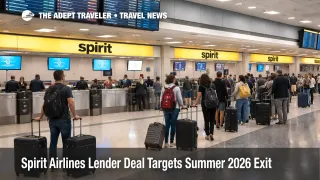
Spirit's bankruptcy runway is starting to look more defined. Spirit Airlines said it reached an agreement in principle with lenders and secured creditors that would support an exit from Chapter 11 by late spring or early summer 2026, a step that could reduce debt and lease obligations from about $7.4 billion pre filing to about $2.1 billion after emergence.
For travelers, the near term is not about flights stopping, it is about a smaller schedule that can change more often, and offers fewer same day backups when something slips. Spirit has been shrinking its fleet and network during the case, and the proposed deal is intended to fund the last stretch of restructuring that still needs to be finalized and approved in court.
Spirit Bankruptcy Exit Plan: What Changed
The core update is financial, not operational, but it has immediate planning consequences. Spirit says the lender deal gives it the support needed to complete its restructuring process and emerge from Chapter 11 by late spring or early summer 2026.
Spirit has framed the outcome as a leaner airline with a more focused schedule, lower fixed obligations, and a bigger push into upsell products, including expanded first class style seating and premium economy, plus loyalty and co brand credit card enhancements. CEO Dave Davis said the agreement "allows Spirit to move toward completing its transformation," while positioning the carrier to compete as a lower cost airline that can still sell value add options.
The practical point: this is not final until it clears the remaining legal and documentation steps. An agreement in principle signals direction, but it is still a process, and the airline can continue adjusting schedules while it works toward confirmation and exit.
Which Spirit Travelers Are Most Exposed Through Summer 2026
The most exposed travelers are anyone whose trip depends on Spirit for a thin route, a specific departure time, or a tight connection that leaves no margin when a flight time shifts. A smaller network is not automatically worse, but it is less forgiving, because one cancellation or retime can remove the only workable same day option.
Families and leisure travelers also tend to carry the most risk when an airline is in active right sizing mode, because peak travel days can be protected while shoulder day flying gets trimmed. Spirit has explicitly said it plans to concentrate flying in peak periods and reduce off peak exposure, which is a sensible cost move, but it changes what customers can count on week to week.
If you are buying separate tickets, for example a Spirit flight into a cruise, a wedding weekend, or a prepaid resort transfer, treat schedule volatility as the real hazard, not the bankruptcy headline. Spirit's limited interline footprint means your recovery options are mostly within Spirit's own network, so the risk rises when frequencies drop.
How To Plan Spirit Trips While The Airline Restructures
If you are already booked, assume you may see at least one schedule change before departure, especially if your trip is 30 to 90 days out. The highest value move is to build time into the itinerary, favor nonstop flights when possible, and avoid last flight of the day departures where a cancellation can force an overnight.
If you have flexibility, the decision threshold is simple. Rebook early if you have hard timed commitments, limited alternate flights on your route, or a tight connection to another paid segment, because the downside of waiting is losing the last workable seat on a competing carrier when options compress. Wait, and monitor, if you are traveling on a high frequency route where multiple same day substitutes exist and your lodging and activities are flexible.
Over the next 24 to 72 hours, watch for three signals that matter more than the headline. First, whether Spirit discloses additional planned schedule or fleet changes tied to its cost reset. Second, whether court filings and approvals line up with the airline's stated exit window. Third, whether your specific route shows frequency reductions as summer schedules firm up. If you want context on the mechanics of what Chapter 11 does, and does not do, start with Airline bankruptcy explained: what Spirit's Chapter 11 means, then review recent restructuring milestones like Spirit Airlines Restructuring Labor Deals Ratified and the fleet downsizing track in Spirit Airlines Auction 20 Airbus Jets April 20.
Why Spirit Is Restructuring, and What Comes Next
Spirit's second Chapter 11 filing in less than a year is the clearest sign that the first reset did not solve the underlying math of its model under current competition. Spirit previously emerged from a Chapter 11 reorganization in March 2025, then re entered bankruptcy on August 29, 2025, as losses and liquidity pressure persisted.
The mechanism is straightforward. Ultra low cost carriers rely on high aircraft utilization, dense schedules, and ancillary revenue to keep base fares low, but that structure becomes brittle when yields soften or when competition from larger carriers compresses margins. In that environment, expensive leases and underperforming routes turn into cash drains quickly, so the Chapter 11 tool is used to cut obligations, return aircraft, and concentrate the network where the airline can fill seats at acceptable unit revenue.
Spirit is also betting that it can sell more "premium" upsells without fully abandoning its low fare identity. That is why its post emergence plan talks about expanding first class style and premium economy seating, plus loyalty and credit card initiatives, since those are ways to lift revenue per passenger without needing to grow the fleet immediately. The tradeoff for travelers is that the airline can become more stable financially while still offering fewer city pairs, fewer daily frequencies, and less schedule redundancy than the pre bankruptcy Spirit.
Sources
- Spirit seals deal with lenders to emerge from bankruptcy as smaller airline (Reuters, February 24, 2026)
- Spirit Airlines expects to exit Chapter 11 bankruptcy by summer (AP News, February 25, 2026)
- Spirit Airlines Takes Action to Build a Stronger Foundation and Future for America's Leading Value Airline (Spirit Investor Relations, August 29, 2025)
- Spirit Airlines Appoints Airline Industry Leader Dave Davis as President and CEO (Spirit Investor Relations, April 17, 2025)