

Uber Buying SpotHero, Parking Reservations Coming to App
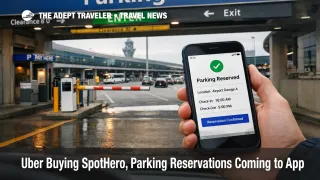
Uber SpotHero parking reservations are headed into the Uber app after Uber announced on February 23, 2026 that it has agreed to acquire the parking reservation platform. Uber says it plans to build a native parking reservation experience powered by SpotHero, with an early focus on commuters, plus parking at events, venues, and airports. The deal's financial terms were not disclosed, and Uber said it expects the acquisition to close in the first half of 2026, pending regulatory review and customary closing conditions.
The traveler relevance is simple, Uber is trying to own more of the door to door trip, including the parts that happen when the traveler does drive. For airport trips, that can mean fewer apps, fewer friction points at arrival, and a more predictable total trip cost when you are comparing driving versus rideshare. For business travel programs, it potentially pulls another historically messy spend category, parking, closer to a single platform that employees already use.
Uber SpotHero Parking Reservations: What Changed
Uber said it will integrate SpotHero's parking inventory into the Uber app, rather than sending users out to a separate product. Uber also signaled that Uber One members should expect parking benefits as part of the membership over time, but it did not provide specifics on what those benefits will be, when they will launch, or whether they will apply broadly or only in select cities.
SpotHero's footprint is large enough that this is not a niche add on. SpotHero says it supports parking at more than 13,000 garages, lots, and valet locations across 400 plus cities in the United States and Canada, which maps cleanly onto Uber's strongest use cases, commuting, airports, and events.
Who Benefits Most, and Where This Matters First
This matters most for travelers who repeatedly face the same parking decision points, frequent airport flyers who drive to the terminal, commuters who pay daily or weekly for parking, and event travelers who book parking near arenas and downtown venues. In those scenarios, the value is not just "finding parking," it is booking a known spot early enough to avoid circling, and arriving with a predictable walk time to the venue or terminal.
Airport use cases are the clearest near term fit. When parking is scarce or pricing spikes around peak departure banks, a reservation model can reduce last mile uncertainty, especially at large hubs like Chicago O'Hare International Airport (ORD) and San Francisco International Airport (SFO), where the time penalty for a bad parking decision can easily exceed the time you thought you saved by driving.
Corporate travel and managed programs are also in the blast radius, in a good way. Parking has often been a fragmented expense category, spread across receipts, ad hoc lots, and inconsistent reimbursement rules. SpotHero has long positioned itself as a way to make that spend more visible, and Uber is explicitly framing this acquisition as an expansion deeper into travel, beyond rides and food delivery.
What Travelers Should Do Now
For trips between now and deal close, do not assume anything changes immediately. Uber said the transaction is expected to close in the first half of 2026, and the "native" in app experience still has to ship, so travelers should keep using their current parking approach until Uber actually publishes availability and terms inside the app.
If you are an Uber One member, treat "parking benefits" as a watch item, not a planning input. Until Uber discloses whether benefits mean discounts, credits, priority inventory, waived fees, or something else, the rational move is to plan parking the same way you do today, then re price once Uber posts the benefit details and any exclusions.
If you manage travel for a team, this is a good moment to audit where parking spend is actually leaking. The practical question is whether consolidating reservations through one channel can reduce out of policy lots, missing receipts, and last minute premium parking choices that happen when travelers arrive without a plan. If this rolls into Uber's reporting and expense integrations, it could become an easier compliance lever than trying to police individual receipts.
For travelers planning airport departures during busy windows, the decision threshold remains the same even with better tooling, reserve early if you are driving and you cannot tolerate uncertainty. Parking is a binary failure mode on departure day, either you have a spot and a predictable walk or shuttle time, or you do not, and your buffer evaporates. The app integration may reduce friction, but it will not change the physics of supply limits at peak times.
Why Uber Wants Parking, and How This Changes Trip Math
Uber's strategic logic is ecosystem density. The company can capture more trip moments by covering both branches of the traveler's choice tree, ride there, or drive there. If Uber can present parking as a first class option next to rideshare, it can keep the traveler inside the Uber interface even when the traveler chooses not to book a ride.
The first order effect is convenience and conversion, fewer steps between deciding to drive and having a reserved place to leave the car. The second order effect is behavioral, if parking is easier to plan and price in the same place as rides, travelers may shift modes depending on total cost, timing, and airport access reliability. On days when curbside access is messy, transit is disrupted, or rideshare pickup rules tighten, reserved parking can become the lowest variance option, even if it is not the cheapest. For a recent example of how ground access can break an itinerary even when flights run, see NYC Transit Shutdown Blocks JFK, LGA, EWR Access.
For SpotHero, the upside is distribution. SpotHero gets access to a much larger consumer base, and Uber gets inventory plus a working marketplace that already spans thousands of facilities. That is why this deal is more likely to show up quickly in commuter and airport corridors than in small, one off leisure destinations.