

NYC Transit Shutdown Blocks JFK, LGA, EWR Access
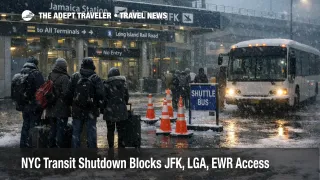
Transit was the failure point as much as the weather. During the February 22 to 23, 2026 storm window, the New York City region saw service suspensions and reduced schedules across major commuter and local networks, which made it meaningfully harder to reach terminals even when a flight still showed "on time." Travelers bound for John F. Kennedy International Airport (JFK), LaGuardia Airport (LGA), and Newark Liberty International Airport (EWR) faced higher odds of missed check in times, broken rideshare pickups, and long detours as normal rail and bus links thinned or stopped. If you must travel in the restart phase, the practical move is to treat airport transfers as an uncertain leg and build a backup plan before you leave your hotel.
The NYC transit shutdown airport access problem is that storms do not have to close runways to break trips, they just have to interrupt the corridor that gets passengers, crews, and support staff to the terminal.
Who Is Affected
Anyone with an itinerary that depends on public transit to reach the airport is exposed, especially travelers connecting from Manhattan, Brooklyn, Queens, the Bronx, and northern New Jersey who normally rely on commuter rail, subway links, and timed transfers. The Metropolitan Transportation Authority said storm impacts included suspended or reduced service across subways, buses, the Long Island Rail Road, Metro North Railroad, and Access A Ride, with LIRR service reported fully suspended until further notice and Metro North operating reduced schedules.
New Jersey travelers connecting into New York City or heading directly to Newark face a similar constraint stack. NJ TRANSIT said bus, light rail, and Access Link service would be suspended starting 600 p.m. Sunday, February 22, 2026, with rail service suspended statewide by 900 p.m. Sunday, and resumption dependent on when conditions safely allow.
Air travelers trying to use rail to reach JFK carry a specific added risk when airport people movers are suspended. The official JFK airport channel indicated a planned full system AirTrain suspension beginning at 11:00 p.m., with free shuttle buses replacing AirTrain JFK service during the outage. That substitution can work, but it lowers throughput and increases variability because buses inherit road conditions, dispatch gaps, and loading friction.
What Travelers Should Do
First, decide if you are actually able to reach the terminal on time, not whether the flight is operating. If your normal plan uses LIRR, Metro North, NJ TRANSIT, or airport people movers, assume those links may be suspended, running at lower frequency, or restarting unevenly, and then add time for curbside congestion and slower security processing once crowds compress. MTA's storm guidance included LIRR suspension, bus degradation, and a pause on Access A Ride reservations after 9:00 p.m. Sunday tied to city travel restrictions, which is a clear signal that mobility was intentionally constrained.
Second, set a hard decision threshold for rebooking versus waiting, and treat it like an operational rule, not a vibe. If you cannot physically start your airport transfer early enough to preserve at least a two hour buffer before bag drop or security, rebook to a later departure or shift by a day while inventory still exists. The reason is mechanical: when transit restarts, it does not restart uniformly, so the first hours after "service resumes" can be the worst time to bet on tight timing, because vehicles, crews, and road clearance are still re syncing.
Third, watch the specific restart indicators that predict whether access is truly improving over the next 24 to 72 hours. Monitor your transit operator's service status and any airport ground access alerts, then verify whether airport connectors are actually moving passengers at scale, not just technically "operating." A planned AirTrain suspension with bus substitution, plus broad commuter rail suspensions, is exactly the setup that produces long, stop start queues at pickup zones and a surge in hotel night displacement near terminals and Penn Station as travelers give up and pause.
Background
This kind of storm disruption propagates through the travel system in layers. The first order effect is simple, fewer trains and buses means fewer passengers reach the airport per hour, which causes missed check in times even when airlines keep some flights operating. The second order ripple is where the system gets ugly, because delayed or stranded passengers hit rebooking desks in a narrow time band, which increases lines, consumes same day seats faster, and pushes more people into overnight stays. That displacement then pressures hotel inventory near the airports and key rail hubs, and it can crowd rental car counters and taxi queues when road conditions improve enough to tempt people back into movement.
There is also a crew and staffing layer that travelers do not see, but it matters. When regional transit is suspended, airport staff and airline crews also struggle to reach terminals, which can slow gate operations, baggage handling, de icing cadence, and turnaround timing. Even after snowfall rates drop, recovery can stay uneven because each operator has to clear equipment, validate infrastructure, and reposition vehicles before they can run full frequency again, and that mismatch is what creates the restart phase "last mile friction" that surprises people who assume the weather story ended with the radar.
For earlier flight side context in the same event window, see Northeast Blizzard Grounds NYC, Philly Flights Feb 22 and Flight Delays and Airport Impacts: Feb 22.
Sources
- Winter storm service changes: February 22-23, 2026
- MTA Announces Proactive Service Suspension on Long Island Rail Road Starting 1 A.M. Monday, and Additional Service Updates Due to Extreme Winter Storm Conditions
- NJ TRANSIT ANNOUNCES ADDITIONAL SERVICE IMPACTS FOR SUNDAY, FEBRUARY 22
- John F. Kennedy Airport (@JFKairport) posts